
Internal noise in communication is one of the hidden costs of busy workplaces. It is the stress, fatigue, assumptions, overload, and distraction that distort a message before anyone has even had time to respond. In this article, I break down how it shows up, why it matters, and what actually helps in UK teams that are balancing meetings, email, chat, and hybrid schedules.
The short version is that clarity fails when people are overloaded
- Internal noise includes stress, tiredness, bias, and mental overload, not just literal background sound.
- It changes how people hear feedback, interpret instructions, and decide what to do next.
- Teams feel it as rework, slower decisions, more friction, and weaker trust.
- The fastest fixes are simpler messages, cleaner meeting habits, and better follow-up.
- If the same confusion keeps returning, the problem is often structural, not personal.
What internal noise means in everyday work
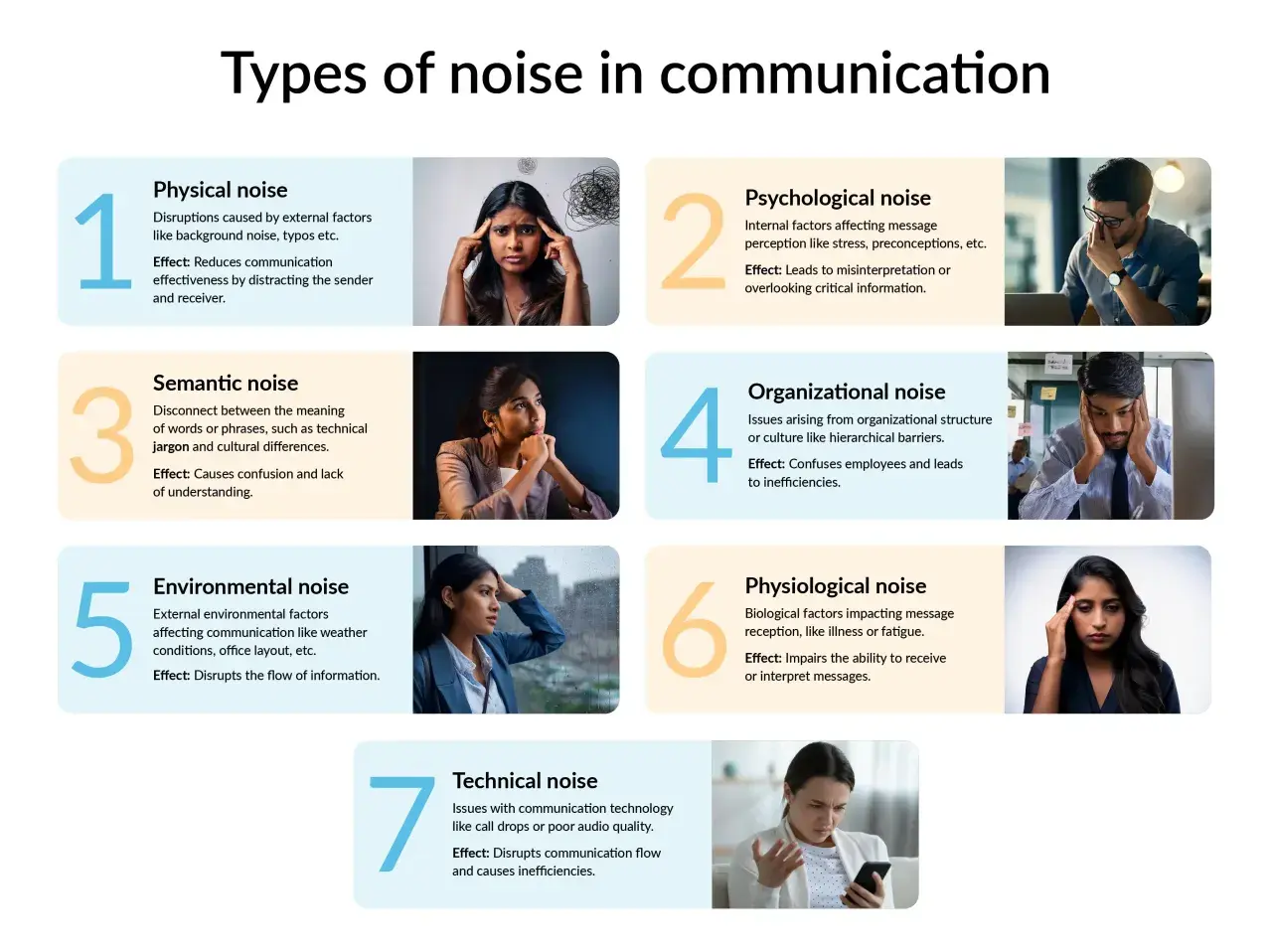
I usually separate it into three practical layers. Psychological noise is what is happening in the mind, such as stress, worry, defensiveness, bias, or daydreaming. Physiological noise is the body getting in the way, such as hunger, illness, fatigue, or the mental drag that comes after too many back-to-back calls. Semantic or conceptual noise appears when language is too vague, too technical, or simply interpreted differently by different people.
The useful thing about that distinction is that it stops people from blaming the wrong cause. A quiet room does not guarantee clarity, and a confident speaker does not guarantee understanding. If someone is overloaded, irritated, or already expecting conflict, they can miss a message even when every word is technically correct.
That is why the next step is not just to define the problem, but to look at the forms it takes in real teams.

The main forms it takes in real workplaces
In practice, the different types of noise overlap. A rushed manager may send a vague message, an exhausted employee may read it defensively, and the reply may add another layer of confusion. I find it easier to spot the pattern when I map the problem by type, because the fix is rarely the same in every case.
| Type of noise | How it shows up | Typical workplace example | What helps |
|---|---|---|---|
| Psychological noise | Stress, defensiveness, anxiety, assumptions, or a fixed emotional reaction | An employee hears feedback as criticism and stops listening to the actual request | Slow the conversation down, separate facts from interpretation, and ask one clear follow-up question |
| Physiological noise | Fatigue, hunger, illness, headache, or mental exhaustion | Someone in a long afternoon of meetings misses the key action point | Keep important discussions short, plan breaks, and avoid loading critical messages onto tired people |
| Information overload | Too many updates, channels, priorities, or notifications at once | A staff member ignores an email because six similar messages arrived in the same hour | Reduce channel sprawl, use one source of truth, and make the action stand out immediately |
| Semantic or conceptual noise | Jargon, unclear wording, or terms that mean different things to different people | One person thinks “urgent” means today, while another reads it as “this week” | Define the term, state the deadline, and confirm ownership in plain language |
What I see most often in UK workplaces is not a dramatic breakdown, but a slow accumulation of tiny misunderstandings. People nod in meetings, skim emails, and assume they have understood enough. Then the error surfaces later as a missed deadline, a duplicated task, or a correction that should never have been necessary.
That brings us to the part many teams underestimate: the cost is not just annoyance. It affects speed, trust, and performance in very ordinary ways.
Why it slows teams down, even when nobody notices
The damage from internal noise is usually indirect. One unclear instruction does not look serious in the moment, but it can create rework, delay decisions, trigger avoidable follow-up messages, and make people less willing to act without checking first. In a busy organisation, that compounds fast.
- More rework, because people act on incomplete or misread information.
- Slower decisions, because nobody wants to commit when the message feels fuzzy.
- Lower trust, because repeated confusion makes people assume hidden meaning.
- More conflict, because stress and ambiguity make neutral comments sound sharper than intended.
- Higher risk, especially in client-facing, operational, or safety-sensitive work where precision matters.
I would not overstate the problem as if every unclear message causes a crisis. The real issue is usually cumulative. A team that loses a little clarity in every conversation eventually spends a lot of time repairing the gaps. That is why effective communication is not just a soft skill; it is a basic productivity issue.
The good news is that internal noise is manageable when you treat communication as a process, not a personality trait.
How I would reduce it in my own conversations
When I want to reduce miscommunication, I start with the smallest useful behaviour change. I do not try to become more eloquent. I try to become more explicit.
- Check your state before you speak or read. If you are tired, irritated, or distracted, assume your first reaction may be unreliable. A short pause often prevents a bad reply.
- Put the decision or request first. People understand messages faster when they know what matters before they get the context. Lead with the action, then explain the background.
- Use one message for one purpose. If you need three decisions, separate them. If you need a reply, make that obvious. Mixed-purpose messages are where confusion grows.
- Ask for a repeat-back. A simple “What is your next step?” is often more effective than asking, “Does that make sense?” The first question reveals the plan; the second often gets a polite yes.
- Close the loop in writing. After an important call or meeting, I like a short recap with the owner, deadline, and key decision. That small habit prevents the message from mutating overnight.
This is not about making every exchange formal. It is about making the easiest version of the message the one people actually remember. Once that habit is in place, communication gets cleaner without becoming slow or over-managed.
That matters even more for managers, because their habits set the tone for the whole team.
What managers can change without adding more meetings
In hybrid UK teams, the biggest mistake is assuming that more messages automatically create more alignment. Usually the opposite happens. What people need is not a larger volume of communication, but a more reliable system for deciding what matters, where it lives, and who owns the next step.
- Cut channel sprawl. If a project lives in email, chat, shared docs, and hallway conversations at the same time, people will miss something. Pick a primary home for the work.
- Define urgency properly. Words like “urgent”, “soon”, and “ASAP” should mean something specific inside the team. If they do not, they become noise.
- Run tighter meetings. Every meeting should answer three questions: what are we deciding, what action follows, and who owns it?
- Reward clarification. If people are punished for asking precise questions, they will stop asking, and the errors will surface later.
- Watch workload, not just wording. Overloaded teams mishear more, forget more, and interrupt more. Communication quality drops when capacity is already stretched.
I also think leaders sometimes forget that tone is part of the message. A rushed message can be technically clear and still land badly. If the team senses pressure every time a manager writes, reads, or speaks, they will start filtering the message through that emotion. That is not a wording problem alone; it is a leadership signal.
Still, there are situations where better communication tactics are not enough, because the confusion is coming from the system itself.
When the confusion is really a systems problem
If the same misunderstanding keeps returning, I stop blaming the individual first. In my experience, recurring noise usually points to one of four deeper issues: unclear roles, mixed incentives, too many handoffs, or a culture that makes questions feel risky.
- Unclear roles mean people are waiting for someone else to decide.
- Mixed incentives mean the message says one thing, but the targets reward another.
- Too many handoffs distort the original request as it moves through the organisation.
- Low psychological safety makes people nod in meetings and ask questions later, when the damage is already done.
This is where a lot of teams get stuck. They keep repeating the message instead of fixing the structure that keeps corrupting it. Repetition helps only when the message is genuinely fine and the problem is attention. When the root cause is process design, role clarity, or trust, the better move is to change the environment that creates the noise in the first place.
That is the most useful practical takeaway I can offer: clarity survives pressure when the process is simple enough to hold it.
Clear messages survive pressure when the process is simple
When I want a message to hold up on a busy day, I use three checks: what is the decision, who owns it, and by when does it matter? If any of those are missing, the message is probably not ready to send.- Decision: What exactly needs to be decided or understood?
- Owner: Who is responsible for the next step?
- Deadline: By when does action or reply matter?
That simple discipline cuts through a lot of internal noise because it removes guesswork. People still need judgment, of course, but they no longer have to decode the message before they can act on it. In real workplace communication, that is usually the difference between a team that keeps circling and a team that moves with confidence.
