
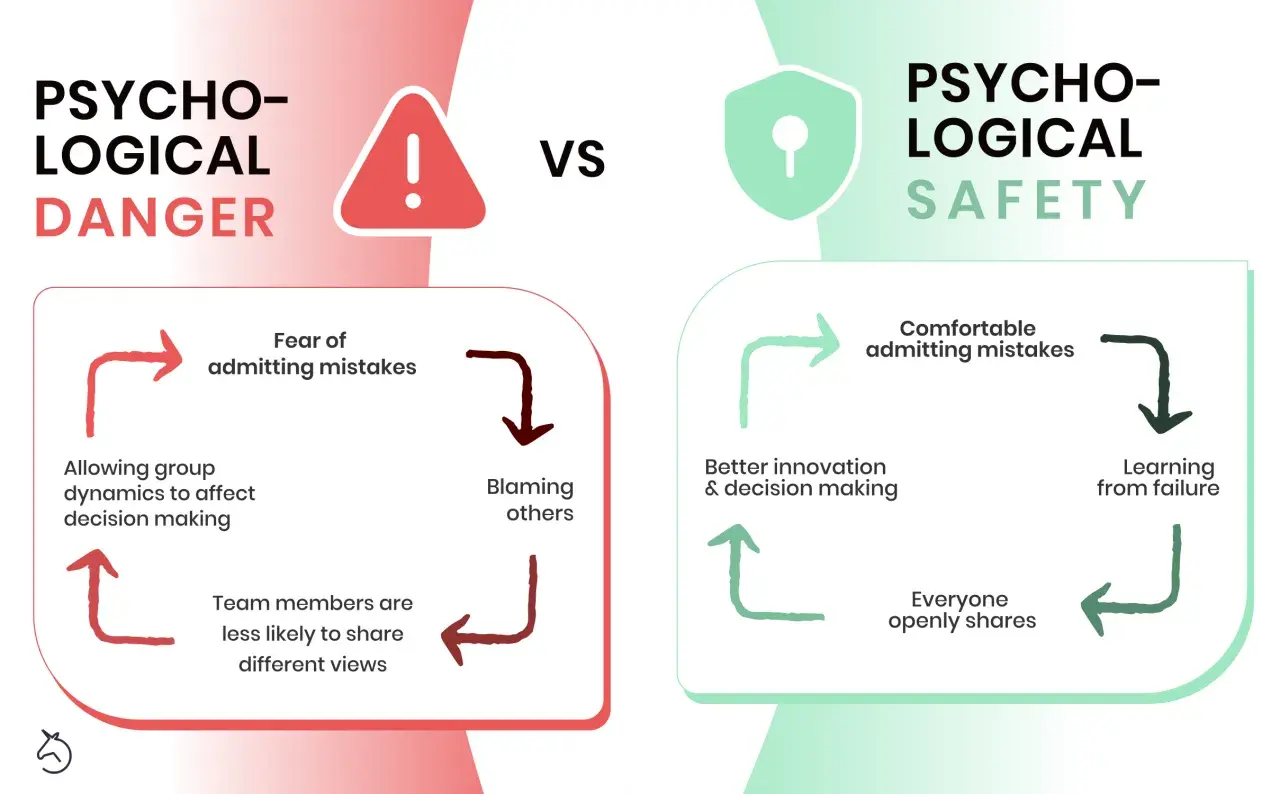
Healthy workplace culture rarely breaks because of one dramatic event. More often, it erodes when people stop telling the truth, stop asking for help, and start managing risk by keeping quiet. This article explains how trust and psychological safety work together, why they matter for performance and wellbeing, and what managers in UK workplaces can do to build both without resorting to slogans.
The practical bottom line for a healthier team culture
- Trust is about whether people believe colleagues and managers will act reliably, fairly, and competently.
- Psychological safety is about whether people can speak up, disagree, and admit mistakes without humiliation.
- The two reinforce each other, but they are not the same thing; confusing them leads to shallow culture work.
- In the UK, this sits alongside duty of care, risk assessment, and mental-health support, not just engagement rhetoric.
- The quickest improvements usually come from manager behaviour: consistency, clarity, and calm responses to bad news.
- Real culture change takes time, not a single workshop or one-off survey.
What these two ideas mean in a real workplace
These two ideas are linked but distinct. Trust answers a simple question: can I rely on you? Psychological safety answers a different one: can I speak honestly here? A team can have one without the other, and that is where many culture efforts go wrong.| Concept | The question people are asking | What it looks like | What breaks it |
|---|---|---|---|
| Trust | Can I rely on this person? | Promises are kept, decisions are explained, standards are applied fairly. | Broken commitments, hidden agendas, double standards. |
| Psychological safety | Can I say what I really think? | People ask questions, challenge ideas, admit mistakes, and raise risks early. | Ridicule, eye-rolling, public shaming, retaliation, silence. |
| When both are present | Can the team learn fast? | People are candid and dependable at the same time. | Shallow harmony or defensive compliance. |
I treat trust as a matter of predictability and fairness, and psychological safety as a matter of permission. In practical terms, that means people need to know both that the team will do what it says and that speaking up will not cost them status. That distinction matters because a culture can look calm on the surface while still being too fragile for real learning.
Once you separate the two, the next step is easier: you can see which part of the culture needs work first, and you can stop pretending that a few friendly team-building exercises will fix everything. That leads straight into the business case.
Why they matter when the pressure is high
When pressure rises, people do not become more honest by default. They become more self-protective. If they do not trust the process, or if they do not feel safe to challenge it, they will often hold back bad news, stay silent in meetings, or wait until a small issue becomes an avoidable crisis.
That is expensive in any sector, but it is especially costly in hybrid teams, customer-facing roles, and environments where errors are hard to reverse. The work may still get delivered, yet the organisation loses speed of learning. People stop taking the small risks that lead to better decisions, which is why stalled culture often shows up later as poor retention, weak collaboration, or leadership frustration rather than as one obvious incident.
For career growth, this matters too. A team that punishes candour teaches people to protect themselves instead of developing judgement. A team that welcomes thoughtful challenge gives people a chance to sharpen their thinking, build credibility, and become more useful leaders over time. The question then becomes not whether the team is busy, but whether the daily habits around it are actually building confidence.
That brings us to the part managers can influence most directly: the routine behaviours that make trust feel real.
How to build trust in everyday management
Trust usually grows through small, repeated proofs rather than through one dramatic speech. In my experience, the managers who build it fastest are not the loudest; they are the ones whose words and actions line up over and over again.
| Manager habit | What it sounds like | Why it works |
|---|---|---|
| Follow-through | "I will come back to you by Friday." | Consistency is the first proof that your word matters. |
| Transparent decisions | "Here is the logic, and here is what I am still weighing." | People stop inventing their own explanations. |
| Fair standards | "The rule applies the same way to senior and junior staff." | Trust collapses quickly when exceptions look personal. |
| Fast ownership | "I missed that, and I am correcting it." | Admitting error makes accountability feel normal, not dangerous. |
The hardest part is usually not the behaviour itself; it is the discipline. Managers often know what the right move is, then undo it by being vague, inconsistent, or too slow to close the loop. I would rather work with a leader who is occasionally imperfect but consistently honest than with one who is polished and unreliable. Teams can absorb mistakes. They do not absorb unpredictability nearly as well.
Once trust is visible, people become more willing to test ideas and surface risk. That is where the second half of the picture shows up most clearly.

What psychological safety looks like in meetings and feedback
I can usually tell whether a team has real safety by watching what happens in the first five minutes of a meeting. Do people ask awkward questions, challenge assumptions, or mention a risk before it becomes a problem? Or do they wait for the manager to speak first and then nod through everything?
- Open meetings start with questions, not just updates. A simple "What are we missing?" often surfaces more useful information than another status round.
- Healthy feedback targets the work, not the person. The line between sharp and damaging is crossed when criticism becomes public, personal, or performative.
- Good conflict is specific. People disagree about a decision, a timeline, or a priority, then move back to the task.
- Mistakes are treated as information. The goal is to learn early, not to stage a blame exercise after the fact.
- Remote colleagues are included on purpose. If only the people in the room feel able to speak, the culture is not safe yet.
A useful test is how you handle a missed deadline. Low-safety language sounds like, "Why didn't you tell me sooner?" Safer language sounds like, "What made this hard to raise earlier, and what would help next time?" The second version does not excuse the problem; it keeps the door open long enough to understand it.
This is where many managers get it wrong: they think safety means softness. It does not. It means that truth can be spoken without fear, which is exactly what strong teams need when the stakes are real.
The common mistakes that quietly undo progress
The biggest mistake I see is managers asking for honesty and then reacting badly when they get it. The second is confusing friendliness with safety. A team can be pleasant, caffeinated, and full of good intentions while still avoiding the topics that matter.
- Rewarding silence. If people only get praised when everything is smooth, they learn to hide friction.
- Changing rules without context. Sudden shifts in priorities may be necessary, but unexplained shifts train people to wait and watch rather than commit.
- Public correction, private praise. The reverse is usually healthier. Public shaming shuts down voice fast.
- Overusing surveys. Asking for input without visible follow-up makes people more cynical, not more engaged.
- Leaving line managers unsupported. Many culture problems sit with the people who run the day-to-day rhythm, not just the senior team.
- Tolerating high performers who damage others. One protected bully can erase months of careful culture work.
Acas has long warned, in different forms, that fear and command-and-control habits suppress employee voice. Once that pattern sets in, people stop raising issues early, which is when most problems are still cheap to fix. The more reliable approach is to make speaking up normal, expected, and visibly safe.
To know whether that is happening, you need to measure behaviour, not slogans.
How to know whether the culture is actually changing
HSE guidance is useful here: start by measuring the culture you already have, and accept that culture change can take several years. I would not rely on one annual survey and a handful of anecdotes. Instead, watch for patterns in how people behave when the stakes are real.
| Signal | What improving culture looks like | What declining culture looks like | How to check it |
|---|---|---|---|
| Meeting behaviour | People challenge assumptions and ask for clarification. | Silence, over-agreement, or late-stage objections. | Observe team meetings for two or three cycles. |
| Error reporting | People raise problems early and share near misses. | Bad news appears only after it has grown. | Review incident logs, escalations, and post-mortems. |
| 1:1 conversations | Staff discuss workload, blockers, and uncertainty. | Conversations stay polite but shallow. | Ask managers what questions they hear most often. |
| Retention and absence | Fewer avoidable exits and less stress-driven absence. | Spikes in turnover, burnout, or quiet withdrawal. | Compare team trends over time, not just one month. |
In the UK, this also sits inside the employer duty of care. Acas says employers must make sure the working environment is safe and carry out risk assessments, and that mental and physical health should be treated as equally important. That turns culture from a "nice to have" into part of how work is managed responsibly.
Once you can see the signals, you can run a simple reset instead of waiting for a full redesign.
A 30-day reset for a stronger team climate
If I were improving one team from scratch, I would keep the first month simple and visible.
- Week 1: Ask every direct report three questions: What is slowing you down? What are you not saying? What would make this team easier to work in?
- Week 2: Clarify decision rights. Who decides, who advises, and how disagreement is handled.
- Week 3: Change one recurring meeting so concerns come before updates. That small switch often reveals the real agenda.
- Week 4: Close the loop on at least one issue that someone raised. Visible follow-through matters more than a polished speech.
The target is not a workplace where nobody feels tension. It is a workplace where tension can be discussed early, mistakes can surface quickly, and people can rely on one another without second-guessing every conversation. That is the version of culture that supports better work, stronger leadership, and steadier career growth.
