
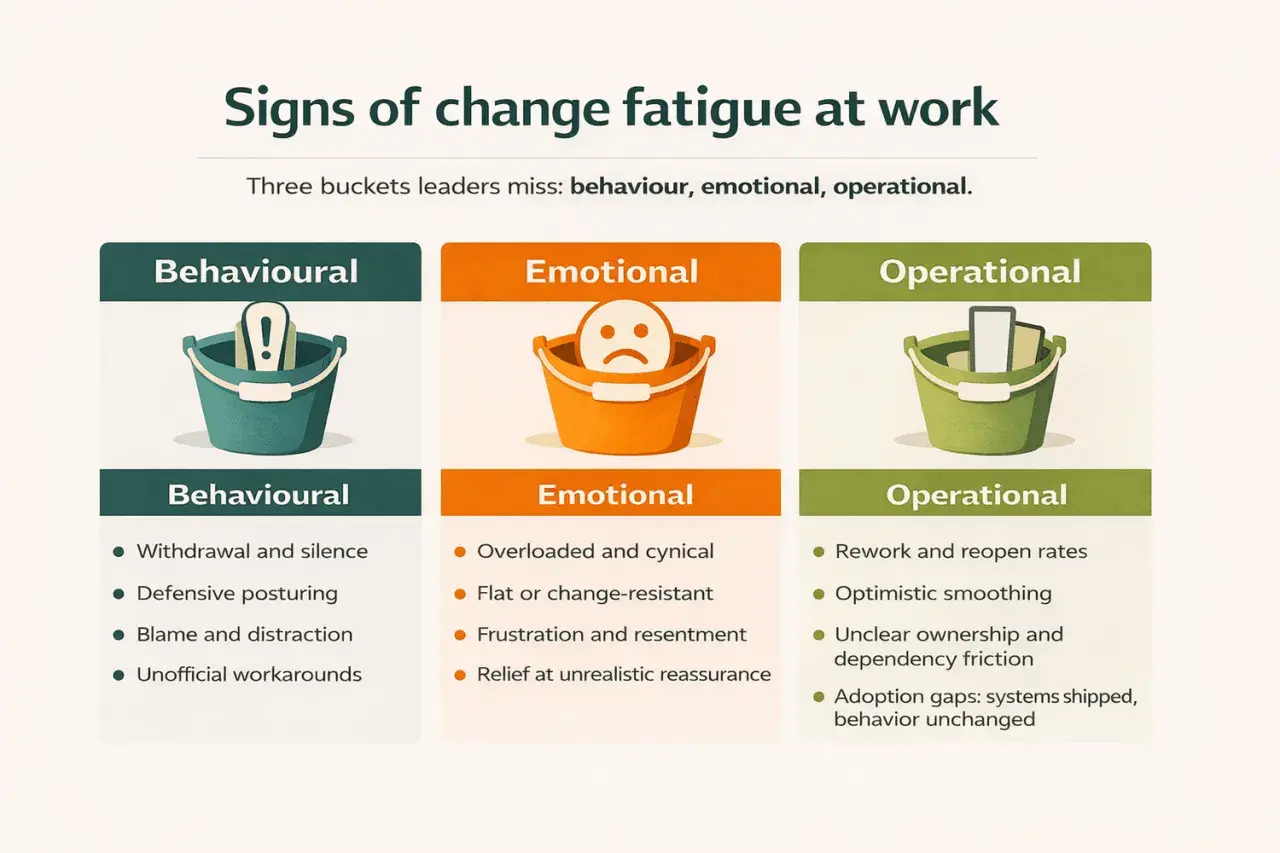
Frequent restructures, policy resets, new systems and shifting priorities can drain a team long before the business sees any benefit. The real issue is not resistance to progress; it is the cumulative strain on attention, trust and motivation. This article explains what change fatigue looks like, why culture can either absorb or amplify it, and what leaders and employees can do to keep work moving without burning people out.
What matters most before the next change lands
- Repeated change becomes damaging when the reason, timing and ownership are unclear.
- Trust, psychological safety and genuine employee voice make change feel manageable.
- People usually need sequencing and recovery time, not another round of generic communication.
- Managers should watch for silence, cynicism, slower decisions and reduced follow-through.
- The strongest response is to reduce overlap, close feedback loops and protect capacity.

What constant change looks like in practice
The early signs are usually quiet before they become obvious. People keep attending meetings but stop contributing. Updates get shorter. Decisions slow down because everyone is waiting for the next announcement. Managers notice more rework, more missed handovers and a growing habit of saying “let’s wait and see” to every new idea.
People rarely reject every change. They reject change that feels repetitive, badly sequenced or impossible to influence. That is why the pattern matters more than any single announcement.
| Signal | What it usually means | What it looks like in a team |
|---|---|---|
| Silence in meetings | People do not believe speaking up will change anything | Short answers, no questions, little debate |
| Cynical humour | The team is protecting itself from disappointment | Comments like “this will all change again next month” |
| Slower decisions | Cognitive overload, not laziness | Escalations pile up and routine choices take longer |
| Attendance without engagement | People are physically present but mentally switched off | Minimal contribution and low energy in discussions |
| Rising absence or turnover | The pressure has moved past normal discomfort | More sick days, more resignations, more internal transfers |
I would not treat every pushback as a problem. Healthy disagreement is useful. The warning sign is when energy disappears and nobody believes the next announcement will be the last. That is the point at which culture starts to absorb less and leak more.
Why workplace culture decides whether change feels manageable
Culture is not a soft extra here. It is the operating system that tells people whether change is worth investing in. In UK organisations, the line manager is often the real culture carrier: people judge fairness, clarity and credibility through the person they see every week, not through the corporate slide deck.
Trust changes the whole experience. When people believe leaders are honest about trade-offs and consistent in their decisions, they are far more willing to adapt. When they expect spin, the same change feels heavier before it has even started.
- Clear rationale gives people a reason to engage instead of guessing.
- Visible follow-through shows that feedback is being used, not just collected.
- Realistic pacing signals that the organisation understands capacity.
- Local autonomy lets teams adapt the change to their actual work.
- Consistency between leaders prevents mixed messages from undoing trust.
That is why culture matters before the project plan does. Once the team believes effort will be ignored, it starts conserving energy instead of investing it.
The triggers that push teams into overload
Some workplaces do not have one big change problem. They have a portfolio problem. Orgvue’s 2024 survey of 700 senior decision makers in large organisations found that 38% would rather quit than lead another major transformation, and leaders reported around nine changes a year compared with two before 2020. That is a strong signal that the pace itself has become part of the issue.
From what I see, the most draining trigger is not change in isolation. It is overlapping change with no recovery window.
| Trigger | Why it drains energy | Better response |
|---|---|---|
| Too many live initiatives | People have to switch context constantly | Pause lower-value work and sequence the rest |
| Unclear purpose | Effort feels like theatre rather than progress | State the problem, the outcome and the trade-off |
| No recovery time | Teams never rebuild their reserves | Build quiet windows between launches |
| Mixed messages from leaders | Trust drops fast when direction keeps shifting | Agree the message before it goes out |
| Everything is urgent | Priorities collapse into noise | Rank changes and say what is not changing |
| Technology introduced without support | People must learn while still doing the old job | Provide training, time and a clear adoption path |
When several of these triggers appear at once, the organisation is not managing change well. It is simply broadcasting more of it. That is a useful distinction, because the fix is usually not another message, but a cleaner sequence and a smaller backlog.
How to separate fatigue from resistance
One mistake I see often is labelling every hesitant team as resistant. That can lead leaders to push harder when they should be simplifying. Resistance is usually about disagreement with direction. Fatigue from repeated transitions is more often about depleted capacity.
Look for capacity, not just attitude
- Are people pushing back on the idea itself, or on the pace and volume?
- Do they lack information, or do they lack time and headspace?
- Are the same people carrying every new project?
- Has the team already been through several unfinished changes?
- Is the problem workload, trust, or both?
Check whether the team lacks context or control
If people do not understand why a change is happening, they will often fill the gap with suspicion. If they understand the why but have no control over the how, they may comply on paper and disengage in practice. Those are different problems, and they need different responses.
When the signs point to exhaustion rather than disagreement, the right answer is usually recovery and clarity, not pressure. And if you are also seeing sleep issues, persistent anxiety or long-term absenteeism, treat it as a wellbeing issue as well as a change issue and involve the right support early.
What leaders should do before launching the next initiative
If I were leading a team through a heavy period of change, I would start by cutting, sequencing and clarifying before I added any new communication. More emails do not compensate for too many moving parts.
- Reduce the number of live changes. If everything is important, nothing is. Pause lower-value work before you add a new initiative.
- Explain the why and the trade-off. People do not need a slogan; they need to know which problem is being solved and what is being deprioritised.
- Give each change a single owner. Ambiguous ownership turns into confusion, duplicated work and slow decisions.
- Equip managers early. Line managers need a simple story, a likely list of questions and the authority to adapt locally.
- Build feedback checkpoints. Ask what is not working, then show what changed because of that feedback.
- Measure adoption and workload together. A rollout that is “complete” but leaves people overwhelmed is not really complete.
My rule of thumb is simple: if I cannot explain the change, the trade-off and the stop condition in one minute, the team probably does not understand it well enough yet. That is usually a sign to slow down, not speed up.
What employees and managers can do day to day
Employees also need practical moves, especially when the organisation keeps shifting. The goal is not to become endlessly adaptable; it is to stay clear about what deserves your energy.
For employees
- Ask your manager what must be done now, later and not at all.
- Keep a running note of what has changed so you are not relying on memory and rumours.
- Protect focus blocks and limit context switching where you can.
- Speak up early if change is crowding out core work.
- Escalate patterns, not just isolated frustrations.
Read Also: DEI Issues in the Workplace - Fix Your Culture Now
For managers
- Translate strategy into two or three priorities the team can actually hold.
- Remove duplicate reporting and unnecessary updates.
- Make meeting load visible, then cut it if the team is overloaded.
- Acknowledge when a new request is extra work, not a trivial tweak.
- Close the loop after feedback so people see where their input went.
If a team is coping by working longer hours every week, that is not resilience; it is borrowed time. I would rather see a manager say, “We are dropping this lower-priority task,” than pretend the same workload can be absorbed indefinitely.
A healthier pace of change looks deliberate, not slow
The best organisations do not remove change; they design its rhythm. They limit overlap, make trade-offs explicit, equip managers early and give teams enough recovery time to absorb what has already landed.
- Fewer concurrent projects
- Clear stopping rules
- Visible manager support
- Real follow-through on employee input
When leaders stop treating change fatigue as an attitude problem and start treating it as a pacing and culture problem, they usually get better adoption, better decisions and fewer quiet workarounds. That is the practical standard I would aim for in 2026: not zero change, just change that people can actually live with.
