
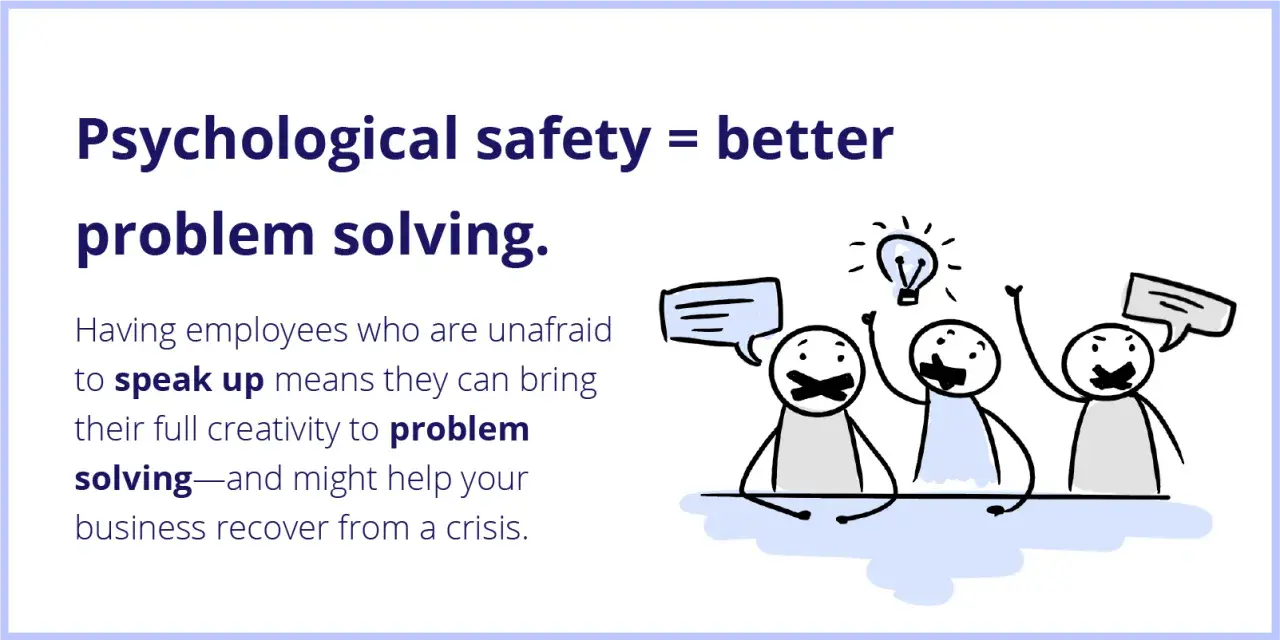
Psychological safety at work is one of the clearest signs that a team can handle pressure without turning defensive. When people can ask awkward questions, challenge a plan, or admit a mistake without being humiliated, the culture becomes faster, calmer, and more honest. In this article I break down what it looks like, why it matters in a UK workplace, how managers build it, what employees can do when it is missing, and how to tell whether the culture is actually improving.
What you need to know before you change the culture
- It is a speak-up climate, not a comfort-first culture.
- People with it raise risks earlier, make better decisions, and waste less energy on self-protection.
- Managers build it through repeated responses, meeting norms, and visible follow-through.
- In the UK, stress risk management and clear support channels are part of the picture, not optional extras.
- Progress should be measured through behaviour, not slogans.
What it really means when people feel safe to speak up
At its simplest, psychological safety means people believe they can take interpersonal risks without being punished or ridiculed. Those risks are ordinary, not dramatic: asking a basic question, disagreeing with a senior colleague, admitting you do not understand, or saying a process is broken.
That is not the same as being conflict-free. In a healthy team, people still challenge one another. The difference is that disagreement stays focused on the work, not the person. I often tell leaders that a safe team is not one where everyone sounds comfortable; it is one where the truth can enter the room early enough to matter.
It also is not a licence to lower standards. Strong teams can be demanding and psychologically safe at the same time. In fact, high standards without fear are usually where the best work happens, because people stop hiding their thinking and start improving it. Once that is clear, the next question is why this matters so much to performance and retention.
Why it matters for performance, retention, and learning
When people feel safe enough to speak honestly, small problems surface earlier. That means fewer surprises, less rework, better handovers, and faster decisions. It also improves learning, because teams are more willing to discuss what went wrong instead of spending their energy on blame management.
According to CIPD’s 2024 evidence review, trust and psychological safety are linked to teamwork, communication, collaboration, and overall performance. That matches what I see in practice: teams that can speak plainly spend less time managing impressions and more time solving the actual problem.
This matters even more in workplaces that are under constant change, because silence is expensive. If people do not feel able to raise a risk, it usually shows up later as missed deadlines, avoidable conflict, stress, or turnover. In other words, workplace culture stops being a soft topic and starts affecting capacity. Once you see that, the next step is learning to spot the difference in real behaviour.

Signs a team has it and signs it is missing
The clearest signals are behavioural. People rarely announce that they feel safe; they show it through what they do in meetings, one-to-ones, and day-to-day decisions. I look for patterns, not slogans.
| Behaviour | Healthy signal | Red flag |
|---|---|---|
| Someone disagrees with a manager | The team debates the idea without shutting the person down | People stay silent in the room and complain privately later |
| A mistake is discovered | It is raised early and used to improve the process | It is hidden, softened, or pinned on one person |
| A junior employee asks a basic question | The question is treated as normal and useful | They are made to feel slow, naïve, or inconvenient |
| Bad news reaches the manager | The response is calm, curious, and focused on action | The response is sarcasm, blame, or visible irritation |
| Feedback is given | Something visible changes afterwards | The same issue keeps returning with no explanation |
If a room feels polite but nothing difficult is ever said, that is not safety; it is caution with good manners. The practical question then becomes how leaders create a space where people can tell the truth without bracing for a backlash.
How managers build it day to day
I would build this through repetition, not grand announcements. A poster about values will not change much if the first response to bad news is still irritation. People learn from patterns, especially from what happens after someone takes a risk.
Make the first response safe
The first response to a concern matters more than the polished answer that comes later. If someone raises a problem, thank them before you evaluate the idea. That small habit signals that candour is useful, not annoying. From there, ask open questions such as what they have noticed, what evidence they have, and what they think the impact might be.
Build disagreement into the meeting
Do not rely on people volunteering dissent spontaneously, because many will not. Ask for a counterview on purpose. Rotate who speaks first. Pause before making a decision and invite the quieter voices in the room. If you always close with agreement, you will get agreement, but you will not necessarily get honesty.
Treat mistakes like data
When something goes wrong, the useful questions are usually procedural, not moral: What signal was missed? What made the error hard to spot? What would stop it happening again? That approach does not remove accountability; it makes accountability productive. Public shaming usually produces silence, not improvement.
Use systems, not slogans
In the UK, the HSE’s Management Standards frame work-related stress around six areas: demands, control, support, relationships, role, and change. That is a practical checklist because a team will struggle to speak honestly if those six areas are badly handled. If you have five or more workers, a written risk assessment is required, so this is not just a style preference; it belongs in the way risk is managed.
If I had to name the single habit that changes most cultures, it would be this: close the loop. People stop speaking up when feedback disappears into a void. They keep speaking when they can see that the organisation acted on what they said. That leads naturally to the employee side of the problem: what to do when the culture around you is not yet safe.
What employees can do when the culture is not there yet
Not every team is safe today, and I would not ask someone to confuse self-protection with passivity. If the environment is patchy or defensive, the goal is to raise issues in the least risky way that still gets the message across.
- Start with the smallest honest version of the issue. You do not need to deliver a perfect speech. A short, factual statement about what happened, what it affects, and why it matters is often enough.
- Use impact, not accusation. “When deadlines change at the last minute, the handover becomes unreliable” is easier to act on than “This team is chaotic.”
- Choose the safest channel first. A private one-to-one, a written note, or a trusted manager may be better than raising something sensitive in a group meeting.
- Ask for a concrete next step. If you raise an issue and get a vague response, ask what will happen next and when you will hear back.
- Keep a record if the pattern repeats. If concerns are dismissed over and over, document what was said, when it was said, and what the response was.
- Ask for support early if workload or wellbeing is affected. If the issue is wearing people down, the conversation should include support, not just performance.
If you are in a stronger position, you can also protect other people’s voice by backing up the colleague who raised the issue instead of leaving them exposed. That matters because trust is rarely built by one heroic statement; it is built when more than one person sees that speaking up did not backfire. The next question is how to measure whether those changes are real.
How to measure whether the culture is improving
You cannot manage what you never observe. I prefer to look at three layers together: what people say, what they do, and what the system rewards. One survey score on its own tells you very little; behaviour over time tells you much more.
| Indicator | What I want to see | What worries me |
|---|---|---|
| Meeting participation | Questions, challenge, and input from different levels | The same few voices dominate every discussion |
| Time to surface problems | Issues are raised early, before they become incidents | Bad news appears only after damage has spread |
| Follow-through | People can point to visible changes after feedback | Feedback is collected, then quietly forgotten |
| Stress signals | People ask for help before they reach breaking point | Absence, irritability, or silence keeps rising |
A simple pulse survey can help if it stays short and specific. I would keep it to three to five statements rated on a 1 to 5 scale, such as “I can raise a concern without fear of negative consequences”, “Different views are welcomed here”, and “When people speak up, something useful happens afterwards”. The point is not to chase a perfect score; it is to see whether the trend is moving in the right direction. That also helps expose the mistakes that quietly destroy trust even when leaders think they are doing the right thing.
The mistakes that quietly destroy trust
Most damage does not come from one dramatic failure. It comes from repeated small contradictions between what leaders ask for and what they reward. Those contradictions teach people to stay careful.
| Mistake | Why it backfires | Better move |
|---|---|---|
| Asking for candour and then reacting defensively | People remember the reaction, not the request | Thank them, clarify the issue, and follow up calmly |
| Confusing silence with agreement | Silence often means caution, not commitment | Ask for a different view before the meeting ends |
| Celebrating one brave comment without changing anything | People conclude that speaking up is symbolic, not useful | Show what action came from the input |
| Letting a toxic high performer set the tone | The whole team learns that status overrides standards | Apply the same behavioural expectations to everyone |
| Fixing tone but not workload or role clarity | Safety collapses when pressure stays unmanaged | Address demands, control, support, relationships, role, and change together |
I see these mistakes more often than outright hostility. They are quieter, which is exactly why they last longer. Once you remove them, the final step is setting a practical standard for what a healthier workplace should look like in daily life.
The practical standard I would use in a UK workplace
If I had to reduce the whole topic to one test, it would be this: can someone surface a risk early, disagree respectfully, or admit an error without being shamed? If yes, the culture is moving in the right direction. If not, no amount of branding will fix it.
The most useful next steps are usually small and visible. Review one meeting norm, one stress-risk check, and one follow-up habit. Then watch what changes. People decide whether to speak up based on what happens next, not what the values page says.
If people can raise risks early, disagree without theatre, and admit mistakes without humiliation, you are moving in the right direction. If they only speak up once the damage is already done, the culture still needs work.
