
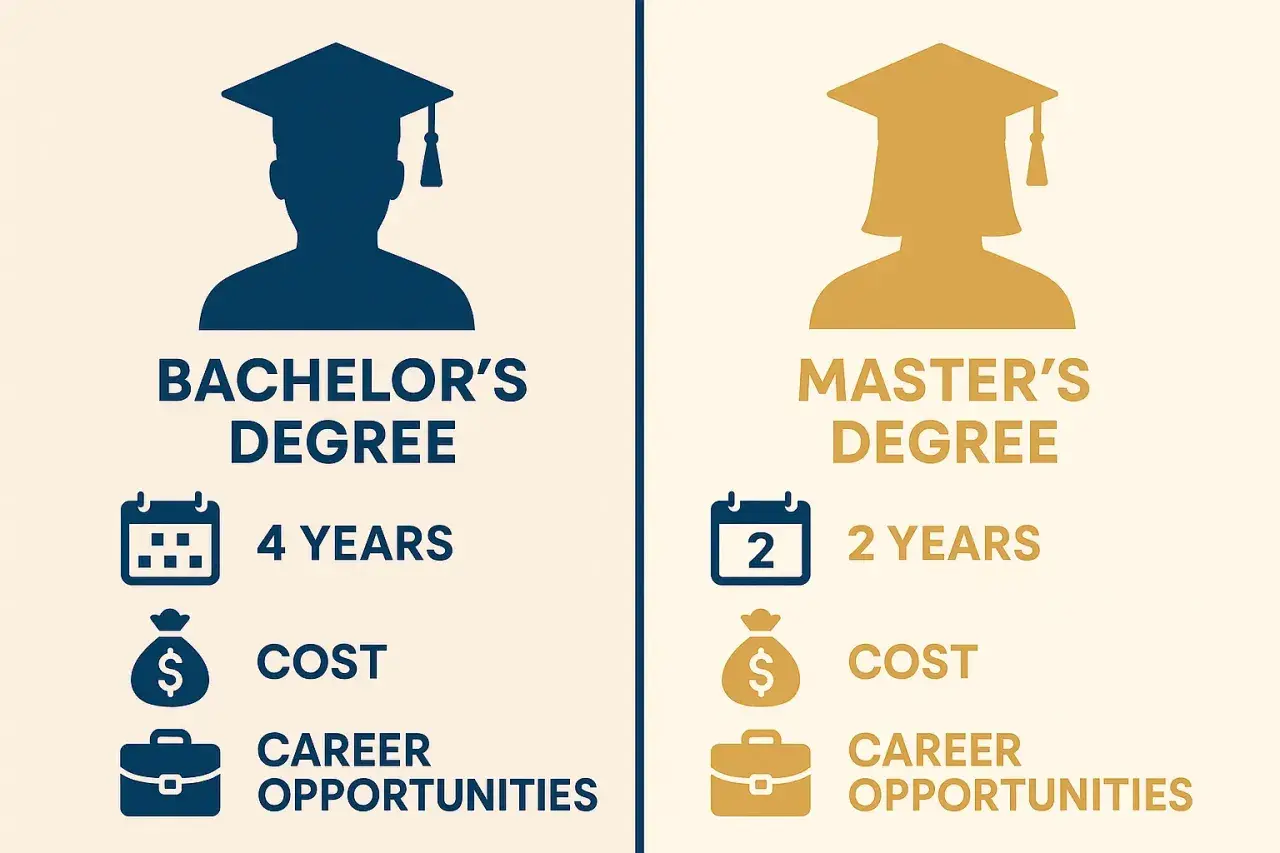
The gap between a bachelor's degree and a master's degree is bigger than a label on a certificate. It affects how deeply you study a subject, how independent the work becomes, how long you spend in university, and what doors open afterwards. This article breaks down the difference in UK terms, then looks at study style, cost, entry requirements, and the situations where one route is clearly better than the other.
The key differences at a glance
- A bachelor's degree is usually the first university qualification; a master's degree is the next stage.
- In most of the UK, bachelor's degrees usually take 3 years full-time, while master's degrees often take 1 year full-time or 2 years part-time.
- Bachelor's study is broader and more guided; master's study is narrower, more specialised, and usually more independent.
- Master's entry normally requires a relevant bachelor's degree, and some courses ask for a 2:2 or 2:1.
- Integrated master's courses blur the line by combining undergraduate and postgraduate study in one route.
What each qualification means in the UK
In the UK, a bachelor's degree is an undergraduate degree and usually the first degree a student earns after school. A master's degree is a postgraduate qualification that comes after a bachelor's and is designed for deeper study, more focused expertise, or professional development. In England, Wales and Northern Ireland, bachelor's awards sit at level 6 and master's at level 7; Scotland uses a different numbering scale, but the progression is still undergraduate to postgraduate.
That distinction matters because the degree level tells you something about the academic demand, not just the title on the parchment. A bachelor's proves you can build a foundation in a subject. A master's shows you can work at a more advanced level, often with tighter focus and stronger research expectations. Once you see that, the way courses are taught starts to make much more sense.

Where the real study-time difference shows up
This is where the gap becomes practical rather than theoretical. Bachelor's teaching is usually built around lectures, seminars, and practical work, with assessments that can include exams, essays, presentations, and practical tests. Master's study usually shifts the balance toward independent learning, research methods, and project work.
| Area | Bachelor's degree | Master's degree |
|---|---|---|
| Academic level | Undergraduate first degree | Postgraduate advanced degree |
| Focus | Broad foundation in one subject or a joint subject mix | Specialised study in a narrower field or professional area |
| Teaching pattern | More lectures, seminars, and practical sessions | More independent study, research methods, and project work |
| Assessment | Mix of exams, essays, presentations, and practicals | Often dissertation, thesis, major project, or research outputs |
| Typical entry | School leaver or equivalent | Relevant bachelor's degree, sometimes with a 2:2 or 2:1 |
That is why a master's often feels less like "more university" and more like a different academic gear. You are expected to handle less hand-holding, make sharper choices about your topic, and defend your thinking more clearly. From there, the questions become easier: how long does each path take, and what does it usually cost?
How long each route takes and what it usually costs
In most of the UK, a standard bachelor's degree lasts 3 years full-time; in Scotland it is usually 4 years. Some programmes stretch to 4 years because of a placement year, a year abroad, or because they are integrated courses. Taught master's degrees are commonly 1 year full-time or 2 years part-time, while research routes can take longer because the dissertation or thesis carries more weight.
Cost is where many people make a bad assumption. Postgraduate tuition often lands somewhere between roughly £4,900 and over £30,000 a year, with an average near £11,000. That does not automatically make a master's poor value, but it does mean the funding model and the return on investment need more scrutiny than they would for a shorter undergraduate course.
I usually tell people to look at three things together: tuition, living costs, and the income they are giving up while studying. A one-year master's can be efficient if it unlocks better roles quickly, but it can also be an expensive detour if it does not change the job market around you. That is the point where the decision becomes strategic, not academic.
When a bachelor's degree is enough and when a master's adds real value
I would not treat a master's as the "better" option by default. It is only better when it changes the quality of the next step.
Choose a bachelor's degree first when
- You want a broad foundation before specialising.
- You are still exploring which field fits you best.
- The jobs you want only require undergraduate-level entry.
- Cost and flexibility matter more than immediate specialisation.
- You want time to build experience before committing to postgraduate study.
For many students, that is the sensible route. A strong bachelor's gives you credibility, room to pivot, and a lower-risk way to test a subject in real life. It also keeps postgraduate study open later, which matters more than people think.
Read Also: Google Project Management Certificate - Your UK Career Guide
Choose a master's degree when
- You already know the niche you want to work in.
- You need a formal qualification for a specialist role or profession.
- Your bachelor's degree is broad, but the job market expects deeper technical knowledge.
- You want to move into research, policy, analysis, teaching, or leadership roles that reward advanced study.
- You need a credible pivot and can use the master's to reset your profile.
That second list is where a master's earns its keep. It can sharpen your position in the market, but only if the course content matches the outcome you want. If it does not, the extra year is just more time in a classroom with a heavier invoice attached. That is why the UK's exceptions matter so much.
The UK exceptions that change the comparison
The biggest source of confusion is that not every "master's" in the UK means a separate postgraduate course. Some integrated master's degrees combine undergraduate and postgraduate study in a single programme, often over 4 years, or 5 in Scotland. Common examples include MEng, MChem, and MMath. The title is a master's-level award, but the route starts at undergraduate level and moves into master's-level work later on.
That matters if you are comparing courses across countries or trying to judge how advanced a qualification really is. A UK student on an integrated master's may be studying a master's-level award without ever applying for a separate postgraduate course. The label is the same; the route is not.
There are also professional and practice-based master's degrees such as the MBA, LLM, and other field-specific awards. These often expect relevant work experience or professional context, not just academic grades. In some subjects, the course is as much about applying knowledge in a real setting as it is about theory, which is why the entry profile can look very different from a standard taught MSc.
Once you factor in integrated and professional routes, the comparison stops being a simple "more years = higher level" equation. The final step is deciding which version of advanced study actually supports your career plan.
A simple way to choose without overthinking it
When I help someone weigh these options, I ask a blunt question: what changes if you choose the longer route? If the answer is only "it sounds impressive," I usually push them back toward the bachelor's or toward gaining experience first. If the answer is "I can enter a different tier of jobs, specialise properly, or qualify for the next professional step," the master's starts to look justified.
- Pick the bachelor's if you need breadth, flexibility, or a lower-risk first step.
- Pick the master's if you need depth, credibility, or a specific career move.
- Check whether the course is taught, research-based, or integrated before you compare titles.
- Look at entry requirements early, because a 2:2, 2:1, subject match, or work experience requirement can change the plan.
- Ignore prestige for a moment and focus on the next practical outcome.
The cleanest way to think about the difference between a bachelor's and a master's is this: the bachelor's builds the base, and the master's is for deliberate specialisation. If that extra level of focus helps you move faster, earn more relevance, or step into the role you actually want, it can be worth it. If it does not, the shorter route is usually the better professional decision.
