
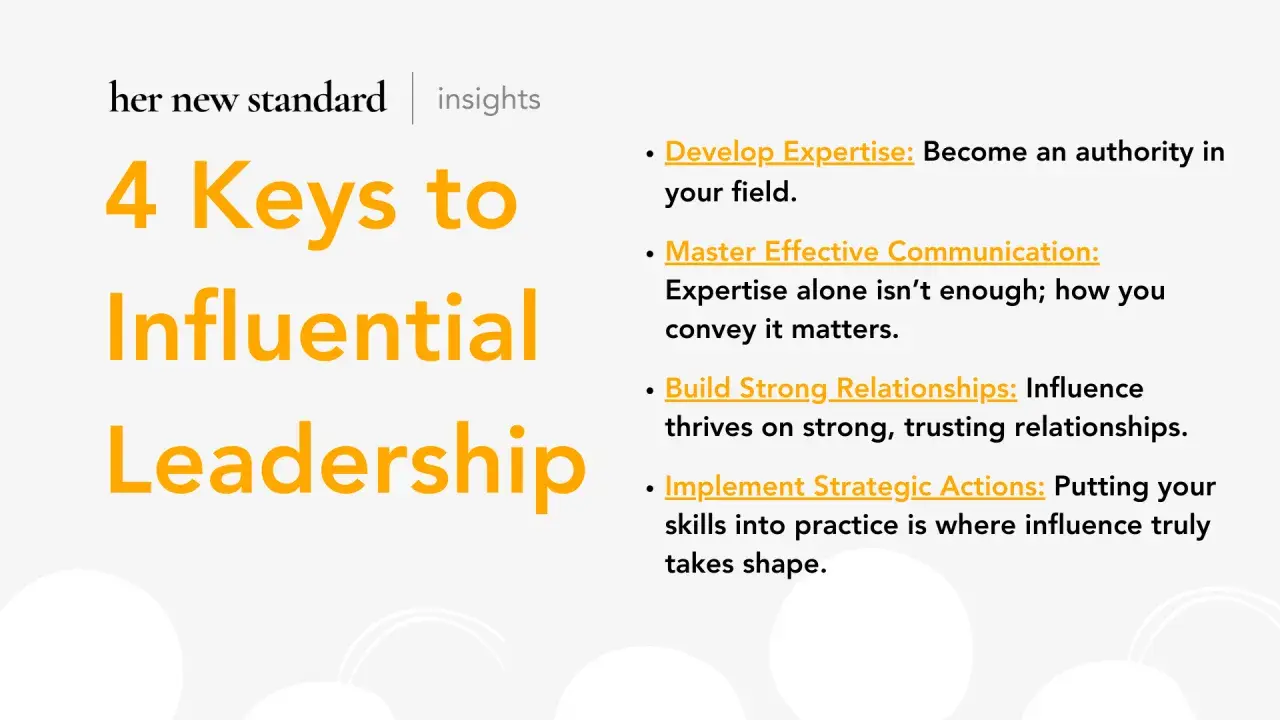
Influential leadership is less about position and more about the ability to shape decisions, build commitment and move people in a shared direction. This article explains what influential leadership is, why it matters in modern teams, and how you can strengthen it through clearer communication, better coaching and more deliberate follow-through. I am also going to separate genuine influence from authority and manipulation, because that distinction is where many leaders get stuck.
The essentials at a glance
- Influential leadership persuades through trust, clarity and relevance, not pressure.
- It works best when people feel heard, understand the goal and see their own role in it.
- Authority can secure compliance, but influence earns commitment and initiative.
- Coaching strengthens influence by replacing quick answers with better questions.
- Common weaknesses include mixed messages, over-talking and trying to win every conversation.

What influential leadership really means
At its core, influential leadership is the ability to guide other people towards a decision or action because they believe it makes sense, not because they are forced to comply. In practice, that means combining credibility, empathy and clarity so that people can see both the direction and the reason behind it. A leader with influence does not need to dominate the room; they make it easier for others to commit.
This is why I treat influence as a leadership skill, not a personality trait. Charisma can help, but it is not the engine. The real work is steadier: understanding what people care about, linking your message to those priorities and following through on what you say. Once that distinction is clear, the next question is why influence matters so much in the way teams work now.
Why it matters in modern workplaces
In many UK organisations, work is cross-functional, hybrid and faster moving than it used to be. That means leaders often have to influence colleagues they do not directly manage, persuade specialists who care about different priorities and keep momentum without relying on hierarchy alone. If you cannot do that, you end up with polite agreement and weak execution.
Influence matters because it changes the quality of commitment. A team member who complies because they were told to do something will usually do the minimum. A team member who understands the logic and feels respected will often take ownership, spot problems earlier and bring better ideas back to you. Gallup’s research on effective leadership points to seven capabilities that support that shift: building relationships, developing people, leading change, inspiring others, thinking critically, communicating clearly and creating accountability. That list is useful because it shows that influence is never just about speaking well. It is about the whole leadership system around the conversation.
Once you see that, the practical focus shifts from telling people what to do to building the behaviours that make them want to follow through.
The behaviours that build trust and movement
Influence is rarely created by one big speech. It is built through repeated behaviour, especially the small moments that tell people whether you are worth trusting. In my experience, these are the habits that matter most:
- Clarity - people need to know what the goal is, why it matters and what good looks like.
- Consistency - if your message changes every week, people stop believing it.
- Listening - when people feel heard, they are more open to changing their view.
- Judgement - influential leaders make decisions that are coherent, not merely popular.
- Emotional control - if you stay steady under pressure, others are more likely to trust your direction.
- Respect - people do not have to agree with you to feel that you are dealing fairly with them.
The Centre for Creative Leadership makes a similar point in its research on leadership skills: influencing others sits alongside communication and self-awareness, which is exactly what I see in coaching conversations as well. Leaders usually do not lose influence because they lack ideas. They lose it because their behaviour makes other people feel uncertain, unseen or managed. The next step is learning how to persuade without drifting into pressure tactics.
How persuasion works without becoming manipulation
Persuasion is part of leadership, but it is not the same as pushing. Healthy persuasion respects the other person's judgement and makes the case clearly enough that they can evaluate it. Manipulation hides the real intent, uses guilt or urgency to bypass thinking, and often wins a short-term yes at the cost of long-term trust.
One useful way to think about influence is through three forms of power. Expert power comes from competence and experience. Referent power comes from trust and the respect people feel for you. Informational influence comes from giving people a clearer picture of the facts, trade-offs or consequences. None of those is bad on its own. The problem starts when a leader leans on one form so heavily that the others disappear.
When I coach leaders, I often recommend a simple persuasion sequence:
- Start with the other person's priorities, not your own slide deck.
- State the outcome you want in plain language.
- Connect the request to something they already care about, such as risk, quality, time or reputation.
- Use one strong example or data point, not a wall of detail.
- Make the next step easy to act on.
That process works because it reduces resistance without reducing autonomy. It also leads naturally to a more practical comparison: when should you lean on influence, when does authority help and when does either one go wrong?
Influence, authority and manipulation compared
These terms are often mixed together, but they are not interchangeable. The table below shows the difference in plain terms.
| Approach | How it works | Strength | Main risk |
|---|---|---|---|
| Influence | Builds commitment through trust, relevance and clarity | Creates ownership and stronger follow-through | Takes time and consistency |
| Authority | Uses role, policy or hierarchy to set direction | Helpful in urgent or regulated situations | Can produce compliance without belief |
| Manipulation | Uses pressure, omission or guilt to force agreement | May win quickly | Damages trust and weakens culture |
My view is straightforward: authority is useful when a decision must be made, but influence is what makes the decision workable once people leave the room. If you want people to act well without constant supervision, influence has to do the heavy lifting. That is where coaching becomes especially useful, because it teaches leaders how to create commitment instead of merely extracting agreement.
How coaching helps leaders become more influential
Coaching is one of the fastest ways to improve leadership influence because it changes the leader's default response. Instead of giving every answer, a coach-minded leader learns to ask sharper questions, listen longer and spot the assumptions underneath the disagreement. That matters because people are far more likely to support ideas they have helped shape.
A simple coaching loop can work well in day-to-day leadership:
- Define the outcome before the conversation starts.
- Ask what the other person sees, not just what they want.
- Reflect back the real concern in your own words.
- Offer one clear option, not five competing ideas.
- Agree a next step and a review point.
Over time, that approach improves the quality of the relationship as well as the quality of the decision. It also gives you a practical way to measure progress. Instead of asking only whether people nodded in the meeting, look at whether they followed through without chasing, whether they raised better questions and whether they started bringing solutions instead of only problems. Those signals are much closer to real influence.
What usually weakens a leader's influence
Many leaders assume they need more authority, a stronger personality or a better presentation. In reality, influence is usually damaged by avoidable habits.
- Mixed messages - saying one thing in private and another in public quickly erodes trust.
- Over-explaining - too much detail can sound like uncertainty rather than clarity.
- Talking past the person - if you ignore their priorities, your message lands weakly.
- Confusing agreement with commitment - a calm yes is not the same as genuine buy-in.
- Using title power too early - if every conversation ends with "because I said so", people stop engaging.
- Skipping follow-through - influence grows when people see that your promises and decisions hold up over time.
The hardest part is that these mistakes often feel productive in the moment. A leader can leave a meeting feeling they were decisive, only to discover later that nobody really moved. Once you recognise these patterns, the final step is setting a higher standard for your next leadership conversation.
A simple standard for your next leadership conversation
Before I finish, I like to use a quick self-check. It keeps leadership grounded in reality rather than wishful thinking.
- Did I make the goal clear in one sentence?
- Did I show that I understood the other person's concern?
- Did I explain why this matters now, not just why it matters to me?
- Did I ask for a real commitment, not just a polite response?
- Would this still work if my title disappeared from the room?
If most of those answers are yes, you are leading through influence rather than pressure. That is the standard I would use for any manager, coach or senior leader who wants people to move with them, not merely comply.
