
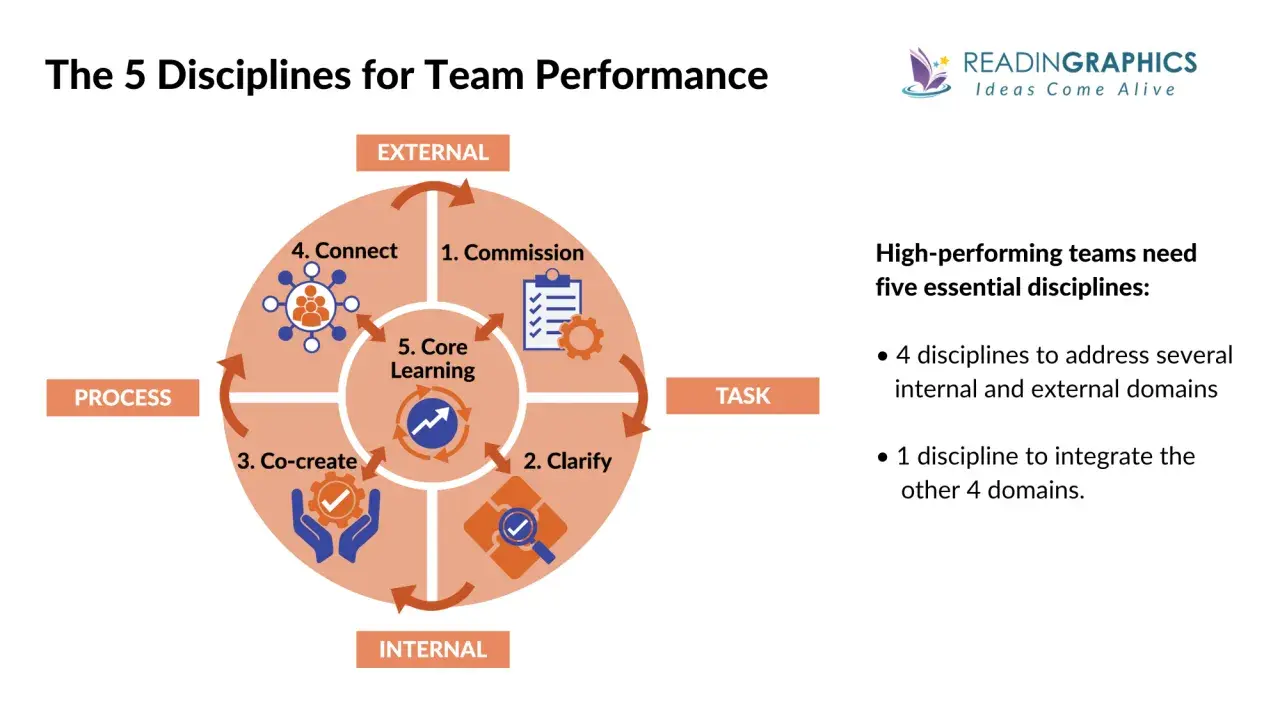
Coaching a team is less about motivational talks and more about changing how people think, decide, and work together under pressure. This is where team coaching earns its value: it targets the patterns that shape performance, from meeting habits and decision rights to trust and accountability. In UK organisations, that matters because hybrid working and cross-functional delivery often expose coordination problems long before individual capability becomes the issue.
What matters most when improving how a team works
- The goal is not just better morale; it is better decisions, clearer ownership, and more reliable execution.
- It works best when the whole group is treated as a system, not when one person is fixed in isolation.
- A useful engagement starts with a clear contract, a baseline, and a few observable behaviours.
- It is different from training, facilitation, and one-to-one coaching, so the intervention should match the problem.
- Trust, follow-through, and senior sponsorship usually decide whether the change sticks.
What changes when a group is coached as a system
When I look at a struggling group, I rarely see a simple “people problem”. More often, I see a pattern problem: the same voices dominate, decisions are revisited, disagreement stays polite but vague, and nobody is fully clear on who owns what. Coaching the team means working on those shared habits, not just asking individuals to try harder.
The real target is collective behaviour. That includes how people prepare for meetings, how quickly they surface risks, whether they challenge assumptions in the room, and whether commitments survive contact with the diary. A group can have strong individual performers and still underperform if the hand-offs are weak or the norms are fuzzy.
In my experience, the fastest gains come when the team can name three things honestly: what slows them down, what they avoid saying to each other, and what a better version of collaboration would look like in day-to-day work. Once that is visible, the conversation becomes practical rather than defensive. From there, the next step is learning how the process actually works.
How the process works in practice
A credible engagement is usually more than a one-off workshop. It needs enough time for the group to see its own habits, test new ones, and review what changed under real pressure. If the work is done well, the team should experience the process in its actual context, not in a glossy off-site bubble that disappears on Monday morning.
Contract the work clearly
Contracting is the explicit agreement on purpose, scope, boundaries, confidentiality, and success measures. I would never start without it. The team needs to know why this work is happening, who owns the outcomes, and what will be observed or discussed. Without that clarity, coaching can drift into vague conversation with no decision attached.
See the team in action
The most useful insight usually comes from watching the group do real work. A coach may observe a meeting, interview stakeholders, or review how decisions are made across functions. That is where the hidden dynamics show up: who interrupts, who softens conflict, who provides detail, and who quietly carries the load after the meeting ends.Turn insight into experiments
Once the pattern is clear, the work becomes experimental. The coach helps the group test one or two changes at a time, such as using a decision log, naming a single meeting owner, or setting a rule that every risk must be stated before a plan is approved. Small changes matter because they are easy to repeat. Big promises rarely survive the next busy week.
Read Also: Leadership Coaching UK - Is it Worth the Investment?
Review what changed
Evaluation should be plain and visible. Did decisions happen faster? Are responsibilities clearer? Are fewer issues coming back unresolved? Professional bodies such as EMCC Global treat team coaching as a distinct capability with standards around ethics, programme quality, and evaluation, which is exactly the right direction of travel. Good practice is not about theatre; it is about outcomes you can see in the way the group works.
That process works best when the problem matches the method, which is not always true. The next question is when this approach is worth using, and when another intervention is a better fit.
When it works best and when it does not
I would use this approach when the friction sits in the group itself, not just inside one person. It is useful when a leadership group is newly formed, when two functions need to collaborate more cleanly, when a merger has created confusion, or when a capable team has become careful, slow, and politically tense.
| Situation | Good fit | Why it helps |
|---|---|---|
| A newly formed leadership team | Yes | Norms, roles, and decision rights are still being shaped. |
| Cross-functional friction | Yes | The problem sits in hand-offs, priorities, and shared ownership. |
| One manager is underperforming | Usually not first choice | The issue is more likely individual capability or conduct. |
| Serious conflict or misconduct | No | This usually needs HR, mediation, or formal management action. |
| Team lacks clarity on goals | Sometimes | It helps only if leadership is willing to define and hold the line. |
The limits matter as much as the opportunities. If the sponsor will not back decisions, if the team has no time to meet properly, or if the real issue is an unresolved performance problem in one person, coaching the whole group will disappoint everyone. McKinsey’s change research has long pointed to visible senior sponsorship as a major factor in transformation success, and that remains true here: without support from the top, the work rarely survives the first difficult week.
That is why the method needs to be separated from facilitation, training, and one-to-one work. Those tools overlap, but they do not solve the same problem.
How it differs from facilitation, training, and one-to-one coaching
People often use these interventions as if they were interchangeable. They are not. The fastest way to waste time is to choose a method that sounds right but solves the wrong problem. I tend to ask one simple question first: do we need a decision, a skill, a behaviour shift, or a better group dynamic?
| Intervention | Main job | What changes | Best used when |
|---|---|---|---|
| Coaching the team | Improve the way the group works together | Decision quality, accountability, trust, and coordination | The problem sits in relationships, meeting habits, or shared ownership |
| Facilitation | Help the group reach a decision or complete a session | A plan, workshop output, or agreement | The team needs structure for a specific conversation |
| Training | Transfer knowledge or a method | Skills and understanding | The group lacks a shared capability or framework |
| One-to-one coaching | Develop an individual leader | Personal insight and behaviour | One person is the bottleneck |
The difference is simple but important. Facilitation helps a group get through a conversation. Training helps it learn something new. One-to-one coaching helps an individual lead better. Coaching the whole team changes the operating system that sits underneath all three.
Once those distinctions are clear, the usual failure points become easier to spot. Most weak results are not mysterious; they are the product of avoidable mistakes.
Common mistakes that weaken the result
I see the same errors again and again. They are not dramatic, which is why they are so damaging. They make the work look active while the underlying habits stay untouched.
- Treating it like a morale event. A good session can improve energy, but energy is not the same as behaviour change.
- Focusing only on personalities. Sometimes people are difficult, but often the system rewards the wrong behaviour.
- Skipping measurement. If nobody defines what “better” looks like, the team will default to vibes.
- Ignoring power dynamics. A leader’s behaviour sets the ceiling for how honest the group can be.
- Leaving no follow-through. New habits need repetition in real meetings, not just agreement in a workshop.
- Hiring for polish rather than depth. A smooth presentation is not a substitute for the ability to work with conflict and accountability.
How I would choose an approach that fits a UK organisation
If I were advising a UK leadership group, I would start with the problem pattern, then work backwards to the intervention. I would ask whether the main issue is alignment, execution, trust, role clarity, or leadership behaviour. That answer determines whether the work needs coaching, facilitation, training, or a combination of all three.
For provider selection, I would look for three things. First, clear evidence that the coach has worked with real leadership groups, not just individuals. Second, a straightforward explanation of how they diagnose team dynamics, gather feedback, and measure progress. Third, a quality signal that shows professional discipline. In the UK market, EMCC Global accreditation is one reasonable marker, but I would still probe the actual method rather than relying on logos.
I would also ask how the coach handles confidentiality, what happens between sessions, and how the sponsor stays involved without taking over the process. A strong coach should be able to explain the balance between challenge and safety in plain English. Psychological safety means people can speak honestly without fear of humiliation; without that, the group will perform for the room rather than work on the real issue.
Measure the change with plain indicators: decision turnaround, meeting length, the number of items carried forward, clarity of ownership, and whether people now say the difficult thing earlier. Those are boring measures, but they are the ones that reveal whether the group is actually changing. Once you have that logic in place, the real value starts to compound after the sessions end.
The habits that keep the gain after the coach steps back
The lasting benefit is rarely a dramatic breakthrough. It is usually a small set of habits that make the team easier to lead and harder to distract. The group starts to notice when it is slipping back into old routines, and that awareness is often the difference between a temporary uplift and a genuine shift in performance.
The habits I would protect are simple: a clear agenda for every meeting, explicit decision rights, visible ownership of actions, and a regular review of what is working and what is not. If the leader models those habits consistently, the team is far more likely to keep them. If the leader stops, the group usually drifts back to its old defaults.
So the useful question is not whether the intervention sounded impressive. It is whether the team now handles disagreement faster, follows through more reliably, and makes better use of each person’s time. If it does, the work has done what it should. If it does not, the problem was probably misdiagnosed from the start.
