
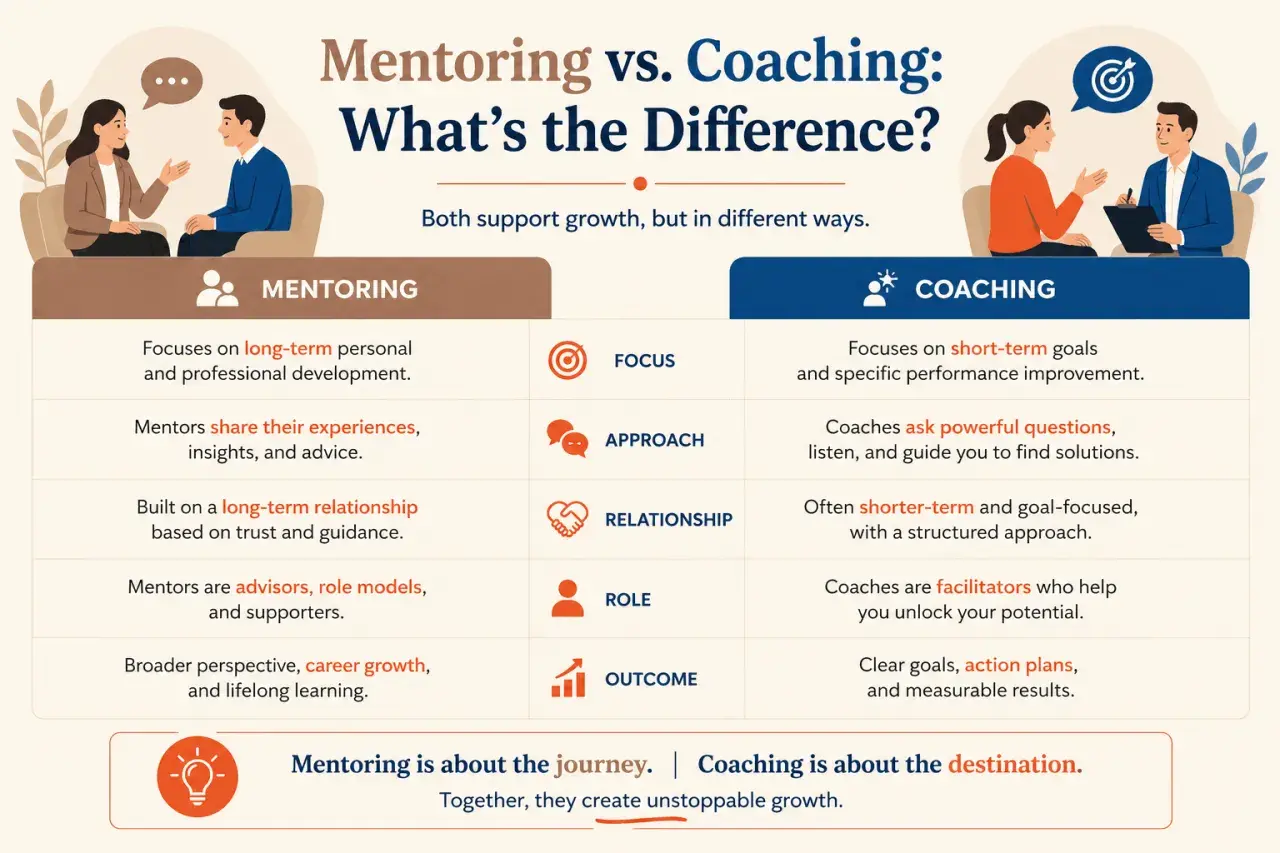
In leadership, the real challenge is rarely whether to support people, but how to support them in the right way. Coaching helps someone think more clearly, take ownership, and close a specific performance gap; mentoring gives them experience, context, and career judgement they cannot always build alone. This article breaks down how the two work in practice, where the line between them matters, and how managers in the UK can use both without blurring their purpose.
What matters most before you choose support
- Coaching works best when the person already has the capability but needs sharper thinking, better questions, or stronger accountability.
- Mentoring works best when the person needs lived experience, sector insight, or guidance on career moves and leadership politics.
- The two are not interchangeable, and the wrong choice usually slows progress rather than speeding it up.
- Good practice starts with a clear purpose, a time frame, and a shared understanding of what success looks like.
- For leaders, the biggest gain comes from using a coaching mindset day to day while reserving mentoring for situations where experience really matters.

How the two approaches differ in practice
The easiest way I find to separate them is this: coaching helps a person discover their own answer, while mentoring helps them access someone else’s relevant experience. In coaching, the conversation is usually structured around goals, obstacles, reflection, and action. In mentoring, the conversation is more likely to include advice, pattern recognition, examples from the mentor’s own career, and practical warnings about what tends to work in a given environment.
That difference sounds neat on paper, but in real workplaces it matters because the wrong style can frustrate both sides. If someone needs clarity and the manager keeps telling them what to do, the conversation becomes dependency. If someone needs guidance on a specific career move and the mentor only asks open questions, they may leave with more reflection than direction.
| Aspect | Coaching | Mentoring |
|---|---|---|
| Primary aim | Improve performance, confidence, and decision-making | Share experience, perspective, and career guidance |
| Main source of value | Questions, reflection, challenge, and accountability | Lived experience, examples, and practical advice |
| Best for | New goals, behaviour change, skill application, problem-solving | Transitions, promotion, long-term development, navigating culture |
| Typical tone | Non-directive and exploratory | Supportive and advisory |
| Common risk | Becoming vague or too abstract | Turning into a one-way lecture |
| Best leadership use | Improving ownership and problem-solving | Building capability, succession, and institutional memory |
A useful shorthand is that coaching draws out, while mentoring adds in. Once that distinction is clear, it becomes much easier to decide which approach belongs in a given situation.
When coaching is the better fit
I reach for coaching when the person is capable, but something in their thinking, confidence, or habits is getting in the way. That might be a manager who knows what good delegation looks like but keeps holding on to decisions, or a rising leader who understands the business but freezes when conflict appears. In those cases, advice alone rarely fixes the issue, because the gap is not knowledge first; it is judgement, awareness, or follow-through.
The strongest coaching conversations usually involve one of three things: a clear goal, a current obstacle, and a decision that needs to be owned by the coachee. The coach’s job is not to solve the problem for them. It is to slow the conversation down enough for the person to see their assumptions, test options, and commit to action.
- Use coaching when the person already has some skill but is not applying it consistently.
- Use coaching when the main issue is focus, confidence, prioritisation, or accountability.
- Use coaching when you want the person to build independent thinking rather than dependency on the manager.
This is also where the UK government’s coaching guidance is useful in practice: it frames coaching as one-to-one support that improves performance and helps someone work toward a goal. That framing is small, but it is important, because it keeps coaching tied to outcomes rather than vague encouragement. The next question is when the issue is not thinking, but experience.
When mentoring is the better fit
Mentoring is the stronger option when someone needs context they cannot yet build from first principles. A new line manager, a person stepping into a more senior role, or someone trying to move across functions often benefits from a mentor who has already seen the terrain. In these cases, the value is not just encouragement; it is perspective. The mentor can say, in effect, “I have seen this before, here is what tends to matter, and here is the mistake people make when they are new.”
That is especially useful in leadership development, where informal rules matter as much as formal ones. How do you influence without authority? When do you push, and when do you wait? How do you read a room before a difficult meeting? Those are the kinds of questions mentoring handles well because they depend on judgment built over time.In the UK, mentoring is also common in career development, graduate pathways, and inclusion programmes because it helps people see routes they may not yet know how to navigate. Reverse mentoring can be particularly valuable here: a junior employee helps a senior leader understand customer behaviour, digital habits, or lived experience that is easy to miss from the top. That only works when the senior person is willing to learn rather than perform authority.
Where coaching asks, “What do you notice?” mentoring often asks, “What does experience suggest?” Both are useful, but they answer different needs. Once you understand that, the leadership question becomes how to make both approaches credible inside the same culture.
What effective leadership looks like when you use both
Good leaders do not use coaching as a slogan and mentoring as a reward. They create simple rules around when each approach is appropriate, who owns it, and what the relationship is meant to achieve. In my view, the best leaders are not the ones who personally provide everything. They are the ones who know when to coach, when to advise, and when to connect someone with the right mentor.
Three habits make the biggest difference:
- Set the contract early. Say what the relationship is for, how often it will meet, and what kind of confidentiality applies.
- Keep development separate from appraisal where you can. People open up more when they are not trying to protect themselves from a rating conversation.
- Use psychological safety deliberately. That means creating enough trust for people to admit uncertainty, challenge assumptions, and speak honestly without fear of embarrassment or punishment.
CIPD has consistently treated these approaches as part of wider learning and development rather than as isolated perks, and that is the right lens. When organisations embed them properly, they improve more than individual performance: they build internal mobility, reduce avoidable turnover, and strengthen the pipeline for future managers. In 2026, many teams are also layering in lightweight AI support for reflection prompts or session notes, but that should stay secondary. The human relationship still does the real work.
Common mistakes that weaken both approaches
Most failures I see are not caused by the method itself. They come from bad design or confused expectations. A manager may say they are coaching, but then jump straight into instruction. A mentor may mean well, but fill the session with stories that never connect to the mentee’s actual challenge. The result in both cases is the same: the person leaves with less clarity than they had when they arrived.
- Using coaching to disguise poor management. If the issue is a clear capability gap, direct instruction may be needed before any reflective conversation.
- Turning mentoring into advice dumping. Experience only helps if it is filtered and relevant.
- Mixing roles without saying so. If someone is both line manager and coach, the boundaries need to be explicit.
- Choosing people by seniority alone. A good mentor is relevant, not just senior.
- Leaving the relationship open-ended. Development works better when there is a review point or a clear finish line.
The practical fix is simple, though not always easy: name the purpose before the first conversation, and return to it whenever the discussion drifts. That keeps support honest, which is what most people actually want.
A simple rule for choosing the next conversation
If you are unsure which approach to use, I would use this rule. If the person needs to think better, choose coaching. If the person needs to know better, choose mentoring. If both are true, start with coaching to sharpen the problem, then bring in mentoring for context and judgement.
For leaders, that usually means building a small mix of behaviours rather than relying on one style all the time. Ask more questions when you want ownership. Give more context when you want speed. Use both when you want long-term growth. That is the practical centre of coaching and mentoring, and it is where the strongest leadership development tends to happen.
