
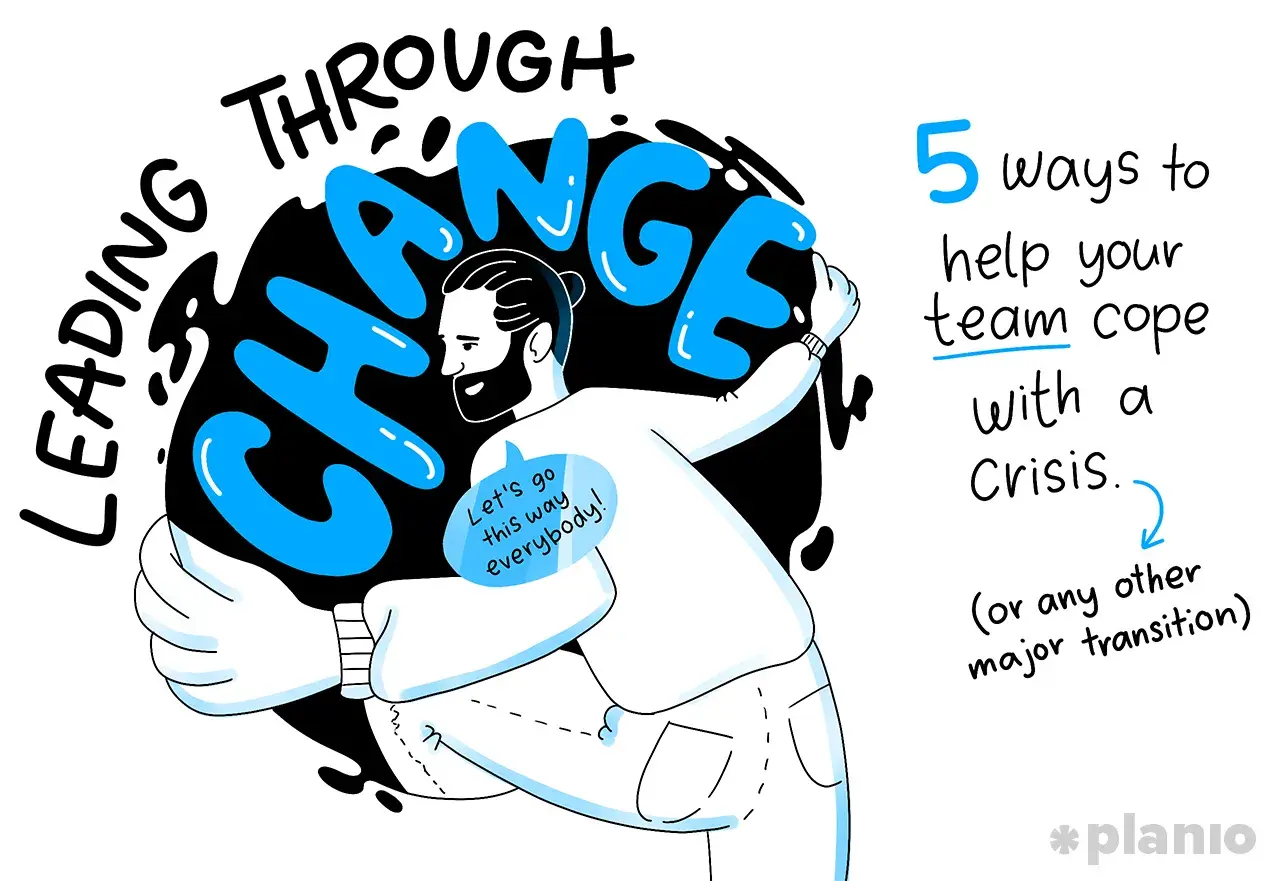
Leadership through change is less about control and more about making uncertainty workable. The leaders who do it well keep the message clear, reduce noise for their teams, and help people stay effective while roles, tools, and expectations are shifting. In practice, that means combining communication, coaching, and a realistic rollout plan rather than relying on one big announcement.
The essentials before you lead a team through transition
- Clarity beats charisma. People need to understand what is changing, why it matters, and what stays stable.
- Resistance is usually information. It often signals fatigue, unclear priorities, or fear of losing competence.
- Local managers carry the weight. Teams trust the people closest to the work more than distant strategy slides.
- Coaching makes change stick. Short, practical conversations help people move from uncertainty to action.
- Measure adoption, not just activity. Attendance and announcements do not tell you whether the new way of working is actually in place.
What leading through change really means
When I talk about leading through change, I am not talking about motivational speeches or polished slides. I mean helping people move from one way of working to another without losing trust, momentum, or basic performance. That requires a leader to handle both the business side of the transition and the human side at the same time.
It helps to separate change management from change leadership. Change management is the structure: timelines, training, communications, governance, and process design. Change leadership is the human work: setting direction, handling ambiguity, making trade-offs visible, and keeping people steady enough to adapt.
| Aspect | Change management | Leading through change |
|---|---|---|
| Main focus | Delivery, process, and adoption steps | Confidence, clarity, and commitment |
| Primary tool | Plans, milestones, training, communications | Conversations, visibility, coaching, and decisions |
| Time horizon | Usually tied to the project or programme | Continues throughout the transition |
| Success signal | Tasks delivered on time | People can work differently with confidence |
I treat the two as complementary, not competing. A project can be technically sound and still fail if the people expected to use it do not trust the path or understand their role in it. Once that distinction is clear, the next question is why people resist change even when the business case looks obvious.
Why people resist change, and what that resistance is telling you
Most resistance is rational. People are rarely rejecting progress for the sake of it; they are usually reacting to loss. They may be losing competence, status, predictability, workload balance, or simply the comfort of a routine they know they can perform well.
The UK Government Communication Service notes that organisations often go through major change roughly every three years, with smaller changes layered on top in between. That means many teams are not dealing with one neat transition; they are dealing with repeated shifts that slowly drain attention and goodwill. In that context, resistance often looks like fatigue, not defiance.
Three patterns show up again and again:
- Loss of control. People want to know what they can influence and what is already decided.
- Loss of competence. A confident employee can become hesitant when a new system makes them feel slow or exposed.
- Loss of meaning. If the change is not clearly linked to customer value, quality, or survival, it feels like administrative noise.
William Bridges’ transition model is useful here because it reminds me that people do not switch emotionally at the same speed as a project plan. They move through endings, a neutral zone, and a new beginning. The neutral zone is where morale often dips and mistakes rise, which is normal, not a sign that the whole effort is broken.
That is why the visible behaviour of the leader matters so much more than the announcement itself.

The behaviours people actually follow
In a transition, teams watch for proof more than inspiration. They ask, often silently, whether leaders are consistent, whether the new priorities are real, and whether anyone will help when the old habits stop working. The behaviours below tend to matter more than any single speech.
| Behaviour | What it does for the team | What goes wrong without it |
|---|---|---|
| Visible sponsorship | Shows that leaders will use the new way of working themselves | People assume the change is optional |
| One clear narrative | Reduces rumour and mixed messages | Teams fill the gaps with their own worst-case stories |
| Fast feedback loops | Lets you fix friction before it hardens into cynicism | Small problems become a story that the change is failing |
| Manager enablement | Gives line managers enough confidence to answer questions locally | Employees feel abandoned by the people closest to the work |
| Trade-off clarity | Makes priorities believable | Everything is treated as equally important, which usually means nothing is |
Prosci’s research is a useful reminder that this is not a soft issue. Its change management research links effective change management with projects meeting or exceeding objectives 88% of the time, compared with 13% when it is poor. I do not read that as a magic formula; I read it as evidence that the human side of transition is often the decisive side.
Those behaviours only work if they are translated into a simple operating rhythm, which is where the first 90 days matter.
A 30-60-90 day playbook you can actually run
When change drifts, it usually does so because nobody has a clear rhythm for what happens next. A simple 30-60-90 day structure keeps the transition practical and helps teams see progress without being overwhelmed. In a UK SME, a new CRM rollout, a restructuring, or a hybrid-working reset can all benefit from the same basic pattern.
- First 30 days: map the people affected, brief managers before the wider launch, explain why the change matters, and name the first three or four friction points you expect. This is the stage for clarity, not perfection.
- Days 31-60: run the change on a smaller scale where possible, collect weekly feedback, and remove the most obvious blockers quickly. Early wins matter here because they give people something concrete to trust.
- Days 61-90: standardise the new way of working, retire the old workaround, and start measuring adoption rather than meeting attendance. If the old method is still the easiest option, the change is not finished.
What I like about this structure is that it protects against two common mistakes: rushing the launch and leaving the team to “figure it out” alone. It also gives you a clean way to communicate progress without pretending the work is done before people have actually adapted.
The same rhythm also gives managers room to coach individuals, instead of treating everyone as if they adapt at the same speed.
Coaching the people who are carrying the change
Coaching is where leadership becomes personal. A leader can set the direction, but a coach helps people translate that direction into usable next steps. That matters because most employees do not need a grand theory; they need to know how their own work is changing on Monday morning.
I find the best coaching conversations in change are short, specific, and practical. They are not therapy sessions, and they are not disguised pep talks. They are conversations that reduce mental clutter and help someone decide what to do next.
- What feels unclear right now?
- Which part of this affects your work most directly?
- What is one action you can take this week?
- What support do you need from me or your manager?
That last question matters more than it looks. In transitions, support can mean access to a new tool, time to practise, a decision from another team, or simply permission to learn without being judged too early. A manager who listens before answering usually gets more honest feedback than one who launches straight into reassurance.
Good coaching also reduces burnout. People do not always burn out because the change is large; they burn out because they feel responsible for making sense of it alone. Once coaching is in place, the next thing that slows change down is usually a set of avoidable leadership mistakes.
Common mistakes that slow change down
I see the same errors repeatedly, and most of them are fixable. The problem is not that leaders lack intelligence; it is that they underestimate how quickly a transition can become confusing when communication, sequencing, and support are out of sync.
| Mistake | Why it hurts | Better move |
|---|---|---|
| Announcing before managers are ready | Local leaders cannot answer basic questions confidently | Brief managers first and give them simple talking points |
| Overloading people with messages | Important details get lost in the volume | Repeat the same message in smaller, timed doses |
| Treating all resistance as negativity | You lose useful feedback and create fear of speaking up | Separate genuine concerns from deliberate obstruction |
| Changing too many things at once | People cannot tell what matters most | Sequence the rollout and protect attention |
| Measuring activity, not adoption | You get a false sense of progress | Track actual behaviour change and work outcomes |
The mistake I would challenge most leaders on is hiding trade-offs. If one priority is being paused so another can land, say so. If a process is changing because the old one no longer serves customers well, say that plainly too. People can handle hard news; what they struggle with is ambiguity dressed up as optimism.
If you track those signals early, you can tell whether the organisation is genuinely settling into the new way of working.
When the new normal starts to stick
The real test of change is not whether people attended the launch or nodded during the town hall. It is whether the new behaviour starts to show up without constant prompting. I look for a few simple signs: managers can explain the change in their own words, the same basic questions stop resurfacing, workarounds begin to disappear, and teams stop treating the old process as the default escape route.
- People can explain the change clearly without reading from a script.
- Frustration drops because the process is becoming familiar, not mysterious.
- Local leaders are solving issues closer to the work instead of escalating everything.
- Confidence rises before enthusiasm does, which is normal and useful.
If I had to reduce the whole approach to one line, it would be this: make the destination understandable, make the route manageable, and make the people feel supported while they travel. That is what strong leadership and coaching look like during transition, and it is what separates a change that merely happens from one that actually holds.
