
The route is clearer once you separate specialisms from seniority
- Front end, back end, full stack, QA, DevOps, and leadership are different kinds of work, not just different labels.
- UK job titles are inconsistent, so the job description matters more than the title on the business card.
- Apprenticeships, degrees, and self-study can all work if they produce real project evidence.
- Salary usually rises with scope, not just with years of coding.
- The fastest progress comes from depth in one stack, strong debugging habits, and clear communication.

The main role families in software development
I usually think about this field as a set of adjacent specialisms rather than one ladder. A company may call someone a software engineer, developer, or programmer, but the real work is usually a mix of interface building, server-side logic, quality assurance, delivery automation, or people leadership.
| Role | What it focuses on | Typical work | Why it matters |
|---|---|---|---|
| Front end developer | The user interface | Builds pages, components, accessibility features, and responsive layouts | Makes the product usable and visible to customers |
| Back end developer | Business logic, APIs, and data | Creates server-side logic, integrates services, and manages databases | Keeps the product reliable, secure, and scalable |
| Full stack developer | Both front end and back end | Moves across the interface, APIs, and data layer to ship complete features | Useful in smaller teams and fast-moving product groups |
| Mobile developer | iOS or Android apps | Builds native or cross-platform apps and works with device-specific features | Important when mobile is the main customer channel |
| Software tester / QA | Quality and risk reduction | Runs manual and automated tests, reports bugs, and checks releases | Prevents expensive defects from reaching users |
| DevOps / platform engineer | Delivery and reliability | Works on CI/CD, infrastructure, monitoring, and automation | Makes shipping faster and safer |
| Software engineer | Broader build-and-maintain work | Analyses requirements, writes code, tests systems, and improves existing software | Acts as an umbrella title in many UK teams |
The biggest mistake I see is assuming these are all interchangeable. They are not. A strong job ad usually makes the focus obvious: if it talks mostly about browser work, you are looking at front end; if it talks about APIs and data, it is back end; if it talks about releases and uptime, it leans toward platform work. Once you can read those signals, it becomes much easier to map the career path in front of you.
How a software career usually progresses in the UK
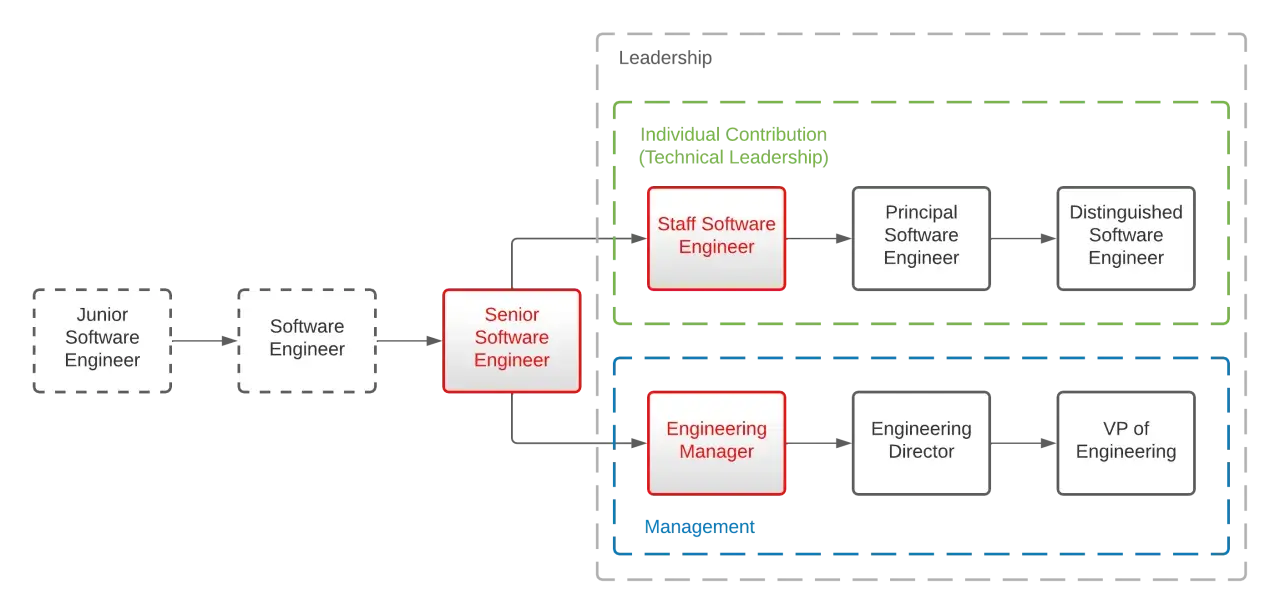
Career growth is not just a march from junior to senior. In the UK, the more useful split is between technical depth and people leadership. Some developers stay on the technical track and become specialists; others move into coordination, delivery, or team management.
| Stage | What changes | What I would expect you to own |
|---|---|---|
| Junior developer | Learning the codebase, tools, and team habits | Small features, bug fixes, safe commits, and asking good questions |
| Mid-level developer | More autonomy and broader technical judgment | Features end to end, debugging, and working across teams without constant support |
| Senior developer | Trade-offs, risk, and mentoring | Architecture decisions, review quality, and helping others move faster |
| Tech lead / staff / principal | System-wide influence | Standards, technical direction, and cross-team consistency |
| Engineering manager | People, delivery, and team health | Hiring, coaching, planning, and removing blockers |
I would not treat these as rigid rungs. A strong senior engineer may never want people management, and that is fine. In fact, the best technical careers are often built by people who keep growing in scope without forcing themselves into a leadership track they do not want. Once you know that split, the next question becomes much more practical: which path fits the way you naturally work?
How to choose the path that fits your strengths
I would not choose a role purely because it looks easier or pays slightly better at entry level. That usually leads to boredom later. A better filter is to ask what kind of problems you actually enjoy solving after the novelty wears off.
| If you enjoy... | Start with... | Watch out for... |
|---|---|---|
| Design, visuals, and user experience | Front end development | Underestimating browser complexity, accessibility, and performance |
| Data, rules, and system behaviour | Back end development | Ignoring API design, testing, and database basics |
| Variety and end-to-end ownership | Full stack development | Spreading yourself too thin before fundamentals are solid |
| Bug hunting and release confidence | QA or software testing | Being boxed into manual work unless you learn automation |
| Automation, cloud, and reliability | DevOps or platform engineering | Jumping into tooling before understanding systems and scripting |
| Coaching, coordination, and ownership | Tech lead or engineering manager later | Moving into management before you actually enjoy the people side |
This is where a lot of career advice gets lazy. Front end is not automatically beginner-friendly, back end is not automatically harder, and QA is not a lesser path. They are just different problems. The better question is which problems you can keep solving well when the work becomes routine, because that is what determines how far you can go. That also leads straight into the skills employers look for before they trust you with real ownership.
The skills UK employers look for now
Good developers do more than write code. They can break a messy problem into small steps, explain why they chose one approach over another, and ship work without creating avoidable risk. I look for four things early: solid fundamentals, decent debugging habits, readable collaboration, and the ability to learn new tools without freezing.
- Programming fundamentals - one language well is more useful than three languages badly.
- Version control - Git tracks changes, and pull requests let the team review work before it ships.
- Testing - unit tests, integration tests, and end-to-end tests catch different kinds of failure.
- APIs and databases - APIs are the rules that let systems talk to each other, while databases store the data.
- Accessibility, security, and performance - these are not extras once software is in production.
- Communication - clear notes, precise questions, and early risk flags save time for everyone.
CI/CD, which means an automated build-test-deploy pipeline, is now normal in many teams. If you are aiming at platform or delivery work, it is central. If you are aiming at product development, it still matters because release quality is part of the job, not an afterthought. The next step is figuring out how people actually enter the field in the UK, because the route you choose affects how fast you build evidence.
How people usually enter the field and build momentum
The UK apprenticeship ladder is broader than many people expect. There are routes from Level 2 and Level 3 into Level 4, Level 6, and even some Level 7 programmes, which means university is not the only serious starting point. For many people, the strongest route is the one that lets them earn, learn, and ship real work at the same time.
| Route | Best for | Real advantage | Main trade-off |
|---|---|---|---|
| Apprenticeship | People who want paid experience and structure | You learn in context and build a CV at the same time | Competitive and less control over the curriculum |
| Degree | People who want theory, depth, and time to explore | Strong foundations and good employer signalling | Time and tuition cost |
| Bootcamp or self-study | Career changers who need speed | Fastest way to build a portfolio if you stay disciplined | No guarantee of a job; proof-of-work matters a lot |
| Junior role or internal transfer | People who already have domain knowledge or good projects | Faster credibility inside a real business | Fewer openings and more competition |
I would not romanticise any one route. Apprenticeships work well for people who want structure. Degrees work well when you want time to think and explore. Self-study works when you are disciplined enough to produce visible evidence, not just consume tutorials. The common thread is simple: employers want proof that you can build, not just talk about building. Once that is clear, pay and working conditions become easier to interpret.
Pay, hours, and working conditions that actually shape the job
The National Careers Service currently lists software developer pay at £30,000 starter to £75,000 experienced, with typical hours of 37 to 40 a week and occasional evenings or weekends. Prospects puts software tester pay at roughly £18,000 to £27,000 at graduate level and £35,000 to £50,000 after three to five years.
| Role | Typical UK pay signal | Working pattern | What usually pushes pay up |
|---|---|---|---|
| Software developer | About £30,000 to £75,000 | Mostly standard hours, with occasional release pressure | Complex systems, mentoring, and domain expertise |
| Web developer | About £27,000 to £60,000 | Often 37 to 39 hours a week | Front-end depth, full-stack breadth, or client-facing delivery |
| Software tester | About £18,000 to £50,000 depending on experience | Usually regular hours, though deadlines can intensify | Automation, test strategy, and high-risk environments |
| DevOps / platform engineer | Often strong mid to senior pay once the role owns cloud and reliability work | Can include incident response or on-call responsibilities | CI/CD, infrastructure as code, observability, and system ownership |
The main point is that title matters less than scope. A narrow role in a high-growth environment can out-earn a broader title with little responsibility. I also pay attention to the kind of work the role includes: on-call rotations, delivery pressure, client contact, and leadership expectations all change the experience in ways that a salary number alone will not show. If you want to progress well, the first five years matter more than people admit.
The decisions that make the biggest difference in your first five years
If I were starting again, I would keep five decisions boringly consistent. Those choices do not look dramatic, but they compound fast.
- Pick one core stack and stay with it long enough to see how it fails, scales, and gets maintained.
- Build one public signal of competence, such as GitHub projects, a portfolio site, or a record of shipped work.
- Learn to test your own code before you rely on anyone else to find mistakes.
- Get comfortable with code review, because good feedback is one of the fastest ways to improve.
- Move into leadership only if you enjoy coordination; management is a different craft, not just a bigger title.
The people who grow fastest are usually not the ones chasing every new label. They are the ones who can explain what they built, why they built it that way, and what they would improve next time. That combination opens more doors than a flashy title ever will, and it is the most reliable way to turn an entry-level start into a strong long-term career.
