
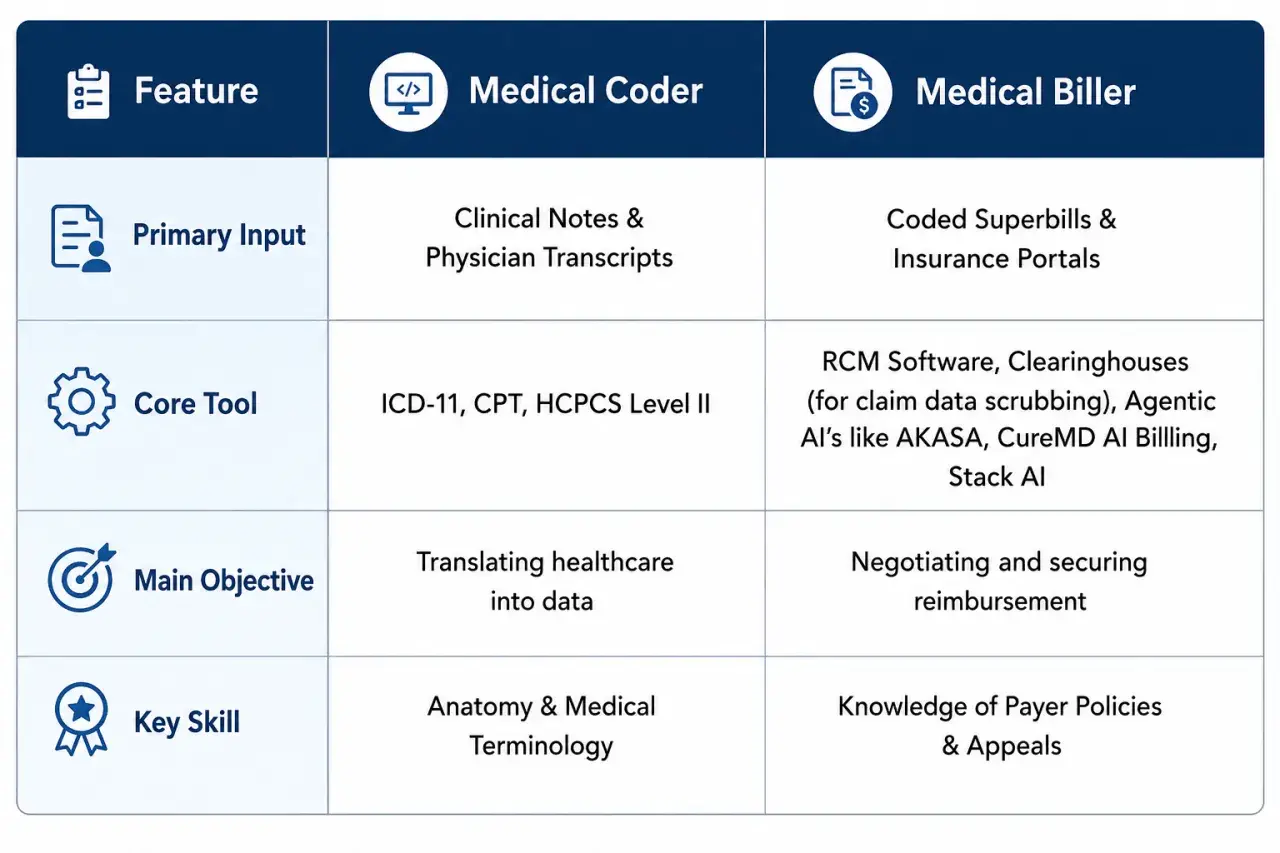
The UK route is usually split between coding and billing
- Clinical coding is the more formalised UK pathway and usually means translating patient records into standard codes.
- Billing in the UK is often part of private patient finance, invoicing, or healthcare administration rather than a standalone title.
- Most employers value accuracy, confidentiality, medical terminology, and Excel before they care about a niche qualification.
- You can enter through apprenticeships, admin roles, or trainee posts, then move up into specialist work.
- For coding, the important milestones are usually a standards course, supervised practice, and ACC/NCCQ progression.
- The fastest route is rarely the flashiest one: start in records, admin, or patient finance, then specialise.
How the UK version of the role really works
In Britain, I would not treat “medical biller and coder” as one neat, standard job title. The coding half is much clearer: clinical coders review notes, discharge summaries, scans, and procedure records, then convert that information into codes used across the health system. The billing half is more likely to appear in private patient finance, invoicing, credit control, or healthcare administration, especially in private hospitals and specialist trusts.
That distinction matters because it changes the route in. If you want NHS work, clinical coding is the better-defined career lane. If you want private healthcare, billing and finance duties may sit alongside patient administration, insurance checks, and invoice resolution.
| UK role | What it usually involves | Where it is common | Best fit for |
|---|---|---|---|
| Clinical coder | Abstracting clinical notes, assigning ICD-10 and OPCS-4 codes, checking accuracy, querying clinicians | NHS trusts, health informatics teams, some private providers | People who like detail, systems, and medical terminology |
| Private patient billing admin | Invoicing, insurer authorisation checks, cash collection, billing queries, reporting | Private hospitals, NHS private patient units, specialist clinics | People who are organised, commercially minded, and comfortable with spreadsheets |
| Health records or patient admin clerk | Preparing records, updating patient data, supporting coding and clinic pathways | NHS, GP practices, hospitals, medical groups | People who want a practical entry point into healthcare administration |
My advice is simple: choose the side you want first, because the skills overlap only partly. Once that is clear, the next step is building the right entry route instead of collecting random courses.
A practical route into the profession
If I were starting from scratch, I would not try to jump straight into a senior title. I would build toward it in layers, because employers trust evidence of reliability far more than ambition on its own.
-
Decide whether you want coding, billing, or both.
Coding is more structured and standards-heavy. Billing is more finance- and process-heavy. If you like rules, terminology, and pattern recognition, coding is usually the stronger fit. If you like invoicing, chasing detail, and reconciling records, billing admin may suit you better.
-
Get into a healthcare admin environment.
A health records, medical secretary, admin assistant, or patient finance role gives you real exposure to clinical language, patient pathways, and systems. That experience is often more useful than a generic course with no workplace context.
-
Learn the vocabulary before you chase the codes.
You need to understand anatomy, common procedures, abbreviations, and how clinicians write notes. In coding, the code is the last step; the interpretation comes first.
-
Apply for trainee or apprenticeship routes.
The National Careers Service lists a Clinical Coder Level 3 Advanced Apprenticeship as one route in. It also points to business administration routes, which can be a useful gateway if you are still building confidence with office systems.
-
Ask for structured training, not just on-the-job guessing.
A good employer should be able to explain what training you will get, who will mentor you, and how your progress will be checked. In coding, that usually means formal standards training and supervised practice.
-
Move from trainee work to accredited or specialist work.
Once you are accurate and consistent, you can start aiming at higher-complexity specialties, senior coder posts, or private billing and finance progression. That is where the career starts to compound.
The pattern is boring in the best possible way: step into the environment, learn the language, then specialise. The formal training path is where the process becomes more specific.
Training and qualifications that actually open doors
You do not need a medical degree to enter this field, but you do need the right baseline. For coding jobs, employers commonly want English and maths, plus enough IT confidence to handle records and databases. For billing roles, the same applies, but Excel, invoicing systems, and insurance workflows matter more.
| Path | What employers usually look for | Why it matters | Typical duration or timing |
|---|---|---|---|
| Entry admin or health records route | GCSEs in English and maths, office skills, typing, spreadsheets, customer service | Builds the foundation for patient data work and healthcare systems | Can start immediately through direct application or apprenticeship |
| Clinical coder standards training | Structured coding training based on national standards | Teaches the rules behind ICD-10 and OPCS-4 coding | One NHS trust says the foundation course takes around two months; NHS England Digital says the CCSC is delivered in no less than 21 days for acute coders |
| NCCQ and ACC progression | Passing the National Clinical Coding Qualification and gaining Accredited Clinical Coder status | Marks a coder as more independent and technically reliable | Often follows a period of supervised practice and study |
| Private billing and finance training | NVQ Level 3 or equivalent experience, good IT skills, invoicing knowledge, private insurance awareness | Supports work in patient finance, invoicing, and cash collection | Usually employer-led, with internal systems training |
Two acronyms are worth knowing early. ICD-10 is the diagnostic classification used to code conditions, and OPCS-4 is the UK system for procedure and intervention codes. CCSC is the Clinical Coding Standards Course, and ACC means Accredited Clinical Coder. In practice, those are the milestones that separate a beginner from someone employers trust with live records.
NHS England Digital says coding staff should start the standards course within six months of beginning employment and then complete refresher training every three years. That gives you a sense of how serious the profession is about consistency, and why casual self-study is never enough on its own.
Once the formal route is clear, the next question is whether you have the right working style for the job.
Skills employers test before they trust you with live records
In 2026, employers are still hiring for the same core reasons they always have: accuracy, judgement, and the ability to keep confidential information under control. A polished CV helps, but the interview usually comes down to whether you can handle detail without losing the bigger picture.
The skill that matters most is not speed. It is disciplined accuracy. A coder who works too fast and misses context creates bad data. A billing admin who pushes invoices too quickly can miss insurer conditions, shortfalls, or missing authorisations. In both cases, the mistake is expensive.
- Attention to detail because one wrong digit or misplaced code can affect payment, reporting, or audit outcomes.
- Medical terminology because notes often use abbreviations, specialty language, and shorthand that you have to interpret correctly.
- Anatomy and physiology basics because coding decisions depend on understanding what was actually treated or operated on.
- Excel and data handling because reporting, reconciliation, and quality checks rely on clean records.
- Communication because you will query clinicians, talk to finance teams, or explain billing issues to patients and insurers.
- Confidentiality and professionalism because you are handling sensitive patient and financial data every day.
One thing people often underestimate is how much of the job is interpretation. You are not just reading a record; you are reconstructing what happened, checking whether the documentation supports it, and deciding whether a query is needed. That is why the better candidates look calm, methodical, and slightly suspicious of incomplete information.
Those skills also shape pay and progression, which is where most people want clarity next.
What pay and progression look like in 2026
Pay varies by region, trust, and whether you are in the NHS or private sector, but the broad shape is easy to see. Entry roles sit in the mid-£20,000s, experienced coding roles move into the £30,000s, and more specialist or supervisory posts can go higher.
| Role stage | Typical UK pay snapshot | What usually drives the jump |
|---|---|---|
| Health records or admin entry point | About £25,000 to £31,000 | Office experience, accuracy, patient data handling |
| Trainee clinical coder | Often around Band 3 to 4, with recent NHS vacancies commonly landing in the high-£20,000s to low-£30,000s | Learning the standards, hitting accuracy targets, building confidence with notes and systems |
| Accredited or senior clinical coder | Frequently around £31,000 to £39,000, with some specialist or lead roles higher | ACC status, specialty knowledge, speed without losing accuracy, mentoring others |
| Private patient billing or finance admin | Usually similar to administrative or coding bands, with team lead roles moving upward | Insurance knowledge, invoicing control, cash collection, reporting, and stakeholder management |
In real life, progression is not just about time served. It is about whether you can be trusted with more complex specialties, more financial risk, or more responsibility for other people’s work. A strong coder becomes a subject-matter specialist; a strong billing administrator becomes the person who can keep a revenue process moving when it gets messy.
Some trusts now also advertise remote or hybrid working for coding posts, which makes the field more flexible than it used to be. That flexibility is useful, but it should not distract you from the bigger question: what is the most credible entry point for you right now?
The smartest first move if you are starting from scratch
If I were starting today, I would pick one of three tracks and commit to it for the next few months.
- Track one is for people already in healthcare admin: move laterally into health records, patient administration, or private patient finance, then specialise.
- Track two is for newcomers: apply for a Level 3 apprenticeship or an entry-level NHS or private healthcare admin role, and use that as your base.
- Track three is for detail-oriented learners with some office experience: target trainee clinical coder jobs and be ready to prove your Excel, terminology, and note-reading skills.
Before you apply, make sure you can talk clearly about two things: why you want the role, and how you handle detail when the information is incomplete. That is where interviews tend to separate serious candidates from people who only like the idea of the job.
That is the practical answer to how to become a medical biller and coder in the UK: choose the right side of the role, enter through admin or apprenticeship if you need to, and then build the standards, systems knowledge, and specialist experience that employers actually pay for.
