
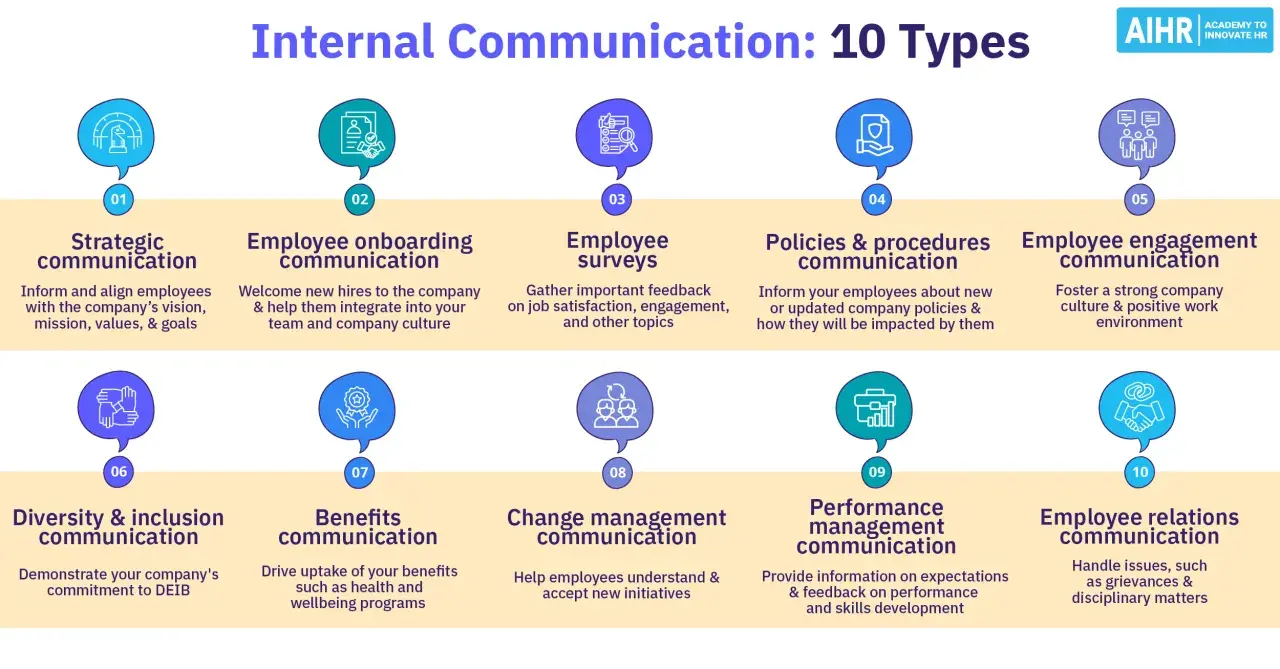
The strongest campaigns solve one business problem at a time
- They begin with one clear outcome, such as behaviour change, trust, recognition, or alignment.
- They use a small channel mix, usually 2 to 3 core channels, instead of trying to be everywhere at once.
- They equip managers properly, because cascade communication still matters in UK workplaces.
- They repeat the message across 3 to 5 touchpoints rather than relying on one announcement.
- They measure action and understanding, not just clicks or open rates.
What readers usually mean when they ask for the strongest campaigns
When people look for strong internal communication examples, they are usually not searching for theory. They want to know what a good campaign looks like in practice, which formats are worth copying, and how to avoid wasting attention on messages that land flat. In my view, that usually means campaigns built around a real business need: a change programme, a values rollout, a safety initiative, a leadership reset, or a push to improve engagement.
That focus is especially important in the UK, where hybrid work, frontline teams, and regional sites often consume information in very different ways. The IoIC’s IC Index 2026, based on nearly 5,000 employees in larger UK organisations, keeps pointing to trust, leadership and manager communication as pressure points. That is why the most effective campaigns are rarely decorative; they are designed to move people, not just inform them.
So the real question is not “what is a nice internal campaign?” It is “what kind of campaign will change something that matters?” Once you frame it that way, the strongest examples become much easier to evaluate. That leads naturally to the patterns that consistently work in real workplaces.

The campaign patterns that work in real workplaces
Good campaigns are not all built the same way. The right format depends on the problem you are trying to solve, the audience you need to reach, and the behaviour you want to change. I usually map campaign ideas against the business outcome first, then choose the creative shape second.
| Campaign type | Best for | Why it works | Common mistake |
|---|---|---|---|
| Change communication | Reorganisations, system rollouts, policy changes | It gives people a clear narrative, a reason to care, and a next step | Overloading people with jargon and timings before explaining impact |
| Values and culture campaigns | New values, culture refreshes, inclusion, ways of working | It turns abstract language into visible examples and repeatable behaviour | Using posters and slogans without showing what changes day to day |
| Safety and compliance campaigns | Security, data protection, health and safety, risk awareness | It makes the issue relatable and easier to remember in real situations | Writing in policy language that nobody would use in a normal conversation |
| Recognition and morale campaigns | Milestones, wins, peak periods, service excellence | It builds pride and connection by showing people that their effort is seen | Turning recognition into noise without a link to purpose or progress |
| Leadership trust campaigns | Periods of uncertainty, transformation, strategic resets | It reduces distance between leaders and colleagues and makes the message feel real | Publishing polished statements that sound scripted and avoid the hard questions |
The point of the table is simple: the format should fit the job. A safety reminder needs repetition and relevance. A transformation programme needs clarity and confidence. A culture initiative needs concrete examples and visible leadership. When those things are mismatched, even a well-written campaign tends to underperform. That is why the best examples are so useful: they show how different goals require different communication shapes.
Five examples I would copy first
Here are the kinds of initiatives I would pay attention to first, because each one solves a different workplace problem without losing sight of the audience.
- A Better Heathrow focused on rebuilding colleague engagement and operational performance after a period of volatility. That makes it a strong example of change communication done with a business outcome in mind, not just a vague culture message. I like this type of campaign because it treats internal communication as part of performance, not a decorative layer on top.
- Heathrow’s Christmas campaign, “Extraordinary together – a season to celebrate”, used a seasonal moment to unite more than 8,000 colleagues during a busy operational period. The lesson here is that timing matters. A good internal campaign often works because it matches the emotional rhythm of the organisation, not because it invents a theme out of nowhere.
- BT Group’s security engagement campaign aimed to change security behaviours across 100,000 employees. That is exactly the kind of scale where bland reminders usually fail. What makes this example useful is the reminder that compliance campaigns need relatability; people act on stories and scenarios much more readily than on abstract rules.
- TUI’s leadership-humanising programme was designed to rebuild trust during organisational change. I would copy the underlying principle here: when people are anxious, they do not want perfect corporate language, they want leaders who sound clear, honest, and human. That is especially true during transformation, when silence tends to create more damage than candour.
- Aberdeen Investments’ “Ringing in the good news” turned business wins into shared momentum. This is a good reminder that recognition campaigns are not fluff when they are tied to real performance. Used well, they create pride, reinforce what success looks like, and help teams see themselves as part of a larger story.
These examples are useful because they cover five different jobs: performance, seasonal unity, security behaviour, trust during change, and pride in achievement. None of them are trying to do everything. They work because the message, audience, and moment fit together.
Why good campaigns fail when the design is wrong
Most weak campaigns do not fail because the topic is unimportant. They fail because the design is lazy or overloaded. In practice, I see the same mistakes repeated over and over.
- Too many objectives - If a campaign is trying to explain strategy, shift behaviour, celebrate teams, and collect feedback all at once, it usually lands as noise.
- No manager layer - A message from leadership is not enough on its own. People still want context from their line manager, especially when the change affects their day-to-day work.
- Channel mismatch - Desk-based staff might live in email and Teams, but frontline colleagues often need signage, briefings, app-based updates, or supervisor conversations.
- One-and-done delivery - A single launch message rarely changes behaviour. Repetition is not a sign of failure; it is usually the reason a campaign sticks.
- Vanity metrics only - Open rates and clicks tell you the message was delivered. They do not tell you whether people understood it, believed it, or acted on it.
In the UK context, this matters because many organisations are still communicating to mixed workforces with very different access patterns. If you rely on a single channel, you are not being efficient; you are leaving part of the audience behind. That is why the next step is not more content, but a cleaner campaign structure.
How I would build one for a UK workplace
When I design an internal communications campaign, I start by stripping it back. If I cannot explain the campaign in one paragraph, it is probably too broad. A useful structure usually looks like this.
- Define one outcome - Decide whether the campaign is about awareness, behaviour, trust, participation, or recognition. Pick one primary outcome and one secondary outcome at most.
- Segment the audience - At minimum, separate desk-based colleagues from frontline or shift-based teams. In larger organisations, I often go further and split by geography, role, or manager level.
- Build the message hierarchy - I like to write three layers: why this matters now, what is changing, and what people need to do. That keeps the message clear and avoids drift.
- Choose 2 to 3 channels - A good mix might include a leader note, a manager briefing, and one reinforcement channel such as Teams, an app, or posters. More than that can work, but only if each channel has a distinct job.
- Plan 3 to 5 touchpoints - For a standard campaign, I would usually plan a teaser, launch, reinforcement, manager follow-up, and close-out. For a major transformation, the campaign becomes a sequence of smaller campaigns rather than one burst.
- Equip managers properly - Give them a short briefing note, suggested talking points, likely questions, and a clear call to action. A one-page manager kit is often more valuable than another corporate email.
- Close the loop - Tell people what happened because of their input or action. If they do not see the result, the campaign feels unfinished.
My rule of thumb is straightforward: if the campaign is meant to change behaviour, it should be easy to explain, easy to repeat, and easy to act on. If it needs a long internal explainer to make sense, the communication architecture is probably wrong. The final test is measurement, and that is where many teams become too dependent on superficial data.
How to judge whether it actually worked
The best measurement approach is simple: look at reach, understanding, and action. If you only look at one layer, you risk confusing visibility with impact. A campaign can be widely read and still achieve very little.
| Campaign goal | Better indicator than open rates | What success looks like |
|---|---|---|
| Awareness | Recall in a pulse survey or team check-in | People can explain the message back in plain English |
| Behaviour change | Completion, adoption, or usage data | The new process is being used consistently, not just mentioned |
| Trust and alignment | Short sentiment pulse or manager feedback | People feel more informed and less uncertain about what happens next |
| Recognition and morale | Participation, nominations, attendance, or peer sharing | Colleagues are joining in voluntarily rather than passively receiving the message |
I also like to ask one harder question: what changed after the campaign that would not have changed without it? That can be a faster rollout, fewer questions, safer behaviour, stronger manager confidence, or better participation in a programme. If the answer is “not much,” the campaign may have been visible but not useful. In my experience, that honesty is where better work starts.
What I would borrow first from the strongest examples
If I had to reduce the whole topic to a few rules, I would keep these. First, make the campaign about one real outcome. Second, make leaders visible without making them over-scripted. Third, build for the people who are easiest to miss, especially frontline teams and busy managers. Those three choices do more for campaign quality than almost any headline tactic.
And there is one final lesson that comes through again and again in strong internal communication: the message has to sound like the organisation it is meant to represent. Not polished beyond recognition, not overloaded with buzzwords, and not so broad that nobody knows what to do. The campaigns that last are the ones employees can repeat in their own words a week later, because that is when communication has genuinely become part of the workplace.
