
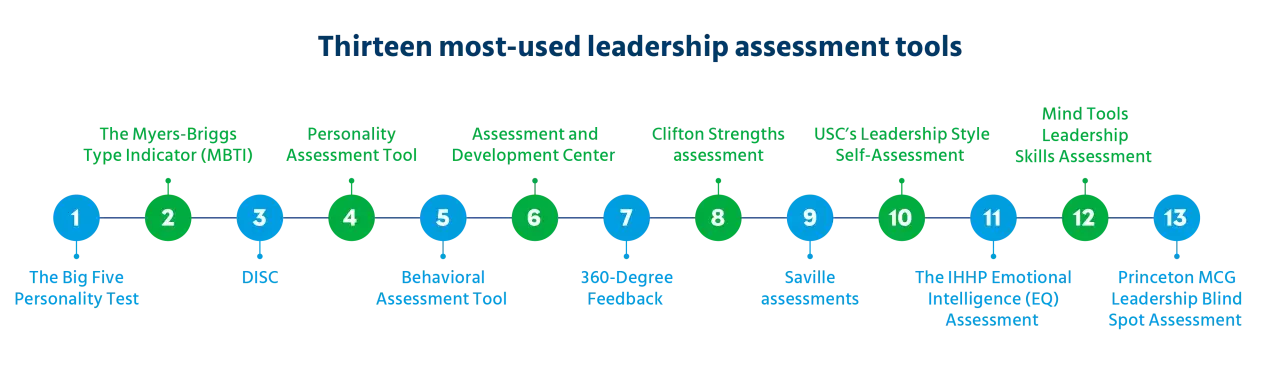
A leadership assessment works only when it changes a decision: who should be promoted, where a manager needs coaching, or which capability gap is most urgent. The useful methods do not just label someone as “good” or “not ready”; they show how a person influences others, handles pressure, makes judgement calls, and learns from feedback. In this article I break down the tools that actually help, the situations they fit best, and the mistakes that turn an assessment into a box-ticking exercise.
The main things to know first
- The strongest programmes combine more than one method, rather than relying on a single score.
- 360-degree feedback is best for behaviour and reputation; it is not a full measure of future potential.
- Psychometric tests are useful for reasoning, judgement, and personality patterns that affect leadership style.
- Assessment centres and simulations are the best way to see how someone behaves under realistic pressure.
- Coaching matters because insight alone rarely changes behaviour without follow-through.
- If the result will shape hiring or promotion, the process needs clear criteria, good raters, and clean documentation.
What a leadership assessment actually measures
When I look at leadership capability, I separate three things that people often blur together: current performance, leadership potential, and leadership style. Current performance tells you how someone is doing in the role they already hold. Potential tells you whether they can handle more complexity, bigger stakes, and broader influence. Style tells you how they lead when they are under pressure, challenged, or stretched.
The best tools look beyond charisma. They try to measure practical behaviours such as decision-making, communication, accountability, resilience, strategic thinking, coaching of others, and the ability to build trust. That matters because a person can be technically strong and still create friction in a team, or be well liked and still avoid hard decisions. A good review should expose that difference.
In the UK, this distinction is especially important in organisations that promote strong individual contributors into management too quickly. The person may already know the job, but leadership adds a different layer: influencing across the business, handling conflict, and making judgement calls when there is no perfect answer. That is why I always ask one question first: is this a development conversation, a promotion decision, or a succession-planning exercise? The answer shapes the whole process, which is where the tools come in.

The tools that matter most in practice
There is no single perfect method. In real organisations, the strongest results usually come from a combination of tools that balance self-view, outside view, and observed behaviour. I also prefer methods that are easy to explain to the person being assessed; if the process is opaque, trust drops fast.
| Tool | What it shows | Best used for | Main limit |
|---|---|---|---|
| Self-assessment | How the person sees their own strengths, habits, and gaps | Coaching and reflection | It can be optimistic, defensive, or simply incomplete |
| 360-degree feedback | How peers, managers, direct reports, and sometimes clients experience the leader | Development, promotion readiness, and stakeholder impact | It depends heavily on rater quality and honest participation |
| Psychometric tests | Reasoning style, personality patterns, judgement, and risk tendencies | Hiring, succession planning, and role fit | It does not show how someone behaves in a live team setting |
| Structured interview | Past behaviour, examples, and decision logic | Selection and calibration | Only works well when interviewers are disciplined and trained |
| Assessment centre or simulation | Observed behaviour in role plays, case studies, group tasks, and presentations | High-stakes promotion and executive selection | More time-consuming and costly than lighter tools |
| Coach-led debrief | What the results mean in context and what to do next | Turning insight into action | It is not a measurement tool on its own |
For multi-rater feedback, I like a small but balanced panel. In practice, many programmes use roughly 5 to 12 raters in total, with at least 3 responses in each relevant group if confidentiality allows. Fewer than that, and the pattern can become too noisy to trust. That is also why the feedback report should be treated as a pattern of evidence, not as a verdict.
The most useful assessment designs are not the most complicated ones. They are the ones that fit the decision and produce usable data, which is exactly what the next step is about.
How I would match the tool to the decision
Different decisions need different levels of evidence. A manager who wants to help a newly promoted team leader does not need the same process as a board-level succession review. I would never force the same instrument into every situation just because it is available.
For hiring or promotion
If the stakes are high, I would use a structured interview, a psychometric battery, and a simulation or case exercise. That mix is useful because it shows both what the candidate says about themselves and what they actually do when the pressure rises. For senior roles, the simulation matters most: a written case, a stakeholder meeting, or a difficult prioritisation exercise can reveal more than a polished interview answer.
For development and coaching
Here I would lean on multi-rater feedback, a self-assessment, and a coach-led debrief. This combination is strong because it surfaces blind spots without making the process feel like a pass-fail test. It also gives the coach something concrete to work with. If the person is struggling with delegation, for example, the conversation can move from vague frustration to a specific pattern: too much control, too little clarity, or an unwillingness to let others own decisions.Read Also: UK Female Leadership Programs - What Really Works?
For succession planning
This is where I want the broadest view. A psychometric profile helps with potential, an assessment centre shows behaviour in context, and a structured interview helps test judgement and motivation. I also want evidence of track record, because future leadership is not just about ability; it is about consistency over time. If someone can perform only when conditions are easy, that is not enough.
One practical rule applies across all three scenarios: choose the lightest tool that still gives you reliable evidence. That keeps the process credible without wasting time, and it leads naturally into the harder question of how to read the results.
How to read the results without drawing the wrong conclusion
I see people overreact to assessment reports all the time. They fixate on one low score, or they assume a high score means the person is ready for anything. Both reactions are lazy. A good read looks for patterns across sources, not isolated numbers.The first thing I check is alignment. If the leader rates themselves highly on clarity, but direct reports consistently say the message is unclear, that is probably a real blind spot. If peers rate collaboration well but the manager rates strategic follow-through badly, the issue may be that the person is helpful day to day but weak on longer-term ownership. Those are different problems, and they need different interventions.
Benchmarks are useful too, but only when the comparison group is relevant. A benchmark is simply a reference point; it is not a truth machine. I care more about whether the behaviour is appropriate for this role, in this culture, at this moment in the business. A fast-growth tech company and a regulated professional-services firm will not always expect the same leadership behaviours to show up in the same way.
There is also a minimum standard for feedback quality. If a category has fewer than three raters, I treat the result as directional rather than definitive. If the report is based on weak participation, the risk of misreading the data rises quickly. That is why a strong debrief always asks for examples, not just adjectives. “You need to be more decisive” is too vague to help. “You delay decisions when you do not have full consensus” is something a coach can work with.
That level of precision is what separates a useful assessment from a pretty document, and it brings us to the failures that make the whole process collapse.
Where these assessments usually go wrong
The biggest mistake is using the wrong tool for the wrong purpose. A 360 report is not a clean promotion test. A personality profile is not a live measure of team behaviour. An assessment centre is not the right answer when the real problem is poor feedback culture. The method has to match the decision.
- Too many competencies make the report hard to act on. I would rather measure fewer things well than produce a long matrix nobody remembers.
- Poor rater selection gives you weak data. People should be chosen because they actually see the person’s work, not because they are convenient.
- Using feedback as a hidden weapon kills trust. If people think the process is a trap, they stop being honest.
- No debrief means no interpretation. Results without conversation often create defensiveness instead of growth.
- No follow-through turns the exercise into theatre. If nothing changes in the next 30, 60, and 90 days, the organisation has learned very little.
- Weak data handling damages credibility. In UK organisations especially, people need to trust that confidentiality and consent are being handled properly.
I would add one more failure that is less obvious: treating the report as a personal verdict rather than a development starting point. Once that happens, people become careful instead of honest, and the feedback stops surfacing the truth. The better approach is more practical, which is what comes next.
What I would do after the report lands
My rule is simple: turn one report into one or two behaviour changes, not ten ambitions. If the person tries to fix everything at once, the effort becomes vague and exhausting. If they focus on one or two visible shifts, the odds of real change go up sharply.
- Pick the two behaviours that matter most for the role.
- Translate each behaviour into something observable, such as “gives clearer decisions” or “delegates with explicit ownership”.
- Agree one concrete action for each behaviour, not a general intention.
- Set checkpoints at 30, 60, and 90 days so the change stays visible.
- Ask one manager, one peer, or one direct report for a short follow-up view after a few months.
If coaching is part of the process, I would start with a short debrief that separates signal from noise, then build a development plan around real work rather than classroom theory. That might mean leading a difficult meeting, presenting a strategy update, or delegating a project that the person would normally hold too tightly. Leadership improves fastest when the feedback is tied to a live situation.
That is the real value of this kind of review: not a label, but a clearer next move. When the method fits the decision and the follow-up is disciplined, the assessment becomes a practical tool for better leadership rather than just another report.
