
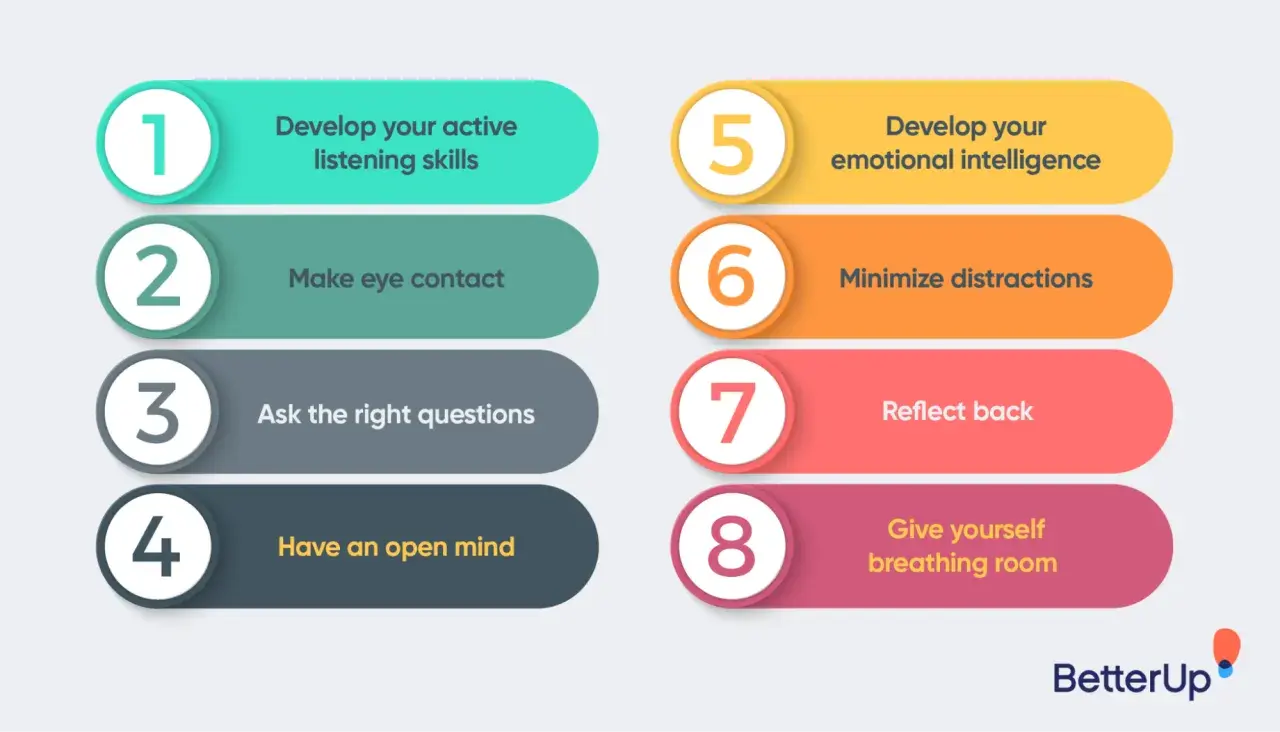
Strong leadership is rarely about speaking more loudly; it is about hearing more accurately. When leaders listen properly, they make better decisions, coach with more precision, and create the kind of trust that keeps people honest instead of merely polite. This article breaks down what effective listening looks like in real management situations, where it fails, and how to turn everyday conversations into better leadership practice.
What effective listening changes in leadership
- Listening improves judgement because it gives leaders more complete information before they decide.
- People speak more honestly when they feel heard, especially in coaching and one-to-one conversations.
- Action matters as much as attention; listening without follow-up quickly loses credibility.
- Good listening is structured, not passive. It uses questions, pauses, reflection, and clear next steps.
- Not every situation calls for deep listening; some moments need fast, decisive leadership.
- In UK workplaces, line managers often shape employee voice more than formal policy does.
Why listening changes leadership outcomes
I treat listening as a decision-making skill, not a courtesy. The best leaders do not listen because they want to appear approachable; they listen because they know that incomplete information leads to weak calls, avoidable friction, and missed risk. In practice, listening improves three things that matter immediately: the quality of the decision, the quality of the relationship, and the quality of the follow-through.
That is especially visible in coaching. A manager who listens well usually spots the real issue faster: not just the deadline problem, but the confidence issue, the conflict underneath the delay, or the workload that has quietly become unmanageable. In UK organisations, where line managers often carry a large share of day-to-day development conversations, that matters more than most people admit. The quieter cost of poor listening is not one bad meeting; it is a team that stops volunteering the truth.
Leaders listen well when they understand that silence is often the price people pay for previous bad reactions. If someone has been dismissed once or twice, they will edit themselves next time. That is why listening has to be visible, consistent, and followed by action. Once that connection is clear, the next question becomes practical: what does strong listening actually look like in the room?

What strong listening looks like in coaching conversations
In a coaching conversation, listening is not the same as being quiet. I want to hear the facts, but I also want to hear the hesitation, the values, and the emotional pressure behind the facts. That means I pay attention to tone, pace, body language, and what the person avoids saying just as much as what they say directly.
| Listening style | What it looks like | Best use | Risk if overused |
|---|---|---|---|
| Passive listening | Nodding, waiting, but not really engaging | Low-stakes updates | People leave unsure whether they were understood |
| Active listening | Questions, paraphrasing, clarifying, summarising | Coaching, feedback, problem-solving | Can feel mechanical if the leader rushes through it |
| Deep listening | Listening for the underlying concern, not just the surface issue | Conflict, resistance, sensitive change conversations | Can slow things down if used where a direct decision is better |
I use a simple sequence when I coach: ask, pause, reflect, clarify, then summarise. The pause matters more than most managers think. People often need a few seconds to move from the first version of their answer to the honest version. If I jump in too early, I get the polished answer, not the useful one. That is why the most skilled listeners sound unhurried without sounding vague.
There is also a difference between listening to content and listening to commitment. A team member may say, “I’m fine with it,” while their tone says they are not. A coach who hears only the words misses the point. A coach who hears the words, the hesitation, and the contradiction is already working on the real issue. From there, the next challenge is avoiding the habits that make people shut down in the first place.
The listening mistakes that quietly damage trust
Most listening problems are not dramatic. They are small, repeatable habits that slowly make people stop talking. I see the same patterns again and again: leaders interrupt to fix, finish sentences to show speed, or move to solutions before the other person has finished explaining the problem. None of that looks disastrous in the moment, but the effect accumulates.
- Listening to reply instead of understand, which turns the conversation into a competition for airtime.
- Giving advice too early, which can make the other person feel handled rather than helped.
- Using empathy language without follow-through, which sounds supportive once and hollow the second time.
- Only listening in calm moments, which means the team never trusts you in the difficult ones.
- Asking questions you do not intend to use, which teaches people that input is decorative.
The biggest hidden cost is politeness. Once a team learns that honest feedback creates friction, it gets very quiet, and quiet teams are dangerous in a different way. They may still perform, but they stop warning you early, stop challenging assumptions, and stop offering ideas that improve the work. That is why listening has to lead somewhere tangible, which brings us to the point most leaders avoid: what you do with the feedback.
Turning employee voice into decisions people believe in
Listening only becomes credible when people can see what happened next. I prefer a four-step rhythm: collect the input, decide what will change, explain what will not change and why, then close the loop. That final step is the one many organisations skip. Without it, people assume the feedback disappeared into a folder somewhere, and the conversation becomes theatre.
- Capture the signal from one-to-ones, team meetings, pulse surveys, and informal conversations.
- Separate patterns from anecdotes; a single opinion may be useful, but repeated comments usually tell you where the system is failing.
- Decide visibly, even if the decision is only to test a change for 30 days.
- Explain the trade-off when you cannot act on a suggestion, so people understand the constraint rather than imagining indifference.
In one leadership study I reviewed, people reported feeling heard about twice as much when a leader listened and then acted, compared with when they shared ideas and nothing happened. That feels right to me. Action does not need to be dramatic, but it does need to be real. Even a small change, a clearer boundary, or a better process can prove that speaking up was worth the effort.
This is where employee voice becomes more than a slogan. In UK workplaces especially, people often decide whether they trust leadership by what happens after the meeting ends, not by what is said during the meeting. Once that is clear, the next task is building a rhythm that keeps listening alive when the pace gets fast and hybrid working makes signals easier to miss.A listening rhythm that works in hybrid and fast-moving teams
In hybrid teams, the loudest voice is not always the most important one; it is often just the most visible one. I like to build listening into the week rather than waiting for a formal reset. That means short one-to-ones, a repeatable opening question, and a deliberate habit of hearing from quieter people before the room settles on a single view.
- Start meetings with one simple question such as, “What am I missing?”
- Rotate who speaks first so the same people do not set the tone every time.
- Reserve the last few minutes of a one-to-one for a direct check on workload, confidence, and obstacles.
- Use brief written input when a topic is sensitive, so people can respond without social pressure.
- Watch for repeated phrases like “it’s fine” or “no problem”; they often hide workload or conflict.
For coaching, I find the best rhythm is not a long, formal session every so often. It is a smaller, consistent pattern: ask one sharp question, listen without rushing, and end with one clear next step. That rhythm is easier to sustain, and in real teams it tends to work better than a grand leadership style that only appears when the calendar allows it. Still, there are moments when listening has to give way to faster judgement, and that boundary matters.
When listening is not enough
Good leadership is not the same as endless openness. There are moments when you listen briefly, decide quickly, and move. If there is a safety issue, a compliance risk, repeated poor performance, or a conflict that is already harming delivery, the leader’s job is not to run a never-ending consultation. It is to gather the necessary facts, make the call, and be clear about it.
That is an important distinction because some managers confuse listening with consensus. They keep opening the conversation long after the decision point has passed, which leaves people frustrated rather than included. I would rather see a leader say, “I have heard the concerns, this is the decision, and here is why,” than pretend every opinion can be adopted. People usually accept a firm decision more easily than a vague process that never resolves.
The real discipline is knowing when to listen for understanding and when to stop listening and lead. Once you can make that judgement cleanly, the habit becomes sustainable rather than performative. The last step is the one I keep if I want the practice to survive a busy week and a difficult calendar.
The listening habit I keep when the pressure rises
If I had to keep only one leadership habit, it would be this: ask one better question, then stay quiet long enough to hear the answer properly. That one change improves coaching, team trust, and decision quality more than most people expect. It also forces me to slow down before I explain, defend, or redirect.
When pressure rises, I keep the habit simple. I summarise what I heard, I name the next step, and I follow up quickly enough that people do not have to wonder whether their input mattered. That is the standard I try to hold: not perfect listening, not theatrical empathy, but disciplined attention followed by clear action. If you build that into the way you lead, the whole conversation changes.
In the end, the strongest leaders do not just hear more words; they hear more accurately, act more fairly, and make it safe for other people to tell the truth earlier. That is what makes listening a leadership strategy rather than a soft skill.
