
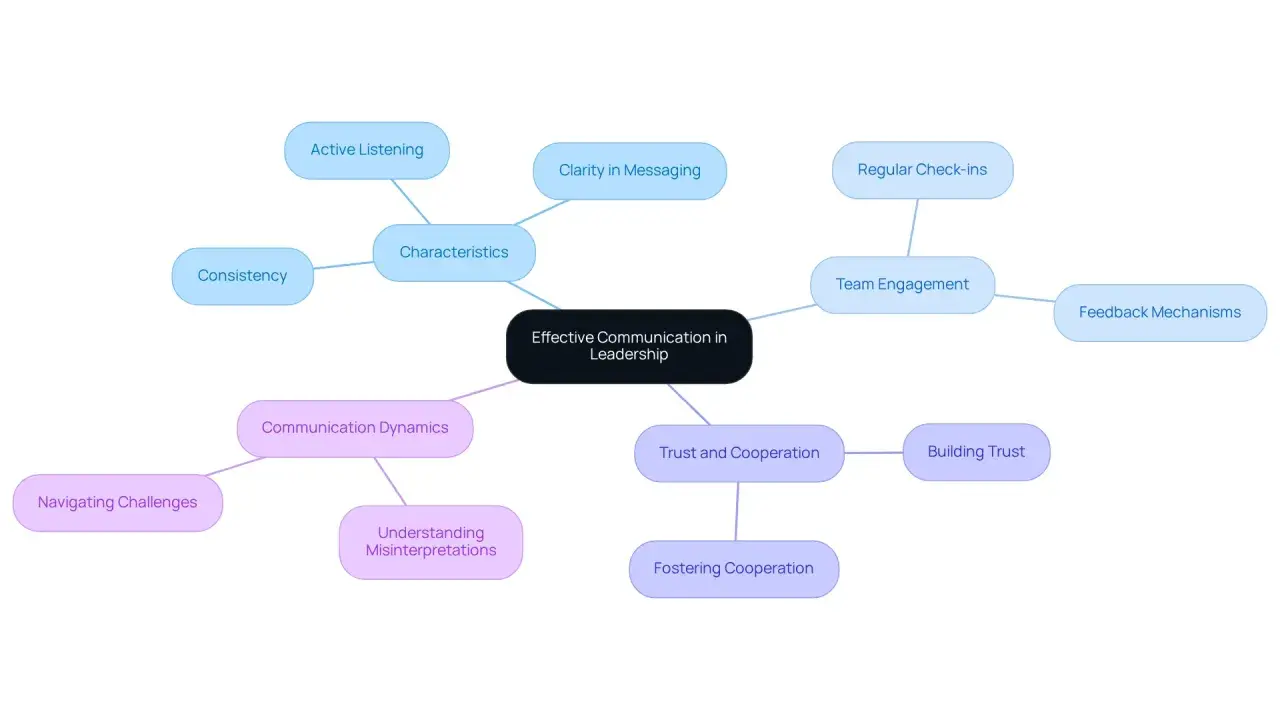
The core habits that make leader messages work
- Clarity first - people need the point, the context, and the expected next step, not just more information.
- Listening changes the quality of the message - leaders who listen well adjust faster and create less friction.
- The channel matters - some messages belong in a one-to-one conversation, others in writing, and some need both.
- Coaching builds ownership - when you use questions well, people think more clearly and solve more for themselves.
- Consistency builds trust - if words, tone, and follow-through do not match, people stop believing the message.
What effective communication from leaders actually looks like
When communication works, people do not just understand the message. They understand why it matters, what changes now, and how their work fits into the bigger picture. That sounds simple, but it is where many managers fall short: they share instructions without enough context, or they share vision without enough direction.
I usually look for four signals. First, the message is clear enough that people can repeat it in their own words. Second, it is specific enough that action is possible. Third, it is consistent with what the leader does next. Fourth, it leaves room for response, because communication in leadership is rarely a one-way broadcast.
In UK organisations, that matters even more because line managers often act as the bridge between strategy and day-to-day execution. CIPD’s employee communication guidance points in the same direction: planning, tailoring, and multi-directional dialogue are what make internal communication useful rather than decorative. That is the standard I would hold most managers to.
Once you see communication as a practical management tool rather than a soft extra, the next question becomes obvious: which skills actually make it work in real conversations?
The skills that make messages land
Good leadership communication is a stack of skills, not one talent. A leader can be confident in public and still be poor at feedback. Another may write well but freeze in conflict. I think the best managers build these capabilities deliberately.
Clarity
Clarity is not the same as simplicity. It means saying the right thing in a way that removes confusion. If a team needs a decision, I would rather hear a direct sentence with one or two necessary details than a long explanation that buries the point. Clarity also means naming the expectation: who does what, by when, and what good looks like.
Active listening
Listening is the skill that keeps communication honest. It reveals what people have heard, what they fear, and what they are not saying yet. Active listening is more than nodding; it means reflecting back, asking follow-up questions, and resisting the urge to fill every pause. Leaders who listen well usually discover that the real issue is not the one that appeared in the first sentence.
Emotional control
People pay close attention to how a leader speaks under pressure. If the tone is sharp, rushed, or defensive, the message becomes harder to trust, even when the content is correct. Emotional control does not mean sounding flat. It means staying steady enough that the other person can think, not just react.Adaptability
Different audiences need different levels of detail. A board update, a team huddle, and a performance conversation do not use the same language. Good leaders adjust the structure, tone, and amount of information without changing the truth of the message. That flexibility is especially important in hybrid teams, where written communication often carries more weight than people realise.
Feedback and follow-through
Feedback is where communication becomes development. It shows people how to improve, not just what happened. Follow-through is even more important: if you ask for action or input and then do nothing with it, trust drops quickly. I treat follow-through as part of the message itself, not an optional extra after the message.
Once these skills are in place, the next decision is tactical: how should the message be delivered so it actually lands?

Choosing the right channel for the message
One of the easiest mistakes managers make is treating every communication like it belongs in the same format. In reality, the channel shapes the meaning. A short email can be efficient, but it is a poor place for nuance. A live conversation builds trust, but it can also blur key details unless you follow up in writing.
| Channel | Best for | Strength | Main risk | My rule of thumb |
|---|---|---|---|---|
| One-to-one conversation | Feedback, development, sensitive issues | Nuance, trust, immediate clarification | Emotion can run ahead of structure | Use this when the message could easily be misread |
| Team meeting | Priorities, changes, shared decisions | Shared context and visible alignment | Quiet people can leave without speaking up | End with a clear recap and next steps |
| Process updates, decisions, summaries | Precision and recordkeeping | Can feel cold or ambiguous | Keep it short and state the action clearly | |
| Chat or instant message | Quick coordination, small clarifications | Speed | Easy to sound abrupt | Use for logistics, not for loaded conversations |
| Town hall or all-hands | Strategy, change, culture, major updates | Scale and visibility | Can become too broad to be useful | Pair it with local manager follow-up |
If I had to give one practical rule, it would be this: the more emotional, ambiguous, or consequential the message is, the more human the channel should be. That does not mean every issue needs a meeting. It does mean that difficult conversations should not be hidden inside a message thread and expected to behave like facts. The channel should fit the job, not the other way around.
This is also where many leaders improve quickly. Once they start matching channel to purpose, their communication becomes less noisy and much easier to act on. That leads naturally to the coaching side of leadership, where the goal is not only to inform but to develop people.
How coaching changes the conversation
Coaching is one of the most effective ways to strengthen a leader’s communication, because it shifts the dynamic from telling to thinking. When I coach a manager, I am not trying to make them speak more. I am trying to make them ask better questions, listen longer, and respond in a way that helps the other person take ownership.
That matters because a lot of management communication is accidental dependency. A leader gives the answer too quickly, the team learns to wait, and no one improves their judgment. Coaching breaks that pattern. It creates space for reflection, and reflection is where better decisions usually begin.
Questions that open up thinking
The best coaching questions are simple and specific. I use questions like: “What outcome are you aiming for?”, “What options have you ruled out, and why?”, “What would success look like by Friday?”, and “What is the real obstacle here?” These questions do two things at once. They surface detail, and they shift responsibility back to the person closest to the work.
When coaching works best
Coaching is strongest when the issue is complex, when a person has room to grow, or when you want commitment rather than compliance. It works well in development conversations, project problem-solving, performance planning, and relationship repair. In those settings, a leader’s job is often to sharpen thinking rather than to hand down a fixed answer.
Read Also: Executive Development UK - What Really Works for Leaders?
When coaching is the wrong tool
There are limits. In a safety issue, a legal risk, a serious conduct concern, or a time-critical crisis, people need direct instruction first. Coaching is not a replacement for decision-making. I would never use open questions to avoid responsibility when clarity is required. The stronger move is to know when to coach and when to be decisive.
That balance is what makes coaching feel credible. People respect a leader who can switch between guidance, challenge, and direction without becoming vague or authoritarian. From there, the biggest threat is not lack of skill, but the everyday habits that quietly erode trust.
The mistakes that quietly weaken trust
Most communication failures are not dramatic. They are small, repetitive, and easy to dismiss in the moment. The problem is that people remember patterns. A single unclear email is forgivable. A habit of unclear emails tells the team that precision is optional.
- Speaking before thinking through the point - this creates rambling messages that sound uncertain and force others to decode the real meaning.
- Using the wrong channel - difficult feedback in chat, complex strategy in a rushed meeting, or vague updates in email all create friction.
- Overexplaining - too much detail can hide the actual decision, especially when people need a clear action now.
- Softening hard feedback until it loses shape - being kind is not the same as being unclear.
- Asking for input and then ignoring it - this is one of the fastest ways to reduce participation in future conversations.
- Changing tone without changing the message - people notice when the words say one thing and the behaviour says another.
The common thread is credibility. Teams will tolerate imperfect delivery, but they do not tolerate inconsistent leadership for long. If you want people to trust the message, they need to see that you mean what you say and that your next action matches your words.
That is why I do not think of communication as a standalone skill. It is a repeatable set of habits that becomes visible in the next decision, the next meeting, and the next follow-up.
What I would prioritise in the next 30 days
If I were coaching a manager who wanted to improve quickly, I would keep the plan narrow. Most people do not need a total reinvention. They need a few habits that make their communication sharper and more reliable.
- Write the point before you speak - one sentence is enough. If you cannot write the point clearly, you probably cannot deliver it clearly yet.
- State the context before the instruction - people act faster when they know why something matters.
- Use one coaching question in every important one-to-one - this keeps the conversation from becoming a monologue.
- Close every live conversation with a recap - I want to hear the decision, the owner, and the deadline before anyone leaves the room.
- Check what people heard - ask them to repeat the next step in their own words; it is a simple way to catch confusion early.
- Follow up once in writing - even a short note can prevent drift after a meeting.
If you apply only these habits consistently, the quality of your communication will change faster than you expect. The point is not to sound more impressive. The point is to make it easier for other people to do good work, make good decisions, and trust your direction when it counts.
