
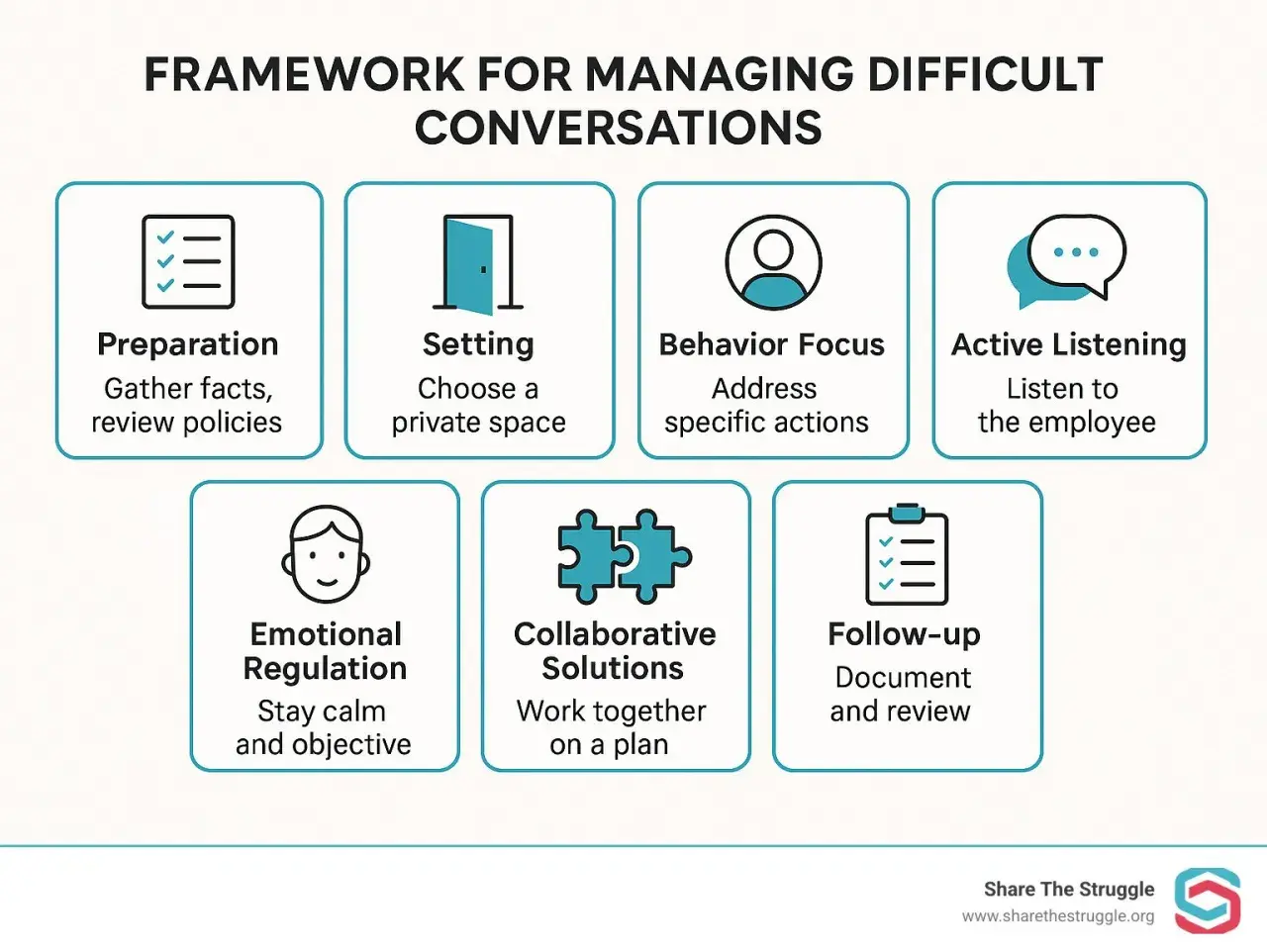
The practical essentials to keep in view
- Decide the outcome before you speak, or the conversation will drift.
- Open with neutral, specific observations instead of labels or assumptions.
- Use facts, examples, and impact rather than vague frustration.
- Make room for emotion, then bring the discussion back to actions and next steps.
- Follow up quickly, especially when tasks, standards, or behaviour need to change.
What makes a workplace conversation difficult
A conversation usually becomes difficult when the subject is sensitive, the stakes feel personal, or the other person may hear the message as criticism of their judgement or character. In my experience, that is why the same issue can feel minor in one context and explosive in another: the facts may be simple, but the meaning attached to them is not.
Common workplace triggers include repeated lateness, missed deadlines, conflict between colleagues, disappointing feedback, pay or promotion conversations, and changes that affect someone’s role or confidence. In UK workplaces, I think the most useful mindset is to deal with issues early and informally where that is appropriate, because small tensions often become harder to unwind once they have been ignored.
The real challenge is rarely the topic itself. It is the mix of uncertainty, emotion, and fear of making things worse. Once you see that clearly, the next step is preparation rather than improvisation.

How I prepare without overthinking it
Preparation matters, but overpreparing can be just as unhelpful as not preparing at all. I usually aim for a short, practical outline: one outcome, two or three facts, and one opening line that sounds calm when spoken out loud.
Define one outcome
Before I start, I ask myself what success looks like in one sentence. For example: “We agree a new deadline and the support needed to meet it,” or “We leave the room with a clearer way of working together.” If I cannot name the outcome, the conversation is probably too vague to be useful.
Separate facts from the story
This is where a lot of conversations go wrong. Facts are observable: a report arrived on Thursday instead of Monday, a comment was made in a meeting, an email chain shows three missed handovers. The story is the interpretation on top of that: lazy, disrespectful, careless, defensive. I try to strip those labels out before I speak, because labels invite arguments and facts invite discussion.
Choose the setting and the first two sentences
A difficult conversation should usually happen in private, with enough time to finish properly. Fifteen minutes is often too short; thirty minutes is a more realistic minimum if the issue has any weight. I also write the first two sentences, because that is usually where nerves show up. A clean opening sounds like this: “I want to talk about what happened on Tuesday and how we move forward,” or “I’d like to discuss a concern I have about the last two deadlines.”
If the issue may become formal later, I keep notes as I go and avoid vague language that could be misread. That small amount of discipline makes the next stage much easier if the conversation does not resolve the matter immediately.
With the groundwork in place, the focus shifts from planning to steering the conversation in real time.
How to steer the conversation without becoming defensive or vague
Once the discussion starts, I prefer a simple structure: state the purpose, describe the issue, explain the impact, and invite the other person to respond. That is often enough to keep the exchange grounded. A useful way to do this is the SBI model - Situation, Behaviour, Impact - which means describing the exact moment, the observable action, and the effect it had.
| Approach | What it sounds like | What usually happens |
|---|---|---|
| Blunt and accusatory | “You always miss deadlines.” | The other person focuses on defending themselves instead of solving the issue. |
| Overly soft | “I’m probably overthinking this, but maybe there’s been a slight issue.” | The message becomes easy to ignore, and the real concern stays buried. |
| Balanced and specific | “The last two reports came in after the agreed date, which affected the team schedule. I want to understand what got in the way and agree a better plan.” | The issue is clear, the tone is steady, and the conversation stays workable. |
I also try to ask one or two open questions early, because a difficult conversation is rarely improved by a monologue. “What’s your view of what happened?” or “What made this harder than expected?” usually opens more useful ground than a long explanation ever will.
The aim is not to win a point. It is to keep the discussion specific enough that a next step is possible. That becomes even more important when emotions start to rise.
What to do when emotions rise
Strong emotion does not mean the conversation has failed. It usually means the subject matters. The mistake is treating emotion as a signal to push harder or talk faster. I slow down instead, and I often name what I can see without making it dramatic: “I can see this is frustrating,” or “I think this is landing badly, so let’s take a moment.”
If the room becomes tense, I use three rules:
- Do not argue over every word when the underlying issue is clear.
- Do not keep speaking just to fill silence.
- Do not continue if the conversation has become personal, aggressive, or unproductive.
A short pause is usually better than a long defensive exchange. Sometimes that means taking two minutes to reset. Sometimes it means rescheduling. The skill is not staying perfectly calm at all times; it is noticing when the exchange has stopped being productive and adjusting before real damage is done.
If someone is upset, I try to separate their reaction from the content of the message. People often hear feedback through the filter of fear or embarrassment, which means the first reaction is not always the final one. That is why the next section matters so much: different situations need different emphasis, even when the underlying communication principles stay the same.
Different workplace situations need different emphasis
The basic structure is similar, but I would not handle every difficult conversation in the same way. A missed deadline, a pay discussion, and a behaviour issue may all need directness, yet each one calls for a slightly different balance between empathy, clarity, and firmness. In the UK, that also means being aware of when an informal conversation is enough and when a more formal route may eventually be needed.
| Situation | Main goal | What to emphasise | What to avoid |
|---|---|---|---|
| Missed deadlines | Restore reliability | Facts, workload, dependencies, a revised plan | Calling it laziness without checking the real cause |
| Repeated behaviour issues | Set a clear standard | Specific examples, impact on others, expected change | Hinting instead of stating the problem plainly |
| Colleague conflict | Protect working relationships | Shared goals, agreed ground rules, future behaviour | Turning it into a blame contest |
| Pay or promotion disappointment | Keep trust intact | Criteria, evidence, current constraints, next milestones | Overpromising outcomes you cannot control |
| Possible formal issue | Create clarity and a record | Accurate notes, policy awareness, consistent language | Being casual with wording or leaving everything undocumented |
In practice, I find it helpful to think in layers. First, can this be handled informally and early? If yes, keep it simple and human. If not, move carefully, document what matters, and align with the organisation’s process so the discussion does not drift into confusion later.
That leads straight to the mistakes that most often undo otherwise good judgment.
The mistakes that quietly make things worse
Most bad difficult conversations do not fail because the topic was impossible. They fail because the opening, tone, or follow-up made the other person shut down. The biggest errors are usually predictable.
- Starting with blame - accusations trigger defence before the actual issue is even understood.
- Rehearsing a speech instead of a conversation - if you are only waiting for your turn to talk, you are not really leading the exchange.
- Using absolute language - words like “always” and “never” are often emotionally satisfying and strategically weak.
- Mixing several issues together - one conversation about one problem is more usable than five complaints in one burst.
- Holding it in public - if privacy and dignity matter, the setting matters too.
- Leaving without a next step - even a hard conversation should end with something concrete.
Another common mistake is confusing intent with impact. Someone may not have meant to create a problem, but that does not erase the effect of what they did. I try to keep both truths in view: intent may shape the tone of the discussion, but impact is what the workplace actually has to deal with.
Once those errors are out of the way, the final piece is making sure the conversation changes something after the room goes quiet again.
How I keep the conversation useful after it ends
The real test of a difficult conversation is not whether it felt smooth. It is whether anything changed afterwards. I usually send a short follow-up within 24 hours if there were actions, deadlines, or agreements. It does not need to be formal prose; it just needs to be clear enough that both people remember the same next step.
Then I set a review point. For many workplace issues, one to two weeks is enough to see whether the agreed change is happening. That timeframe is long enough to show a pattern but short enough to prevent drift. If nothing changes, I do not keep having the same circular talk indefinitely. I move to a clearer escalation path, which may involve a line manager, HR, or a formal process.
That final part matters more than people admit. Some conversations solve the issue. Others simply create clarity, reduce avoidance, and show that the standard has been stated plainly. Even when the outcome is uncomfortable, that still counts as progress.
If I had to reduce the whole approach to one sentence, it would be this: prepare enough to be clear, listen enough to be fair, and follow through enough to be credible. That is the difference between a hard conversation that goes nowhere and one that actually changes how people work together.
