
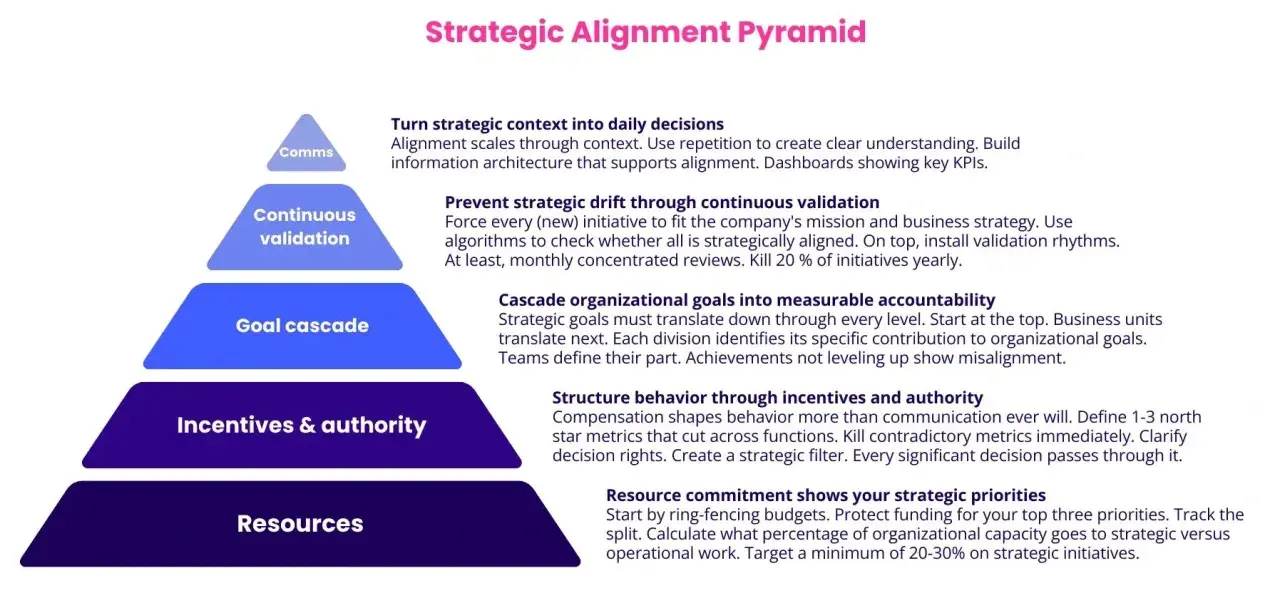
Strong leadership alignment is less about everyone agreeing on everything and more about making sure priorities, decisions, and behaviour point in the same direction. When that is missing, strategy becomes noisy: the message changes from one leader to the next, work gets duplicated, and teams spend too much time guessing what matters most. This article breaks down what real alignment looks like, where it breaks, and how coaching helps senior teams stay consistent without becoming rigid.
Key points at a glance
- Alignment at the top means shared priorities, shared decision rules, and a shared definition of success.
- Most problems show up as slow decisions, mixed messages, duplicated effort, or quiet resistance.
- A clear operating rhythm usually does more for alignment than another off-site meeting with no follow-through.
- Coaching helps when the issue is not intelligence or intent, but hidden assumptions and competing incentives.
- A small set of execution signals is more useful than a long report nobody reads.
What aligned leadership actually looks like
I separate agreement from alignment. Agreement is verbal: people say yes in the room. Alignment is behavioural: they make the same trade-offs once the meeting is over.
That distinction matters because a leadership group can sound united and still send the organisation in different directions. One leader pushes speed, another protects risk, another keeps changing priorities, and the result is not a strategic debate but operational confusion.
| Agreement | Alignment |
|---|---|
| Leaders nod at the same strategy | They make trade-offs in a similar way |
| Priorities sound familiar | Time, budget, and attention follow those priorities |
| Meetings end positively | People leave knowing who owns what and by when |
| Everyone supports the vision | Behaviour stays consistent when pressure rises |
Once you see that difference, the next question is where teams usually lose the thread.
Why misalignment costs more than most teams admit
When the top team is not aligned, the organisation pays in time, trust, and attention. Decisions take longer because they are reopened. Managers receive conflicting signals. Teams start optimising for local wins instead of the wider goal.
| Cost | What it looks like in practice |
|---|---|
| Slower execution | Projects pause while leaders revisit decisions that were already made |
| Lower trust | Middle managers get two versions of the same priority and stop believing either one fully |
| More rework | Teams build work, then rebuild it after a late change in direction |
| Culture drift | Values are talked about, but not reinforced when trade-offs become uncomfortable |
In UK organisations, this becomes especially visible in hybrid settings, where messages travel through several layers before they reach the front line. A small inconsistency at the top can turn into a wide gap by the time it reaches managers and specialists. The more complex the structure, the more expensive the drift.
Those costs show up early if you know what to watch for.
Signs your top team is drifting apart
I usually look for behaviour, not slogans. A leadership group can have polished values and still be out of sync in the day-to-day decisions that matter.
| Warning sign | What it usually means | What to ask next |
|---|---|---|
| Different leaders describe the same priority differently | The strategy is not yet operational | Can each leader explain the priority in one minute? |
| Decisions keep reopening | Decision rights are unclear | Who actually owns the final call? |
| Departments protect their own metrics first | Incentives are pulling against each other | Are we rewarding local performance over shared outcomes? |
| Managers ask for clarification after every update | The message is not landing consistently | What are we saying in the room that is not surviving beyond it? |
| Conflict stays polite but unresolved | The team is avoiding hard trade-offs | Which issue are we not willing to name directly? |
If three or more of these are happening regularly, the problem is rarely communication alone. It is usually a mix of unclear priorities, weak decision rules, and unfinished disagreement. The fix is structural, not cosmetic, which is why the next step has to be deliberate.

How I would build it step by step
When I work through this with a team, I do not start with a long framework. I start with a few uncomfortable but practical questions, then convert the answers into visible operating rules.
-
Choose the few outcomes that actually matter. Keep the list tight. Three to five priorities is usually enough. If everything is important, nothing is. I often ask each leader to write the top three outcomes on their own before we compare notes. The gaps appear fast.
-
Define who decides what. This is where decision rights matter. If a decision belongs to the finance lead, say so. If it needs consultation from operations and sales, say that too. A simple RACI model can help here: Responsible, Accountable, Consulted, Informed. It is not glamorous, but it removes a surprising amount of noise.
-
Set an operating rhythm. A weekly 15-minute check-in, a monthly review, and a quarterly reset are enough for many teams. The point is not to meet more. The point is to make sure priorities, trade-offs, and risks are reviewed before drift becomes expensive.
-
Translate strategy into personal commitments. Each leader should be able to say what they will start, stop, and continue. That turns an abstract plan into visible behaviour. It also exposes the habits that quietly sabotage the bigger goal.
-
Stress-test the plan against real pressure. Ask what happens if revenue slips by 10%, a key hire leaves, or a major client pushes back. Alignment is only real if the team can stay coherent when conditions change. Otherwise it is just a good meeting.
Once the structure is visible, coaching can make it stick, because the real issue is often not the plan but the behaviour around it.
Where coaching changes the dynamic
Coaching is useful here for one simple reason: it makes hidden assumptions speakable. Senior leaders often do not disagree on the goal; they disagree on what the goal requires, what is negotiable, and what they are personally willing to give up.
| Coaching format | Best for | Limitation |
|---|---|---|
| One-to-one executive coaching | Leadership habits, self-awareness, difficult conversations, and pressure points | It may miss system-level tension if the wider team is not involved |
| Team coaching | Shared language, trust, decision-making, and collective accountability | It needs openness, time, and a willingness to surface tension in the room |
When I coach a leadership team, I pay close attention to a few questions. What are we each protecting? Where do our incentives pull us apart? Which decision are we delaying because nobody wants to own the cost? What does this team need from one another, not from the wider organisation?
Those questions work because they move the conversation from theory to behaviour. They also reveal whether the team needs reassurance, a sharper decision rule, or a more honest conversation about trade-offs. If the answers are vague, the execution will be vague too.To know whether the work is actually helping, you need a small set of measures, not a vague feeling that the room is calmer.
What to measure so the work sticks
I would rather track five useful signals every month than twenty vanity metrics that nobody opens. The point is to notice whether the team is becoming easier to follow, faster to decide, and clearer to work under.
| Signal | What it tells you | Simple cadence |
|---|---|---|
| Decision cycle time | Whether the team is deciding faster or getting stuck | Monthly |
| Priority recall | Whether leaders and managers can name the same top priorities | Monthly pulse check |
| Cross-functional rework | How much work is being redone because of mixed direction | Monthly |
| Escalation count | Whether unresolved issues are building up | Weekly review |
| Follow-through rate | Whether actions from leadership meetings actually happen | Every meeting cycle |
A short pulse survey can work well here. Ask managers to rate clarity of priorities, consistency of decisions, and confidence in escalation paths on a 1 to 5 scale. That gives you a quick read on whether the leadership group is becoming easier to work with or just better at sounding aligned.
What matters next is how you protect that progress when the context changes.
Keeping the centre steady when priorities shift
The strongest teams do not treat alignment as a one-off intervention. They revisit it when the business grows, when a new leader joins, when a restructure changes reporting lines, or when the market forces a rethink. That is the part most organisations skip, and it is usually why drift returns.
- Reset after a new appointment, merger, restructure, or strategic pivot.
- Use 30, 60, and 90-day checkpoints after major change.
- Reconfirm priorities, decision rights, and non-negotiables before the pressure rises again.
- Be explicit about what will not be done this quarter.
My practical rule is simple: if leaders cannot explain the current priorities in plain language, the alignment is already fading. The fix is not more noise. It is a tighter conversation, a clearer set of choices, and a regular rhythm that keeps the whole team pointed in the same direction.
