
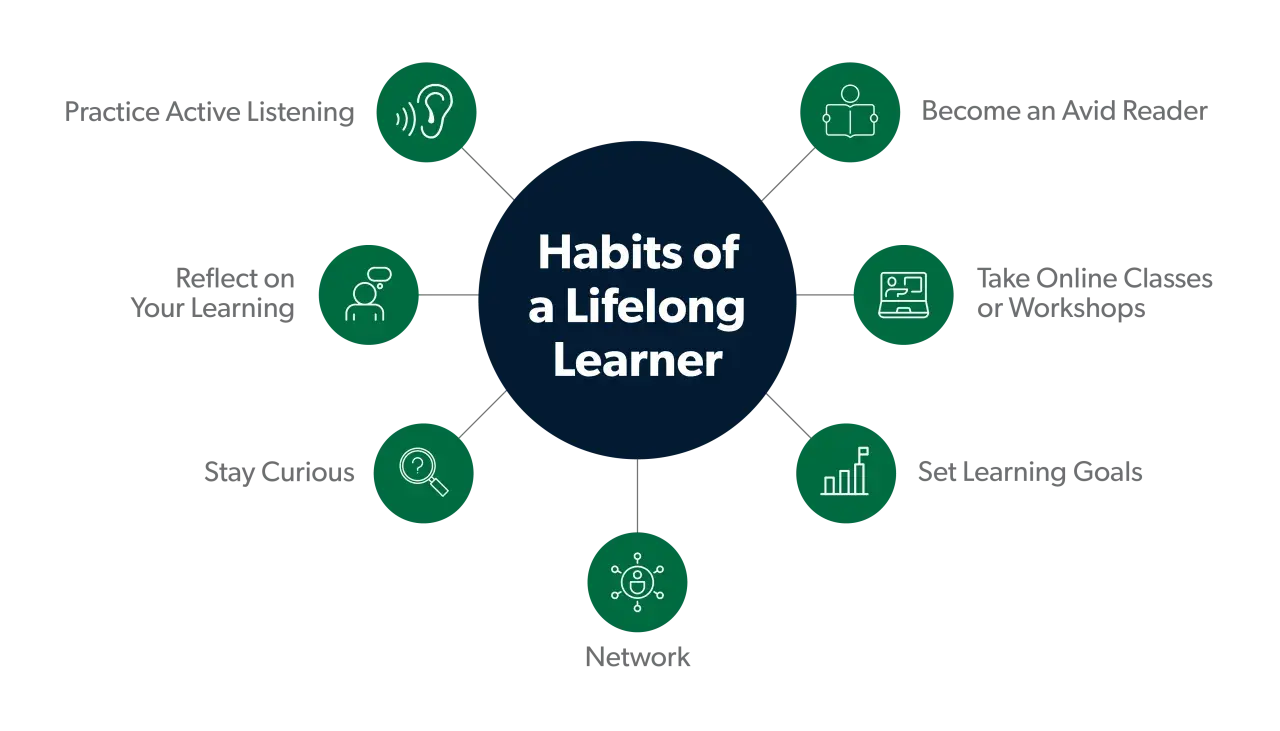
Lifelong education is the disciplined habit of keeping your knowledge and skills current after formal schooling ends. It includes structured training, self-directed study, workplace learning, and the smaller habits that make new knowledge stick. This article explains what it means in practical terms, why it matters in the UK, and how to build a version of it that fits real life.
The essential idea in one minute
- Lifelong education is not just retraining; it is a steady way of staying capable, adaptable, and relevant.
- It usually combines formal, non-formal, and informal learning, depending on your goal and time.
- In the UK, the most practical options are often short courses, CPD, apprenticeships, further education, and self-directed study.
- The habit works best when learning is small, scheduled, and quickly applied to real work or daily life.
- The biggest mistake is usually not lack of talent; it is choosing the wrong format, pace, or target.
What lifelong education actually means
I find it useful to separate the idea from the habit. The idea is that learning does not stop when school or university ends; the habit is the ongoing practice of building knowledge, skills, and judgment across a whole life. UNESCO describes lifelong learning as something that happens across ages, settings, and modes, which is a helpful way to think about it because it includes far more than formal classes.
In practice, lifelong education can mean taking a qualification, but it can also mean improving your digital skills, learning how to lead people better, reading industry material, joining a mentoring relationship, or picking up a new skill because your role changed. I would not reduce it to “going back to school.” That misses the bigger point: people learn everywhere, and the most useful learning is often the kind you can apply quickly.
That distinction matters because it changes how you plan your next step. Once you see learning as a continuous system rather than a one-time event, the real question becomes why it matters so much in working life.
Why it matters for careers, confidence, and adaptability
In the UK, career paths are rarely linear for long. Roles change, tools change, compliance changes, and employers expect people to keep up without starting from zero every few years. Lifelong education helps you stay employable, but it also does something quieter and just as important: it makes transitions less frightening. When you are used to learning, change feels like a process you can manage instead of a threat you have to avoid.
I also think people underestimate the confidence effect. New skills do not only help you do the job; they change how you show up in it. Someone who keeps learning tends to ask better questions, recover faster from setbacks, and see more options when a promotion, career change, or return to work becomes necessary. For leadership roles, that matters even more, because the best leaders are not the ones who already know everything. They are the ones who keep updating their judgement.
There is a practical employer angle too. In many sectors, a current certificate or a visible pattern of continuing professional development, often shortened to CPD, can matter as much as older qualifications. That is why I treat lifelong learning as career maintenance, not optional enrichment. The next step is figuring out which format fits the outcome you actually need.

The main forms of lifelong learning and how to choose between them
| Type | What it looks like | Best for | Main trade-off |
|---|---|---|---|
| Formal learning | Degrees, diplomas, apprenticeships, and accredited certificates | Career switches, regulated roles, and credentials that employers recognise | Usually slower, more structured, and often more expensive |
| Non-formal learning | Short courses, workshops, CPD, coaching, and employer training | Targeted skill gaps and job-specific improvement | May be lighter on formal recognition |
| Informal learning | Books, podcasts, practice projects, peer groups, mentoring, and self-study | Low-cost momentum, curiosity, and steady skill building | Can be unstructured unless you give it a clear purpose |
My rule is simple: choose the least heavy format that can still solve the problem. If you need a recognised qualification, formal learning makes sense. If you need a narrower skill, a short CPD module or workshop is often enough. If you are exploring a topic or trying to stay sharp, informal learning can be surprisingly effective, especially when it is paired with real practice.
The strongest learning plans usually combine all three. A person moving toward management, for example, might read about leadership, take a short course on feedback or delegation, and then practise the skill in weekly team conversations. That mix tends to work better than waiting for one perfect programme. From there, the next challenge is making the habit stick in a normal week.
How to build a learning routine that survives a normal week
I usually recommend treating learning like part of the job, not a side quest. If you wait for free time, it will keep getting postponed. A routine becomes realistic when it is specific, small enough to repeat, and tied to a visible outcome.
Start with one outcome
Pick one result that matters in the next few months. It could be leading better meetings, improving Excel, writing clearer reports, managing your time, or preparing for a promotion. The target should be concrete enough that you can tell when you are getting better. Vague goals like “be more knowledgeable” sound good and produce very little.
Make the weekly unit small
I prefer learning blocks that are easy to protect, such as two 30-minute sessions a week, rather than one heroic evening that never happens. That is not because short sessions are magical; it is because consistency wins. If the habit survives busy periods, it compounds. If it only works when life is calm, it is too fragile to matter.
Read Also: Accounting Cycle Explained: Master 8 Steps & Boost Your Career
Turn learning into output
Passive learning feels productive, but it often disappears quickly. A better approach is to produce something after each session: a short summary, a checklist, a practice email, a revised workflow, or a conversation with a manager. This is where spaced repetition helps. Spaced repetition means revisiting material at increasing intervals so it stays in memory longer, and it works best when you also use the material in real tasks.
Once the rhythm is set, the practical question becomes where people in the UK can learn without overcommitting or overpaying.
Where people in the UK can keep learning without overcommitting
The UK has a broad mix of learning routes, which is useful if you know what you are looking for. For career growth, I would focus first on places that offer a clear outcome, flexible access, and some form of recognition. The format matters less than the fit.
- Further education colleges are often the best fit for practical qualifications, return-to-work routes, and job-related training.
- Universities and distance providers suit people who want deeper study, stronger academic recognition, or a longer-term qualification path.
- Employer training and CPD work well when the skill is directly tied to your current role, especially in regulated or fast-moving sectors.
- Professional bodies are valuable when your field expects evidence of ongoing competence, not just a past degree.
- Libraries, community programmes, and museums are underrated for low-cost learning, confidence-building, and local access.
- Online courses and platforms are the most flexible option, but quality varies, so the content and assessment need to be checked carefully.
Before you pay for anything, I would ask five plain questions: does it solve a real gap, does it fit my schedule, does it lead to something recognised, will I get feedback, and can I use it soon? If the answer is weak on several of those, the course may look better on paper than it performs in practice. Knowing that helps avoid the mistakes that make many learning plans stall early.
The mistakes that make learning look better than it feels
I see the same pattern repeatedly: people are enthusiastic at the start, then the plan becomes too broad, too abstract, or too disconnected from real work. The result is not failure in the dramatic sense. It is slow drift, where the learning never becomes useful enough to continue.
- Choosing trendy topics instead of relevant ones can be exciting, but relevance keeps the habit alive.
- Collecting certificates without application gives the appearance of progress while leaving your actual performance unchanged.
- Relying only on passive input like videos or reading often creates familiarity without skill.
- Trying to learn too many things at once dilutes attention and makes it harder to finish anything.
- Ignoring portability means you may spend time on skills or credentials that do not travel well between roles.
The fix is usually simpler than people expect. Narrow the objective, add one practice step, and review whether the learning changed anything visible in your work. If it did not, adjust the format before you quit the goal. That leads to the final point I would keep in mind before committing to the next course or study plan.
The filters I use before I commit to a new learning path
When I decide whether a learning plan is worth the time, I use three filters: relevance, repetition, and proof. Relevance means the topic solves a real problem in your career or life. Repetition means you can return to it often enough for it to stick. Proof means there is a visible outcome, such as a project, a conversation, a new responsibility, or a recognised credential.
- Relevance keeps the learning tied to a real need instead of a passing interest.
- Repetition makes the knowledge durable instead of fragile.
- Proof turns effort into something you can show, use, or build on.
The point of lifelong education is not to collect endless courses or chase every new topic. It is to build a steady system that keeps you useful, curious, and adaptable as your work and life change. If you keep the learning small, practical, and visibly connected to your goals, it stops feeling like an obligation and starts compounding in the background.
