
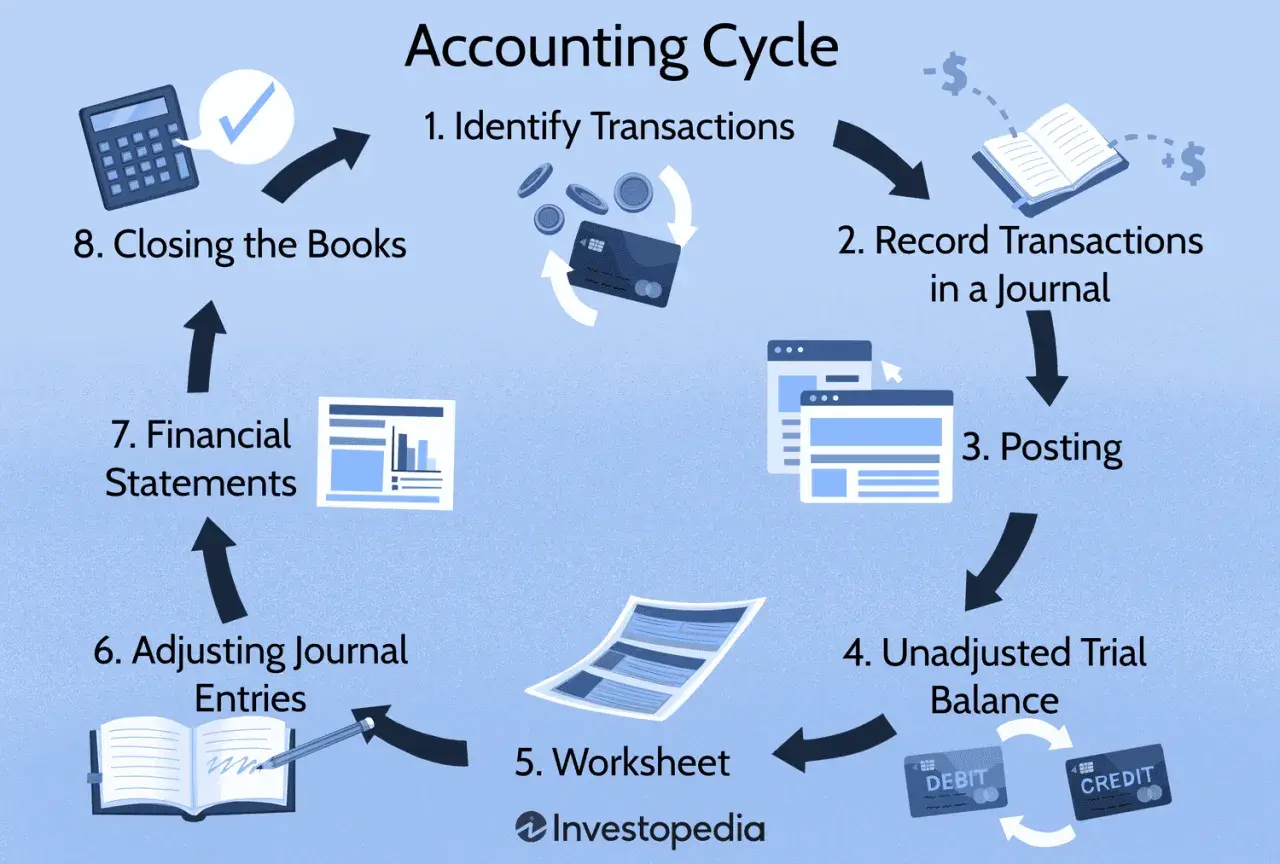
The accounting cycle is the sequence that turns day-to-day transactions into reliable financial reports. I find it easiest to think of it as a control loop: record the evidence, classify it correctly, check the balances, adjust for timing, and then close the period cleanly. For UK learners and early-career finance staff, that sequence matters because it sits underneath bookkeeping, management accounts, and year-end reporting.
The process in one glance
- It begins with source documents such as invoices, receipts, bank statements, and payroll records.
- Transactions are posted through journals and ledgers using double-entry rules.
- A trial balance checks whether debits and credits agree, but it does not catch every mistake.
- Period-end adjustments handle timing issues like accruals, prepayments, depreciation, stock, and bad debts.
- Adjusted figures feed the profit and loss account and the statement of financial position.
- Manual practice still matters even when software automates most of the workflow.

How the accounting cycle works in practice
I teach this as a repeatable sequence rather than a definition. That approach helps learners see why each step exists instead of memorising a list that disappears as soon as the exam ends. In practice, the process is a loop that moves from transaction capture to reporting, then resets for the next period.
- Identify the transaction. A sale, purchase, payment, receipt, payroll run, or asset purchase starts the process.
- Record the entry. The transaction is entered in a journal or captured directly in software using double-entry rules.
- Post to the ledgers. The general ledger and any subsidiary ledgers collect the balances by account.
- Prepare an unadjusted trial balance. This shows whether debits and credits agree before period-end work begins.
- Make adjusting entries. Accruals, prepayments, depreciation, stock movements, and error corrections are posted.
- Build the adjusted trial balance. The revised balances become the bridge to the final reports.
- Produce financial statements. The profit and loss account and statement of financial position are prepared from the adjusted figures.
- Close temporary accounts. Revenue and expense accounts are reset so the next period starts cleanly.
Software can hide the mechanics, but it cannot replace the logic. Once the sequence is clear, the real skill is tracing every figure back to its source, which is where the next stage begins.
Why source documents and double-entry are the foundation
I usually start learners here because weak evidence creates weak accounts. If the first record is vague, every later step becomes harder to trust. A clean bookkeeping workflow depends on documents that prove what happened and when it happened.
What counts as a source document
- Sales invoices and purchase invoices
- Receipts and petty cash vouchers
- Bank statements and remittance advices
- Payroll reports and credit notes
- Stock counts and asset purchase records
Those records do more than support the numbers. They also tell you which account to use, which date matters, and whether something belongs in the current period or the next one.
Read Also: 2-Year Cyber Security Degree UK - Is It Right For You?
Why double-entry protects the workflow
Double-entry bookkeeping means every transaction has a debit and a credit. That balance does not prove the entry is perfect, but it does create a useful audit trail. I like that because it makes missing postings, misclassifications, and unsupported balances easier to spot before they become expensive problems.
Control accounts and reconciliations sit in the middle of that system. A control account is a summary account that should agree with the detail in the sales or purchase ledger, while a bank reconciliation checks the cash book against the bank statement. If the trace from document to ledger is weak, the period-end work becomes guesswork rather than control. That audit trail is what the next stage depends on.
Trial balances and adjustments are where accuracy is won or lost
A trial balance is a check, not a guarantee. I see beginners treat it like proof that everything is correct, but it only shows that debits and credits match in total. A transaction can still sit in the wrong account, the wrong period, or the wrong subsidiary ledger and still leave the trial balance looking neat.
| Adjustment | Why it matters | Typical learner mistake |
|---|---|---|
| Accruals | Recognise income or expense in the period it belongs to | Waiting for cash to move before recording anything |
| Prepayments | Spread a cost across the periods that benefit from it | Charging the full invoice to one month |
| Depreciation | Allocate the cost of a non-current asset over its useful life | Expensing the whole purchase on day one |
| Inventory | Match cost of sales to the stock actually used or sold | Forgetting that closing stock is still an asset |
| Bad debt allowance | Reflect the chance that some receivables will not be collected | Assuming every customer will pay in full |
ACCA’s guidance on period-end adjustments makes the key point clearly: changes here affect both performance and position, not just one side of the report. That is why a good adjustment is not a cosmetic edit. It changes the story the accounts tell.
Bank reconciliation is related but slightly different. It checks whether the cash book and the bank statement agree after timing differences, bank charges, direct debits, interest, or missing postings are considered. If the figures still do not reconcile, a suspense account may temporarily hold the difference, but I treat that as a warning light rather than a fix. Once the numbers are adjusted properly, the final reports become much easier to trust.
From adjusted numbers to year-end reports
At this stage, the adjusted trial balance becomes the bridge to the final accounts. For a UK learner, that usually means the profit and loss account and the statement of financial position, with the exact labels varying a little by entity type and reporting framework. The logic, though, stays the same.
- Revenue and expense accounts are closed because they belong to the period that has just ended.
- Balance sheet accounts stay open because they continue into the next period.
- Temporary accounts are reset so the next month or year starts cleanly.
- The post-closing trial balance should contain only permanent accounts.
That distinction is one of the fastest ways to tell whether someone really understands the workflow. Sole traders, partnerships, and limited companies may use different labels for equity, but the structure underneath is the same: temporary accounts reset, permanent accounts carry forward, and the new period begins with a clean ledger. That is where training starts to feel less theoretical and more like actual work.
How to learn the process faster in training
If I were learning this from scratch, I would do one complete manual pass before relying on software. The reason is simple: software speeds up the work, but it also hides the path between the source document and the final report. If you know the logic first, the screen makes sense. If you start with the screen, the logic often stays blurry.
| Learning route | Best for | Main trade-off |
|---|---|---|
| Manual journals and ledgers | Understanding the logic from first principles | Slower, but it forces you to think through each posting |
| Spreadsheet workbook | Practising adjustments and trial balances | Formulas can hide posting errors if you stop checking the source |
| Cloud accounting software | Job-ready workflow and faster processing | Automation can mask missing knowledge if you never work manually |
| Classroom or exam prep | Structured progression and feedback | Less exposure to messy real-world data unless you add it yourself |
AAT Level 2 is a sensible foundation because it builds double-entry, journals, reconciliations, and trial balances. AAT Level 3 goes further into period-end adjustments, depreciation, and financial statements, which is where the process starts to feel complete. ACCA’s foundational materials also assume computerised systems, which is a useful reminder that employers want more than button-clicking; they want understanding.
I usually recommend a simple training loop: journal a few transactions by hand, post them to ledgers, build a trial balance, make the adjustments, and then repeat the same exercise in software. That repetition reveals where you are guessing and where you actually understand the logic. The biggest mistakes show up very quickly once you do that.
Common mistakes that slow learners and junior bookkeepers down
The mistakes I see most often are rarely dramatic. They are usually small misunderstandings that compound over time.
- Treating a balanced trial balance as proof of accuracy. It only proves the totals agree.
- Confusing cash movement with revenue recognition. That leads to timing errors and distorted profit.
- Forgetting that adjustments affect both profit and position. One entry usually changes two reports.
- Leaving bank reconciliations until the end of the month. Differences become harder to investigate when they pile up.
- Ignoring suspense balances. A suspense account is temporary, not a home for unresolved problems.
- Learning software shortcuts before learning account logic. Speed without understanding creates repeated errors.
HMRC expects business records to be accurate, complete, and readable, so weak bookkeeping is not just a training issue; it can become a compliance issue too. For limited companies, records generally need to be kept for six years, which is another reason to keep the ledger tidy from the start. If records are messy, the year-end process turns into repair work instead of reporting. The final question, then, is not whether you can recite the sequence, but whether you can apply it under work pressure.
What makes this process job-ready in a UK finance role
A job-ready bookkeeper can explain where a figure came from, why it sits in that period, and what evidence supports it. I value that more than memorised jargon because real finance work is built on traceability, consistency, and calm error handling. Those three habits make you useful very quickly.
- Traceability means you can move from source document to ledger to report without losing the thread.
- Consistency means your coding, filing, and naming conventions stay stable from one period to the next.
- Calm error handling means you know when to investigate, when to reconcile, and when to escalate.
Once you can do that, bookkeeping stops being a school exercise and becomes a practical business skill. That is what employers notice, and it is what turns a routine accounting workflow into a foundation for better decisions, cleaner reporting, and steadier career progress.
