
The UK path is usually clinical coding first, billing second
- Clinical coding is the main UK profession here; it means classifying diagnoses and procedures, not software development.
- Billing matters more in private healthcare and medical administration than in the NHS model.
- The only nationally recognised qualification for NHS clinical coders is the NCCQ, which leads to ACC status.
- Formal NHS training is usually employer-led and can take 21-24 days of standards teaching, plus years of supervised development.
- Short online courses are useful for foundations, but they are usually CPD certificates, not a final professional credential.
What the phrase really means in the UK
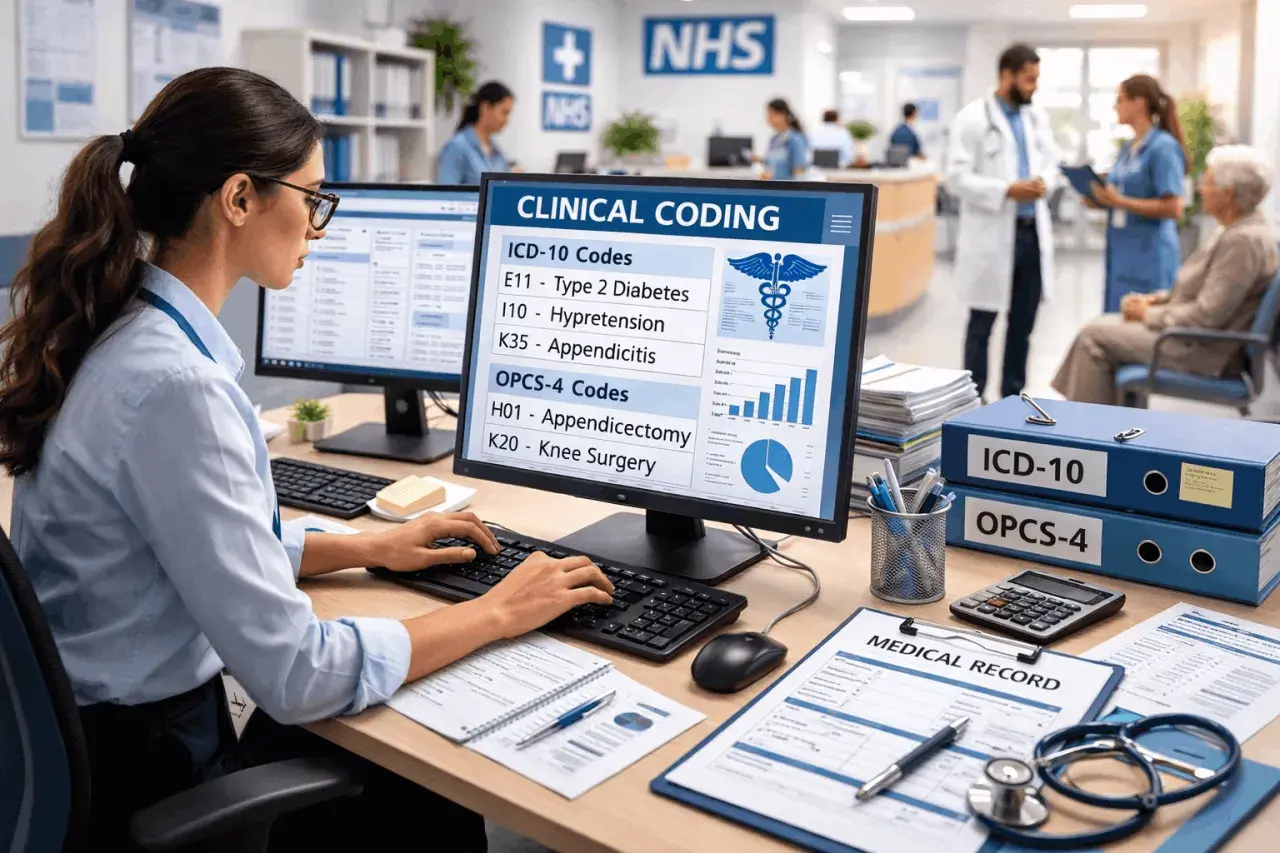
When I look at this search, I do not read it as one fixed course title. In the UK, coding usually means clinical coding: translating diagnoses, operations, and other clinical information into standard codes such as ICD-10 and OPCS-4. That work supports data quality, audit, and funding decisions inside the NHS. Billing, by contrast, usually points to private healthcare administration, invoicing, claims handling, or patient finance support.That difference matters because many people arrive expecting a US-style all-in-one billing programme. In practice, the UK market is split. If you want an NHS coder role, the relevant pathway is clinical coding. If you want private-sector work, billing, medical administration, and claims processes become more relevant. I would treat that distinction as the first filter before paying for any course.
Once you separate the terms, choosing a route gets much easier, because the training options split very cleanly.
The training routes that actually matter
I would group the available options into three realistic paths. Each one serves a different goal, and the wrong one can waste both money and time.
| Route | Best for | Typical time | Recognition | My take |
|---|---|---|---|---|
| NHS employer-led clinical coding | People aiming for NHS or trust-based coder roles | About 21-24 days of standards training, then 2-3 years of development | National coding standards, NCCQ, ACC pathway | Best route if you want a real NHS career |
| Commercial CPD intro course | Career changers, beginners, or people testing interest | A few weeks to a few months | Usually CPD certificate only | Good for foundations, not enough on its own for most NHS roles |
| Private healthcare billing or admin course | Private clinics, medical offices, patient finance, claims support | A few weeks to a few months | Varies by provider and employer | Useful if your target is administration rather than NHS coding |
The formal NHS route is the one people often underestimate. According to NHS guidance, the Clinical Coding Standards Course must use national standards, and the training can be delivered by the organisation itself, a local consortium, or an approved trainer. In Wales, the national programme is a 24-day course for staff already employed in clinical coding roles. That is not the same thing as a weekend certificate with a polished landing page.
If your goal is just to understand the field before committing, a commercial intro course can still be useful. But I would only use it as a starting point. If your goal is employability in the NHS, you need a pathway that leads toward workplace experience and recognised assessment. The next question is what the course actually has to teach before it is worth paying for.
What a good course should actually teach
A serious programme should do more than define terms. It should help you work with real records, understand standards, and build habits that hold up under audit. If a course stays at the level of vague overviews, I would treat that as a warning sign.
Core coding systems
You should see ICD-10 for diagnoses and OPCS-4 for procedures if the course is aimed at UK clinical coding. A strong course may also introduce SNOMED CT, especially if it is trying to give you a broader picture of health data. These are not just buzzwords; they are the language the sector uses to turn clinical notes into structured data.
Reading real records
Good training teaches you how to read discharge letters, operation notes, endoscopy reports, and other messy documentation. That matters because real coding work is rarely tidy. The challenge is not memorising a code list. The challenge is deciding what the record actually supports and what it does not.
Confidentiality and compliance
You should expect coverage of record handling, confidentiality, and data quality. Clinical coding is tied to reporting, finance, governance, and audit, so sloppy handling of data is not a minor issue. In the NHS, accurate coding affects financial flows as well as performance reporting, which is why compliance is part of the job rather than a side topic.
Workflow and checking
I would also look for case-based exercises, feedback, and some kind of quality-checking process. A useful course shows you how coders review, validate, and correct their work. That is especially important if you are moving toward audit or senior coder roles later.
Read Also: Computer Information Systems Online - UK Guide & Best Courses
Billing-specific content
If the course is genuinely about billing as well, it should cover invoices, claims, reimbursement logic, and the admin side of patient finance. That is more relevant to private providers than to NHS trusts. A course that promises both fields but teaches neither in depth usually looks broader than it really is.
Once the syllabus is clear, time and cost become easier to judge, because the depth of training tells you what you are really buying.
What it costs and how long it takes
The price range is wide, and that is one reason people get confused. On current UK course pages, entry-level online certificates often sit somewhere around £19 to £200, while more advanced diploma-style courses can reach roughly £300 to £400. Some providers advertise heavy discounts, which is why the sticker price alone tells you very little.
The more important split is between short courses and formal workplace training. NHS Wales uses a 24-day standards course for eligible staff. NHS England guidance says the Clinical Coding Standards Course is delivered in no less than 21 days for an acute trust coder and 3 days for a mental health trust coder, with refresher training every three years. The NCCQ route itself is not a quick win; IHRIM says a novice NHS clinical coder generally needs a 2-3 year development plan with their employer before sitting the exam.
Entry requirements are also different. Many commercial beginner courses accept people with no previous healthcare background, as long as they can read English, use a computer, and handle basic numeracy. NHS routes are tighter, because they are usually built around existing employment, supervised learning, and approved standards. That distinction is easy to miss if you only skim the sales page.
Those numbers matter most when you connect them to the jobs the training can realistically unlock.
Jobs, pay, and progression after training
If your goal is employability, I would look beyond the certificate and think about the role you want after it. In the UK, the most relevant entry points are usually clinical coder, trainee coder, health records clerk, medical records assistant, or private healthcare administration roles.
For adjacent admin work, the National Careers Service lists a health records clerk at about £25,000 starter to £31,000 experienced. Current NHS vacancy listings in 2026 show many trainee or standard coder roles sitting roughly in the mid-£20,000s to high-£30,000s, while senior coder, trainer, auditor, and lead posts can move higher depending on trust, banding, and experience. That range is useful, but I would not treat it as a promise. Location, specialism, and whether the role includes audit or training work make a real difference.
Progression is usually straightforward once you have strong standards knowledge and enough case experience. In NHS settings, the next steps often include senior clinical coder, auditor, trainer, specialty lead, or coding manager. In private healthcare, the path may look more like billing coordinator, patient finance administrator, medical secretary, or revenue cycle support. Those are different ladders, and that is exactly why the initial course choice matters.
Some roles are hybrid or remote, but do not assume that flexibility is automatic. Coding work can be remote in some trusts, yet data security, access controls, and local policy still shape how the job is done. The final decision is less about the flashiest course name and more about whether the programme fits the route you are actually targeting.
The simplest way to choose a programme that pays off
If I were choosing today, I would start with one question: Do I want NHS clinical coding, private billing/admin work, or just an entry-level overview? That answer should decide everything else. If you want the NHS route, look for employer-led training, approved standards, and a clear path toward NCCQ. If you want private-sector admin, focus on billing, claims, and healthcare office workflow. If you are still exploring, pick a short CPD course that teaches the vocabulary without pretending to be the final step.
- Check whether the syllabus includes ICD-10, OPCS-4, and real record interpretation.
- Ask whether the certificate is CPD-only or part of a recognised NHS pathway.
- Look for trainer credentials and whether the provider works with current UK standards.
- Be cautious if the course promises immediate job placement or instant NHS accreditation.
- Choose billing-focused content only if private healthcare administration is part of your target role.
If you are comparing courses and providers, my rule is simple: start small, verify the standards, and move toward the route that matches the job you actually want. A short introduction can be a smart first step, but it should lead somewhere concrete, not just hand you a certificate and a vague next move.
