
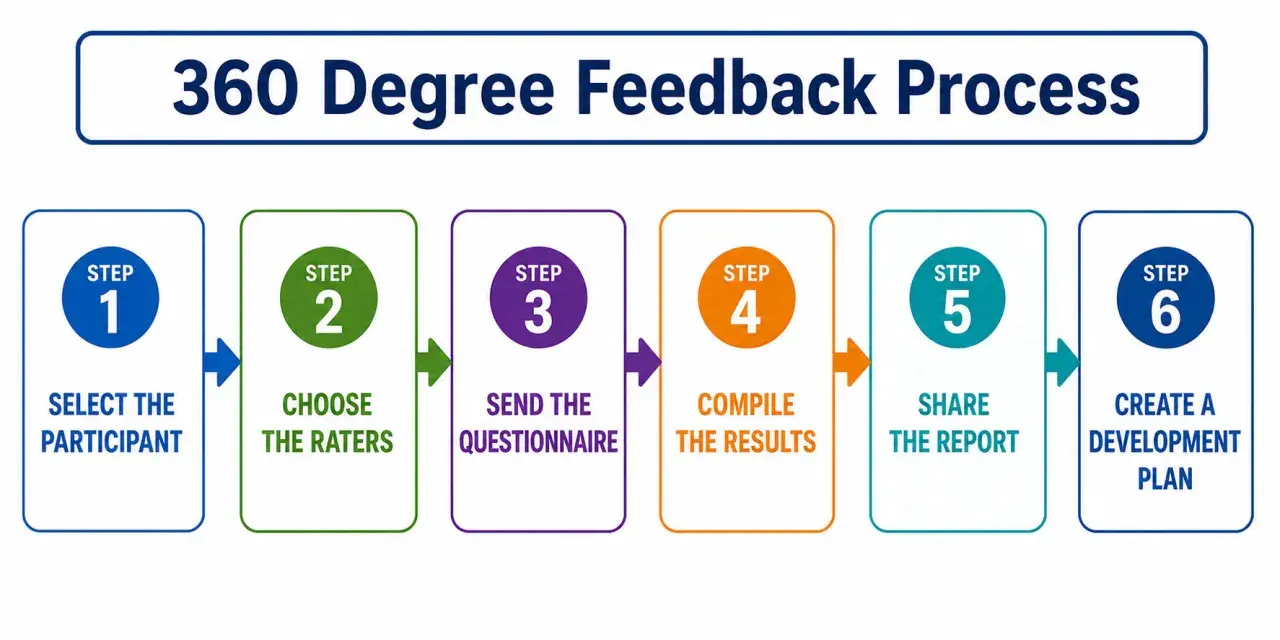
Good management depends on seeing the same behaviour from more than one angle. A 360 feedback process does that by combining manager, peer, direct-report, and sometimes client input, then using it to improve leadership, collaboration, and self-awareness. In practice, it is most useful when you want honest development insight rather than a polished annual scorecard.
Key points to keep in mind
- Multi-source feedback works best when the goal is development, coaching, and leadership growth.
- More raters do not automatically mean better insight; quality, fairness, and follow-up matter more.
- Anonymous comments can improve candour, but poor anonymity design can backfire in small teams.
- Use the results to set a concrete development plan, not to decide pay on the spot.
- In the UK, data handling, confidentiality, and clear communication are part of the design, not an afterthought.
What this method really measures
At its best, this is not a popularity contest. It is a structured way to understand how someone shows up across relationships: with their line manager, with peers, with direct reports, and sometimes with external stakeholders. That wider lens matters because many management issues are invisible from one viewpoint alone.
I usually think of it as a behaviour tool, not a personality tool. It tells you whether people experience a manager as clear, accessible, decisive, reactive, fair, or inconsistent. It does not prove intent, and it does not replace actual performance data, but it does expose patterns that a one-to-one review often misses. That distinction matters, because the next question is not whether the method sounds useful, but where it actually earns its keep.
Where it helps and where it disappoints
CIPD's evidence review suggests that multi-source feedback can feel more credible because it draws on several perspectives, but the gains over time are usually small. That is the important nuance: it can sharpen development, but it is not a magic fix for poor management or a shortcut to objectivity.
| Situation | Good fit | Weak fit | Why it matters |
|---|---|---|---|
| Leadership development | Yes | No | Behaviour change is the goal, so broad feedback is useful. |
| Succession planning | Yes | No | It helps spot whether someone already behaves like a bigger-role leader. |
| Pay or bonus decisions | No | Yes | People start managing the score instead of the behaviour. |
| Very small teams | Only with caution | Often | Anonymous feedback becomes guessable fast. |
| Cross-functional roles | Yes | No | These roles are usually hard to judge from one manager's view alone. |
| New managers with little exposure | Sometimes | Sometimes | You need enough observation for the ratings to mean something. |
If I had to reduce that table to one rule, it would be this: use the method when you want to improve behaviour, not when you want to settle a formal decision quickly. That leads naturally to the design question, because a good process is what makes honest answers more likely.

How to design a process people will answer honestly
The process matters more than the label. I have seen well-run multi-rater reviews create real development momentum, and I have also seen rushed versions produce polite noise. The difference usually comes down to clarity, trust, and a questionnaire that asks about observable behaviour rather than vague traits.
- Define the behaviour you want to measure. I would rather ask about decision-making, communication, follow-through, and delegation than about being "a strong leader" in the abstract.
- Choose raters who have real contact. Pick people who see the work regularly, not just those who happen to be available or politically convenient.
- Keep the survey short. Eight to twelve well-written items is usually enough for a meaningful review, plus two open questions for context.
- Decide on anonymity before launch. If the team is small, say so honestly. Confidentiality is often realistic; full anonymity is not always.
- Use a simple scale with clear anchors. A five-point scale works well if everyone understands what each point means.
- Schedule the debrief before the survey goes out. The report is only the raw material; the conversation is where the change starts.
- Separate development from compensation. Once people think every comment can affect pay, they stop speaking freely.
My practical rule is to keep the first cycle simple enough that people finish it without fatigue, then improve the design after you have seen the response quality. That makes the next problem easier to solve: how to read the results without turning them into a false verdict.
How to read the results without forcing a verdict
Numbers can help, but they can also seduce managers into overconfidence. A review that looks precise is not always precise. I pay more attention to patterns than to the headline average, because patterns tell you whether the issue is broad, localised, or simply a misunderstanding of expectations.
| Pattern | What it may mean | What I would do next |
|---|---|---|
| Low scores from most groups | A repeated behaviour problem | Choose one or two habits and build a 90-day action plan |
| High self-score, lower scores from others | A blind spot or a different standard | Ask for examples and compare expectations directly |
| One group is much harsher than the others | A relationship or workflow issue | Look at that specific context before drawing conclusions |
| Comments are positive but vague | People are being cautious or polite | Use the debrief to press for concrete examples |
| One extreme comment among many average ones | An outlier, not necessarily a trend | Treat it as a clue, not a decision rule |
On a five-point scale, I treat a one-point gap between self-ratings and others as a conversation starter, not a verdict. The point is to understand why the gap exists. That is also why the written comments matter so much, because they usually explain what the numbers cannot.
Common mistakes that quietly ruin the exercise
Most bad feedback systems do not fail loudly. They fail through small design errors that undermine trust and make the whole exercise feel performative.
- Using it for pay decisions - people quickly learn to game the process instead of speaking honestly.
- Asking too many questions - long surveys create fatigue and shallow answers.
- Choosing reviewers with little contact - ratings from distant observers are often weak signals.
- Ignoring the manager's role - if the line manager does not help interpret the report, nothing changes.
- Sharing raw comments without context - isolated remarks can sound harsher than they are.
- Faking anonymity in a small team - once people can guess who said what, candour drops fast.
- Stopping after the report - if there is no action plan, the whole process becomes expensive theatre.
I think the most damaging mistake is the easiest to miss: collecting feedback without any follow-up structure. People will remember that more than the questionnaire itself. That is why UK organisations also need to think about privacy and data handling before they launch the cycle.
What UK managers should keep in mind in 2026
In the UK, the people side and the data side have to work together. If comments can identify an employee, they should be handled as employment records, with limited access and a clear retention period. The ICO treats anonymisation as context-specific, which is exactly why a five-person team needs a different design from a large, dispersed business.
I would be careful about promising absolute anonymity unless the design truly supports it. In many cases, "confidential" is the more accurate word. I would also keep development notes separate from formal appraisal paperwork whenever the purpose is coaching rather than judgement, and I would explain to employees who can see the report, how long it will be kept, and what it will be used for. That level of clarity does more to build trust than any glossy HR language ever will.
There is also a broader management point here. CIPD's recent performance review guidance still treats structured reviews as part of a wider performance cycle, even though annual reviews alone have lost favour. In other words, this method should sit inside a bigger system of goal-setting, coaching, and regular check-ins, not replace them.
The lean version I would run first
If I were setting this up for a leadership cohort in 2026, I would keep the first version deliberately lean: six to eight raters where anonymity is still believable, eight behaviour statements, two open questions, and one debrief with a trained manager or coach within two weeks of the report. I would then translate the results into no more than two development priorities for the next 90 days.
That approach is usually enough to surface the real issue without drowning people in process. The strongest review systems are not the most elaborate ones. They are the ones that make a difficult truth easier to act on, and that is what turns multi-source feedback from an HR ritual into a management tool that actually changes behaviour.
