
Strong management is rarely about having all the answers; it is about knowing whose interests shape the decision, who can slow it down, and who needs to be brought in early. That is why the types of stakeholders and their roles matter so much in practice: once you can separate decision-makers, influencers, users, and people affected by the outcome, communication becomes sharper and conflict becomes easier to manage. In this article, I break down the main stakeholder groups, show how their responsibilities differ, and explain how to prioritise them without turning the process into bureaucracy.
The stakeholder groups that matter most in real management work
- Internal stakeholders usually shape direction from within the organisation, while external stakeholders influence the work from outside.
- Not every stakeholder needs the same level of attention; influence, urgency, and impact should drive your prioritisation.
- Clear roles prevent overlap, conflict, and the classic mistake of consulting the wrong people too late.
- Stakeholder mapping works best when it stays simple: identify, group, rank, communicate, and review.
- In the UK context, customers, employees, suppliers, regulators, and sometimes trade unions or local authorities can all affect delivery.
What a stakeholder really is in management
In management, a stakeholder is anyone who can affect a decision or be affected by it. That includes people inside the organisation and people outside it. I keep the definition broad on purpose, because the real mistake is not confusing the term with a shareholder; it is forgetting the quieter groups that can still shape the outcome.
A shareholder owns equity. A stakeholder may have no ownership at all and still have real influence. That matters in day-to-day management because a customer can walk away, a regulator can halt a launch, and a team member can make or break delivery long before a board meeting does.
Once you accept that wider picture, the next step is to separate the main groups and understand what each one actually expects from the organisation.

The main stakeholder groups and what each one does
I usually find it easier to group stakeholders by where they sit in relation to the organisation and how much power they have over the result. That keeps the conversation practical. It also stops leaders from treating everyone as if they need the same message, the same frequency, or the same level of detail.
| Stakeholder group | Typical role | What they care about | Management focus |
|---|---|---|---|
| Senior leaders and board members | Set direction, approve resources, remove blockers | Risk, return, alignment, reputation | Keep updates concise, strategic, and decision-focused |
| Line managers and project leads | Translate strategy into action | Delivery, capacity, deadlines, coordination | Clarify ownership, dependencies, and escalation routes |
| Employees and delivery teams | Carry out the work and surface operational issues | Workload, clarity, fairness, support, tools | Share context early and listen to constraints |
| Customers and users | Validate whether the work creates value | Quality, service, usability, reliability, price | Gather feedback and test assumptions before launch |
| Suppliers and partners | Provide materials, systems, services, or expertise | Forecasts, payment, scope, continuity | Manage handovers, service levels, and expectations |
| Regulators and public bodies | Set and enforce rules | Compliance, safety, transparency, legality | Build compliance into planning, not as an afterthought |
| Investors, communities, and trade unions | Shape legitimacy, labour relations, and support | Trust, fairness, sustainability, returns | Engage early when decisions have wider impact |
Internal stakeholders
Internal stakeholders are the people inside the organisation who shape how work gets done. In most cases, that means leaders, managers, and employees. Their role is not just to execute decisions; they also influence whether those decisions are realistic. A strategy that looks elegant on paper can fail quickly if the people expected to deliver it were never consulted about time, tools, or capacity.
In my experience, internal stakeholders are often underestimated because they feel familiar. That is a mistake. Familiar people still need clarity, especially when priorities shift, budgets tighten, or a new process changes how work is handed over.
External stakeholders
External stakeholders sit outside the organisation but can still alter the outcome. Customers are the obvious example, but they are not the only ones. Suppliers, regulators, investors, community groups, and sometimes trade unions can all influence whether a decision works in the real world.
In the UK, this wider view matters because many organisations operate in environments where compliance, public trust, and labour relations can affect speed just as much as internal capability. If you ignore external stakeholders until the last minute, you usually pay for it later in delays, rework, or resistance.
Primary and secondary stakeholders
I also like the primary and secondary distinction because it reveals pressure points that the internal-external split can hide. Primary stakeholders are directly affected by the decision or project. Secondary stakeholders are affected indirectly, or can influence the outcome without being the main beneficiaries or victims.
For example, employees affected by a restructuring are primary stakeholders. The local community, a professional body, or the media may be secondary stakeholders. They might not own the decision, but they can shape how it is received and whether it is accepted.
Once the groups are clear, the practical challenge becomes priority: who needs close attention, and who only needs to be kept informed? That is where stakeholder mapping earns its keep.
How to prioritise stakeholders before decisions get messy
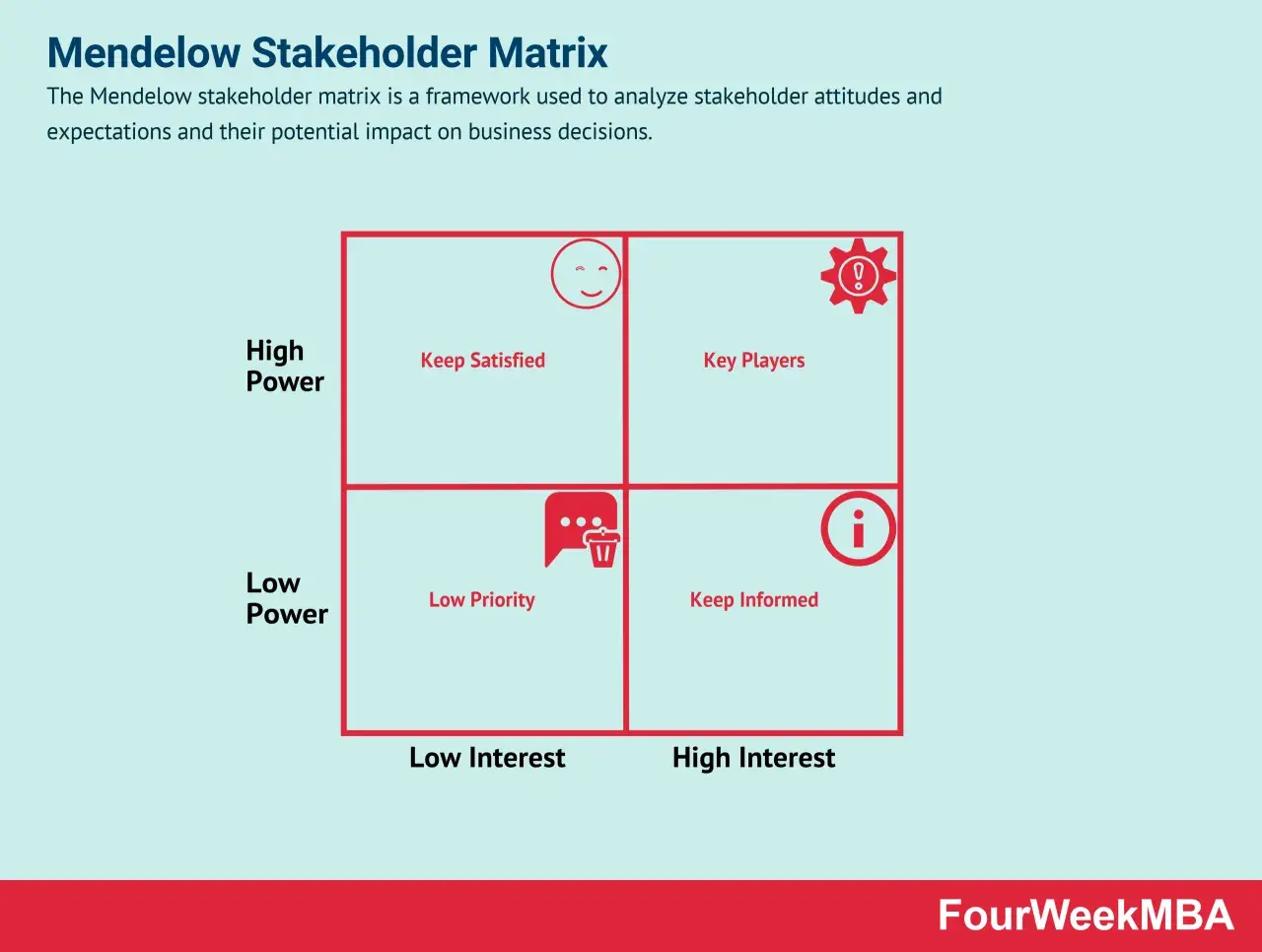
A useful stakeholder map is not a decorative chart. It is a decision tool. The easiest version is the influence-interest matrix, which helps you sort people by how much power they have and how much they care about the issue. That gives you a much cleaner answer than trying to manage everyone the same way.
| Influence | Interest | Best approach |
|---|---|---|
| High | High | Manage closely |
| High | Low | Keep satisfied |
| Low | High | Keep informed |
| Low | Low | Monitor lightly |
The real value of this matrix is not the labels; it is the discipline. A stakeholder with high influence and low visible interest can still derail a plan if they feel surprised. A stakeholder with high interest and low influence may not block the work, but they can provide crucial insight if you listen early.
For a major change programme, I would review the map every two to four weeks. For smaller operational work, monthly is often enough. The point is to treat stakeholder priorities as something alive, not something you file away after the first planning meeting.
That prioritisation sets up the next question: once you know who matters most, how should you actually talk to them?
How to communicate with each group without wasting effort
Communication goes wrong when leaders send the same message to everybody and call it stakeholder engagement. It is faster, yes, but it is rarely effective. Different groups want different things: some want decisions, some want reassurance, and some want evidence that their concerns were heard.
Decision-makers want options and consequences
Senior leaders and sponsors usually do not need a long narrative. They need a clear recommendation, the trade-offs, the risks, and the cost of delay. If you give them too much background, you may lose the decision inside the detail.
Teams want context and timing
Employees and delivery teams need to know why the decision matters, how it changes their work, and when it will take effect. If you skip the timing, people fill the gap with speculation. If you skip the rationale, they often assume the change was imposed without thought.
Customers want clarity and credibility
Customers care about impact: what improves, what changes, what breaks, and what they should expect next. They also notice whether the organisation is honest. If there is a downside, say it plainly. That usually builds more trust than a polished message that avoids the hard part.
Read Also: Become a Manager - Your UK Guide to Promotion & Skills
Regulators and formal bodies want evidence
Regulators, auditors, and other formal bodies want consistency, traceability, and compliance. A vague promise is not enough. They expect evidence that the organisation has thought through the risks and the controls.
When roles overlap, a simple RACI matrix helps. It separates who is Responsible, who is Accountable, who is Consulted, and who is Informed. I use it when confusion is likely, because it reduces the kind of silent friction that eats time later.
With the message tailored to each group, the final challenge is avoiding the habits that make stakeholder management look more organised than it really is.Mistakes that turn stakeholder management into guesswork
The most common error is treating every stakeholder as equally important. That sounds fair, but it is usually a management trap. If everyone gets the same level of attention, nobody gets the right level of attention.
Another mistake is confusing communication with consultation. Sending updates is not the same as asking for input. People notice the difference quickly, and once they do, trust becomes harder to rebuild.
I also see leaders focus only on the obvious supporters and forget the people who are quietly opposed. A negative stakeholder is not always loud. Sometimes they are simply positioned well enough to delay approvals, block access, or shape opinion behind the scenes.
- Do not map only the obvious names at the top of the organisation.
- Do not treat a stakeholder register as a one-time exercise.
- Do not assume silence means agreement.
- Do not confuse urgency with importance.
- Do not leave difficult stakeholders out of the conversation just because the conversation feels awkward.
The pattern is consistent: when stakeholder work feels messy, the problem is usually not the stakeholder itself but the lack of a clear method. A simple map, reviewed regularly, solves more problems than most people expect.
That brings the topic back to the leadership skill underneath it all, because the best managers do not just identify stakeholder groups, they use that insight to make better decisions.
The stakeholder lens that keeps decisions grounded
When I look at the strongest managers, they are rarely the ones who speak to the most people. They are the ones who know which voices matter at which stage of the work. That is the practical value of understanding stakeholder types and responsibilities: it helps you decide where to focus, when to consult, and where to set boundaries.
If you want a quick test before any important decision, ask three questions: who can approve it, who will do the work, and who will carry the downside if it goes wrong? If those three groups are clear, your management becomes much more precise. If they are not, the project is already more fragile than it looks.The best stakeholder strategy is not complicated. Keep the map simple, update it regularly, and communicate with purpose. That is usually enough to turn a vague management challenge into a controlled process with fewer surprises and better results.
