
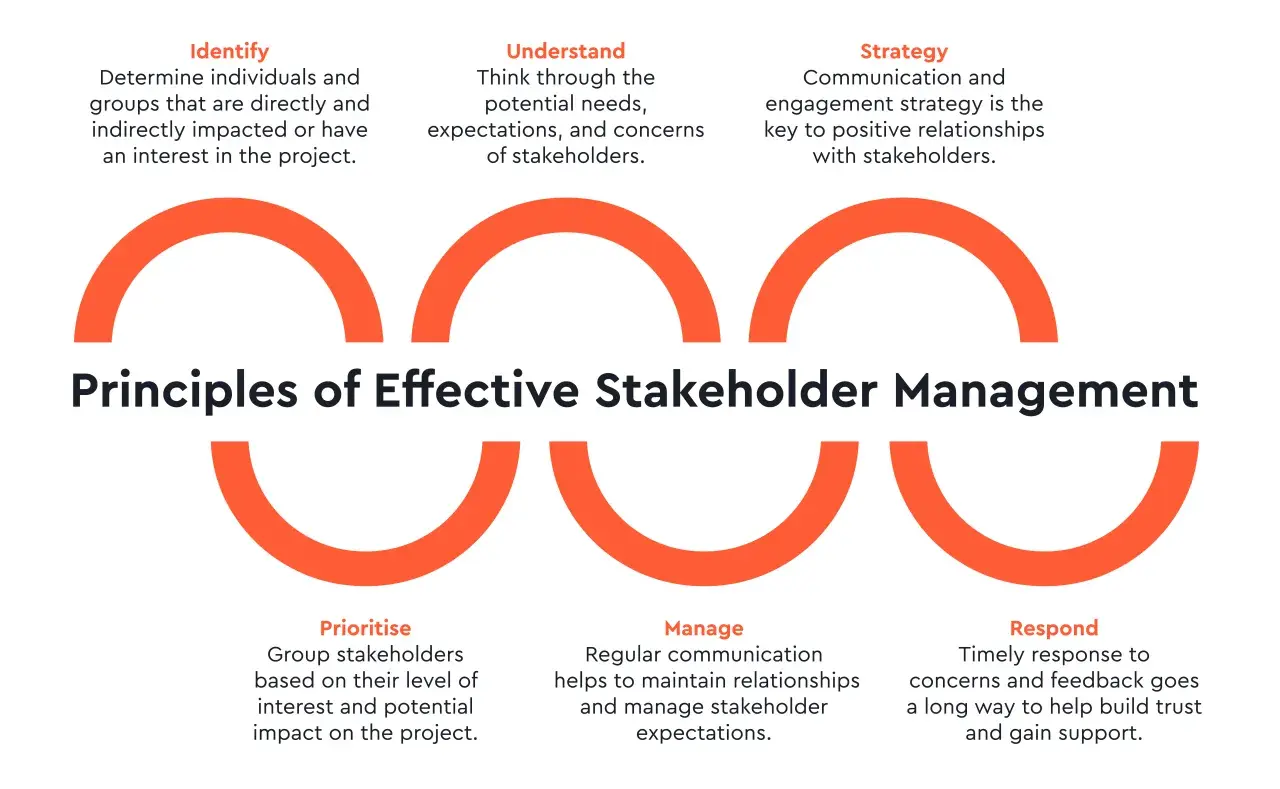
Managing stakeholders is less about persuasion and more about clarity: who matters, what they care about, when they need to hear from you, and how you handle disagreement without slowing the work. In practice, the people who do this well protect trust, reduce surprises, and keep decisions moving. This article breaks the process down into a practical framework you can use on projects, change programmes, or day-to-day leadership work.
The essentials you need to manage stakeholders well
- Start by mapping influence and interest, not just titles.
- Tailor the message, channel, and cadence to each group.
- Make decisions visible early so uncertainty does not turn into resistance.
- Use a simple communication rhythm with a clear owner and a decision log.
- Treat conflict as data: it usually points to a hidden risk, assumption, or trade-off.
The real job is aligning expectations, not collecting approvals
Most people think stakeholder work is about getting sign-off. I see it differently: it is about aligning expectations early enough that sign-off becomes routine instead of dramatic. A sponsor, a team lead, a supplier, and an employee representative can all support the same project for very different reasons, so the first question is never “Who has the biggest title?” It is “Who can help, block, delay, or reshape this work?”
That distinction matters because stakeholder management fails when everyone is treated as one audience. Strong leaders separate influence from interest, formal authority from informal influence, and support from simple politeness. Once that is clear, the next step is to build a map you can actually use.
Map influence before you map communication
A stakeholder map gives you a working picture of who needs attention and how much. The simplest version is still the power-interest grid: high power and high interest people need close engagement, while low power and low interest stakeholders usually need lighter-touch updates. That sounds basic, but it prevents a lot of wasted effort.
| Position on the map | What it usually means | My default response |
|---|---|---|
| High power, high interest | Can shape scope, budget, deadlines, or approval | Engage closely, meet regularly, surface risks early |
| High power, low interest | Can slow or stop decisions but may not want detail | Keep satisfied, brief with concise updates and clear asks |
| Low power, high interest | Lives with the change or feels the impact | Keep informed, invite feedback, explain the “why” |
| Low power, low interest | Limited direct impact | Monitor for changes, avoid unnecessary noise |
I also try to note two things that are easy to miss: hidden influence and emotional temperature. Someone without formal authority may still be the person leaders listen to, and a stakeholder who was calm last month may now be anxious because a deadline moved or a budget was cut. Once you see those patterns, communication stops being generic and becomes strategic. That sets you up to decide what each group should hear, and how often.
Set the right cadence for each group
The biggest communication mistake I see is sending everyone the same update at the same time. It creates noise for some people and leaves others under-informed. A better rule is to match cadence to risk, influence, and decision speed.
| Stakeholder group | What they usually need | Useful cadence | Best channel |
|---|---|---|---|
| Project sponsor | Progress, risks, decisions, escalation points | Weekly or fortnightly on active work | Short meeting or concise written brief |
| Senior leadership | Business impact, budget, milestones, exceptions | Monthly unless a decision is needed sooner | One-page update or executive call |
| Delivery team | Priorities, blockers, dependencies, changes | Daily or weekly depending on pace | Stand-up, shared board, team channel |
| Customers or end users | What is changing and why it matters to them | Milestone-based or when impact changes | Email, workshop, demo, or update session |
| Suppliers, regulators, employee reps | Scope shifts, compliance issues, timing, consequences | As soon as a change could affect them | Formal note plus direct conversation |
I usually recommend three layers of communication: real-time escalation for blockers, regular status updates for rhythm, and milestone briefings for decisions or major changes. That structure works well in UK organisations where projects often involve several departments, compliance pressures, or employee representation. A short, predictable update is usually more effective than a long, irregular one. Once the cadence is set, the quality of the message becomes the differentiator.
Use communication to reduce uncertainty, not create more of it
Good stakeholder communication does four things: it explains progress, exposes risk, states what has changed, and makes the next decision obvious. If a message does not do at least one of those jobs, I would usually shorten it or delete it.
- Lead with the point. Do not bury the risk, decision, or ask in the fourth paragraph.
- Separate facts from interpretation. Stakeholders trust you more when they can see what is confirmed and what is still an assumption.
- Keep one decision log. A simple record of what was agreed, by whom, and when prevents the same argument from resurfacing next week.
- Use the right channel for the tension level. Email works for routine updates; a call or workshop is better when trade-offs are still unresolved.
- Ask for one clear action. People respond better when they know whether you need approval, feedback, or a decision.
There is also a practical rule I use with leadership teams: no surprises in formal meetings. If a sponsor is going to be asked to defend a decision, they should have heard about it before the meeting. The same logic applies to frontline teams and external partners. Surprises do not just annoy people; they make them defensive, and defensive stakeholders are harder to bring with you. Even then, some conversations will still turn into resistance, and that is where many managers lose control.
Handle resistance without turning every disagreement into a battle
Resistance is not always a problem to defeat. Often it is a signal that someone sees a risk you have not explained, a cost you have not acknowledged, or a change that will land on them unevenly. The mistake is to treat every objection as obstruction.
When I need to work through pushback, I usually follow a simple sequence:
- Listen for the real concern, not just the stated objection.
- Restate the issue in plain language so the other person knows they have been understood.
- Separate the non-negotiables from the flexible parts of the plan.
- Offer options with clear trade-offs instead of a vague compromise.
- Document the decision so the same issue does not reappear in a different form.
This approach works because it keeps the conversation practical. If a stakeholder wants more detail, I give it. If they want more control, I clarify what control they actually have. If they want the project to move slower, I ask which risk they believe is not being managed. In many cases, you are not dealing with hostility at all; you are dealing with uncertainty that has not been named clearly enough. That makes the final step easier to see: the habits that quietly damage trust.
The mistakes that quietly damage trust
Most stakeholder problems do not start with one big failure. They start with a series of small ones that build up over time. The common pattern is predictable:
- Everyone gets the same message. That usually means no one gets what they actually need.
- Updates arrive too late. Once people hear bad news from someone else, trust becomes harder to recover.
- People are mapped by title only. Informal influence is often more powerful than the org chart suggests.
- Assumptions are not written down. This is how teams end up arguing about a decision they never fully defined.
- Silence is treated as agreement. In reality, silence can mean confusion, caution, or quiet opposition.
- Too much detail is sent to the wrong audience. Senior stakeholders usually want implications, not a dump of activity.
The fix is rarely more meetings. It is better discipline: clearer owners, shorter updates, earlier escalation, and a visible record of decisions. When those habits are in place, you spend less time chasing people and more time leading the work. The last thing I would add is what that looks like when it is actually working.
What strong stakeholder management looks like in practice
When the system is working, you notice it in small ways before you see it in the final outcome. Meetings are shorter because the real issues were already discussed. Stakeholders raise concerns early instead of waiting until they are frustrated. Decisions move faster because the right people were involved at the right point, not all at once.
- Questions are specific rather than vague.
- Escalations come with context, not just complaints.
- People disagree, but they disagree on facts and trade-offs rather than assumptions.
- Updates are shorter because they are more relevant.
- The same issue does not keep resurfacing under a different label.
