
Successful transformation rarely fails because the idea is weak; it fails because the organisation cannot absorb it fast enough. Managing change and innovation means deciding what to improve, what to retire, how to move people, and how to turn experiments into habits without exhausting the business. In this article, I focus on the practical side: how to align leadership, build adoption, measure progress, and avoid the mistakes that make good plans stall.
The essentials in one view
- Change is about adoption; innovation is about creating useful new value, and both need the same management discipline.
- The biggest failure point is usually not the idea itself, but weak sponsorship, poor communication, and overload.
- A workable approach moves from diagnosis to pilot to rollout, with clear owners at each stage.
- People managers matter more than slide decks because they translate strategy into daily behaviour.
- Measure adoption, behaviour, and business impact together so you can tell the difference between activity and progress.
- In the UK, diffusion and practical uptake matter as much as invention, especially when resources are tight.
Why change and innovation belong in the same conversation
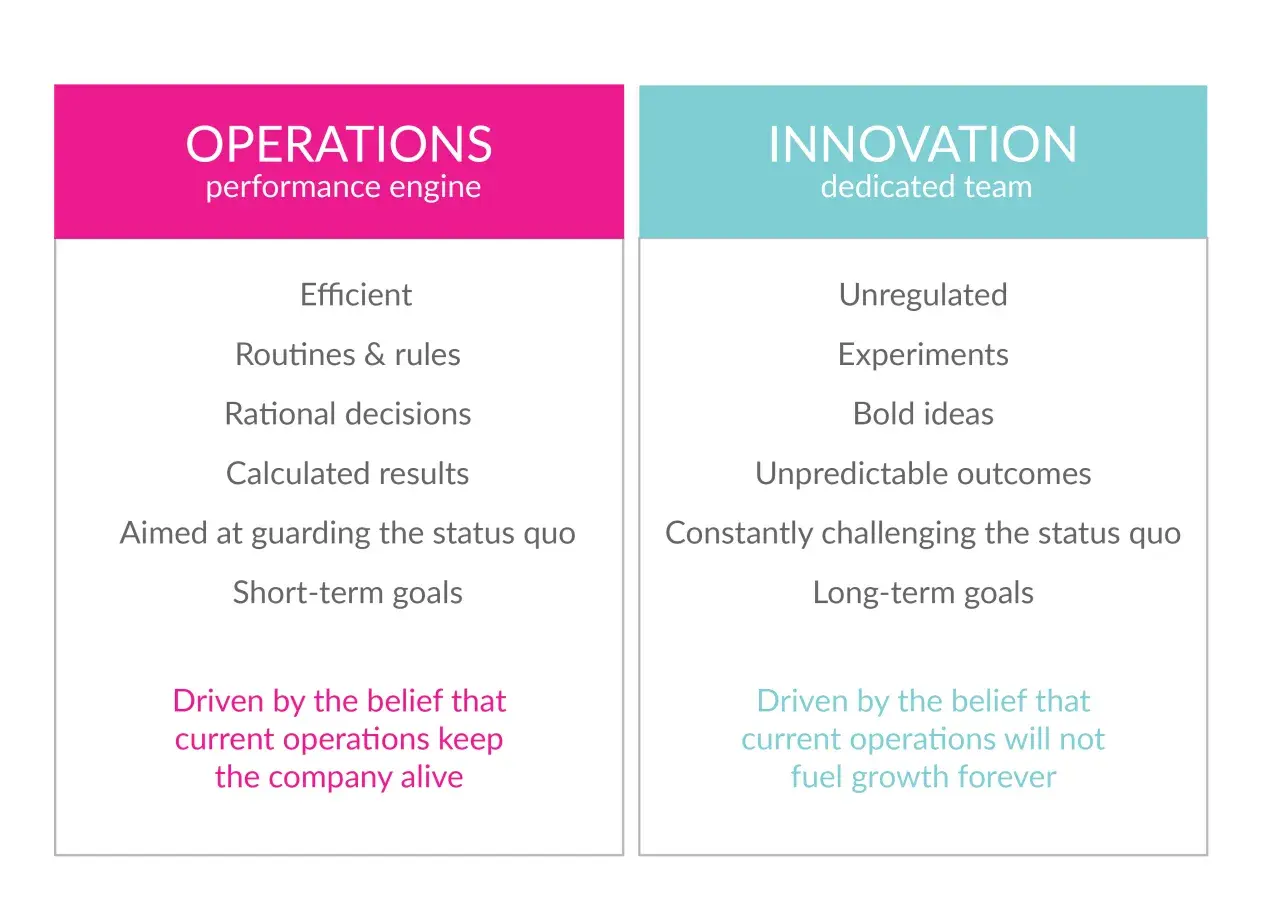
Change is the movement from the current state to a new one. Innovation is the creation of something that did not previously exist in the business: a product, a process, a service, or a better way of working. I separate them in my head, but I never manage them as if they were independent, because a good idea that nobody uses is not innovation in any practical sense.
CIPD notes that organisational change is constant and that many initiatives miss their intended outcomes when the people side is neglected. That is the right lens: the real challenge is not only designing a better future, but making the organisation capable of living in it.
| Element | Change | Innovation | What a manager should do |
|---|---|---|---|
| Purpose | Move the organisation to a better operating state | Create new value or a better way of delivering it | Connect both to a visible business problem |
| Risk | Resistance, confusion, fatigue | Experimentation without adoption | Set guardrails and define success early |
| Time horizon | Often immediate and operational | Can be iterative and exploratory | Use short cycles, then scale what works |
| Success signal | People actually work in the new way | The new idea solves a real problem | Track behaviour, not just launch activity |
Once that distinction is clear, the next question is simpler and harder at the same time: what usually breaks first when organisations try to do both at once?
Where transformation usually breaks down
- Weak sponsorship. Senior leaders approve the initiative, but they do not keep showing up for it. That creates a signal problem: people quickly decide the change is optional.
- Change overload. One programme may be manageable. Five overlapping initiatives create fatigue, and even good ideas start to feel like noise.
- Innovation theatre. Teams run workshops, post sticky notes, and collect ideas, but there is no route to decision, funding, or rollout. People notice that gap immediately.
- The middle-manager gap. Frontline and middle managers are expected to explain the change without being given time, answers, or authority. That is where momentum often leaks away.
The pattern I see most often is this: leaders focus on the destination and underestimate the daily friction of getting there. That friction is not a side issue; it is the work.
When you know where the pressure points are, the more useful task is to build a route that turns ideas into behaviour without pretending the journey is frictionless.

A practical route from idea to adoption
I prefer a simple route because complex change rarely becomes clearer when the process becomes more ceremonial. A pilot is not a demo. It is a test with a decision rule.
- Define the problem in plain language. Before anyone talks about new tools or bold ideas, name the business problem. If the issue is slow approvals, poor customer response, or inconsistent quality, say so directly. People commit faster when they understand the pain point.
- Choose one bounded experiment. Do not try to transform everything at once. Pick one workflow, one team, or one customer journey and test the new approach there first. For a small process change, a two-week pilot may be enough; for a role, policy, or system change, I would usually want 60 to 90 days before scaling.
- Design the rollout before the launch. I would never wait until go-live to think about training, support, approvals, or comms. If the new way of working needs new habits, the rollout plan should show who owns each handoff and what “good” looks like in week 1, week 4, and week 12.
- Measure adoption, not just attendance. A completed workshop does not mean the change landed. Look for actual use: log-ins, new process steps, reduced rework, faster turnaround, or fewer escalations. That is the difference between activity and adoption.
- Scale only when the evidence is strong enough. If the pilot works, expand with discipline. If it does not, adjust the design or stop it. The discipline to stop weak ideas is part of innovation maturity, not a sign of failure.
That route keeps the work honest. It also protects the organisation from the most expensive mistake of all: scaling a half-finished idea because nobody wants to admit the pilot did not prove enough.
How to keep people moving with the change
Most leaders overestimate how much a launch announcement changes behaviour. People need repetition, context, and enough control to feel safe. They also need answers to a short list of questions that are often skipped in the rush to communicate the “big picture”.
- What is changing?
- Why is it happening now?
- What stays the same?
- What support will I get?
- How will success be judged?
The practical part is not just telling people the answers once. It is repeating them in the places where work actually happens: team meetings, manager 1:1s, onboarding, and status reviews. I have rarely seen a transformation fail because of one loud critic; it usually stalls because the quiet middle never gets enough clarity or support.
That is why managers matter so much. They translate strategy into daily behaviour. If they do not understand the change, they will improvise. If they do understand it but feel unsafe or overloaded, they will delay. In both cases, the organisation pays for the gap between intent and execution.
One thing I do not overcomplicate is resistance. I treat it as data. Resistance often tells you that a real concern has not been answered, that the sequence is wrong, or that the team does not trust the timeline. Once you treat resistance as a signal instead of a threat, you can work with it instead of around it.
People move more willingly when they can see a path that is credible, supported, and worth the effort. That brings us to measurement, because without it, confidence is mostly guesswork.
How to know whether the new way is sticking
I like a 30, 60, 90-day review rhythm for most medium-sized changes. It is frequent enough to catch drift, but not so noisy that every problem becomes a crisis. The point is to measure a mix of leading and lagging indicators so you can tell whether the new behaviour is taking hold.
| Metric | What it tells you | Typical review cadence |
|---|---|---|
| Adoption rate | How many people or teams are using the new process or tool | Weekly in pilot, monthly after rollout |
| Cycle time | Whether the new method is faster or cleaner than the old one | Weekly during implementation |
| Rework or error rate | Whether quality is improving or slipping | Monthly |
| Employee confidence | Whether people feel able to use the new way consistently | Monthly pulse checks |
| Customer or service impact | Whether the change is improving the result that matters externally | Monthly or quarterly, depending on volume |
The trap is to celebrate a launch and then stop looking. A useful innovation programme should create clearer work, not just a short burst of enthusiasm. If the numbers improve but the people hate the process, the model is fragile. If people like the process but the business result does not move, the idea is probably not strong enough.
The best metric set is usually small, visible, and repeatable. I would rather track five indicators well than fifteen badly.
What UK organisations should keep front of mind
For UK organisations, the adoption side matters as much as the invention side. GOV.UK’s 7 Lenses of Transformation is useful here because it treats transformation as a combination of organisation, culture, process, and technology rather than a single workstream. That is a more realistic model for complex change, especially when teams are already balancing cost pressure, regulation, and shifting customer expectations.
- In regulated sectors, the change plan must include auditability and approval time. Speed matters, but so does traceability.
- In SMEs, capacity is usually the constraint, not ambition. Keep the first pilot narrow and practical so it does not compete with daily operations.
- In hybrid teams, informal learning is weaker. Repeat the message through more than one channel and make managers part of the communication loop.
- For skills-heavy changes, do not assume people will absorb a new process just because they attended a briefing. Build in coaching, practice, and time to fail safely.
What matters in the UK context is not just whether an idea is smart, but whether it spreads. Diffusion is the real test. A breakthrough that stays in one team is interesting; a capability that moves across the organisation changes performance.
That is why I tend to focus on practical uptake, not just originality. A modest innovation that works consistently is usually more valuable than an elegant one that never leaves the pilot phase.
What I would keep on the desk for the next change cycle
- One sponsor who can make decisions quickly.
- One pilot with a real workflow, not a toy example.
- One page that shows what will change, who owns it, and how success will be measured.
- One weekly communication rhythm for managers and teams.
- One clear point at which the idea is scaled, paused, or stopped.
If I had to reduce the whole discipline to one sentence, it would be this: do not ask people to support a new future before you have made the path visible, safe enough to try, and measurable enough to trust. That is the difference between a programme that looks busy and one that actually changes the organisation.
