
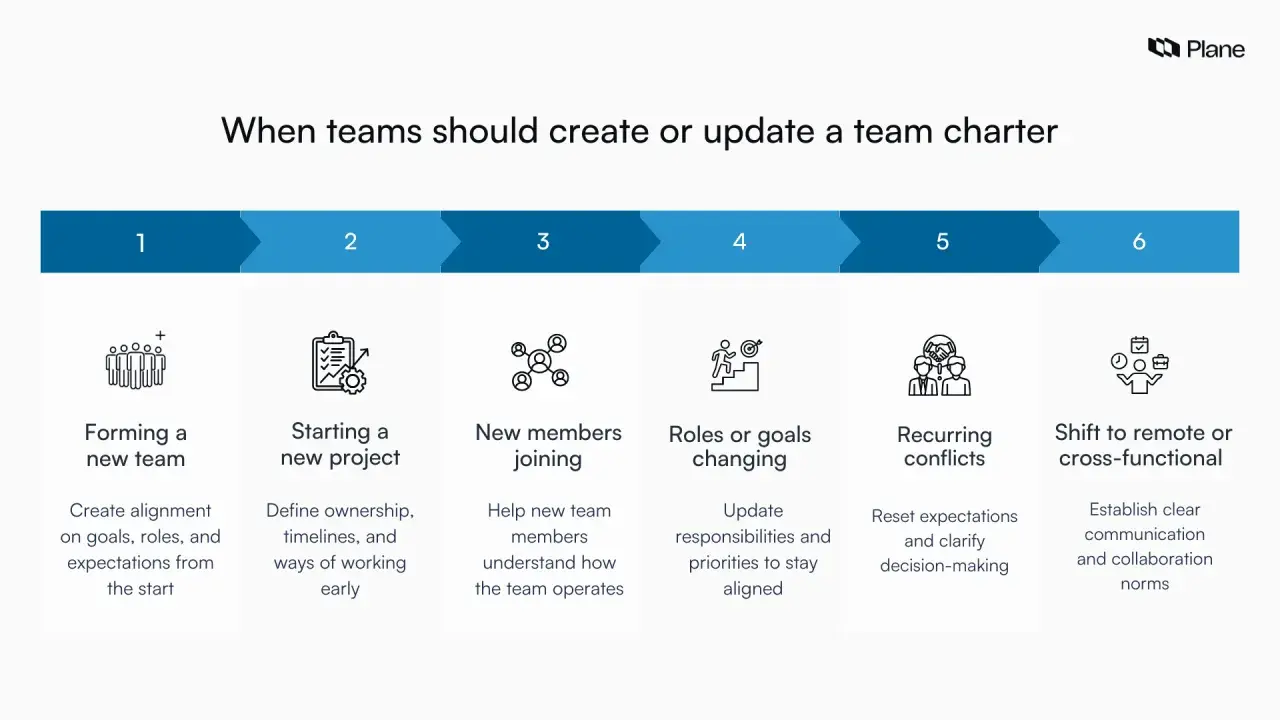
A clear charter saves time because it answers the questions that usually slow teams down: why are we here, who decides, and how do we work when priorities clash? A good group charter turns those answers into a short, usable agreement that helps a team focus on results instead of re-litigating the basics. In management, that matters most when the team is new, hybrid, cross-functional, or under pressure.
What this document gives a team in practice
- Shared purpose so everyone understands why the team exists and what success looks like.
- Clear roles so people know who owns decisions, delivery, and support tasks.
- Operating rules for meetings, communication, escalation, and conflict.
- Faster alignment when priorities change or trade-offs need to be made.
- Better accountability because expectations are written down, not assumed.
- Cleaner onboarding for new joiners who need context quickly.
What a charter actually does for a team
I think the easiest way to understand this document is to treat it as a working agreement, not a decorative statement. It gives a team a practical answer to the questions that usually cause friction: what are we trying to achieve, how do we divide the work, and how do we behave when the pressure rises?
That makes it much more useful than a vague mission statement. A charter can sit alongside a project brief, a role description, or a policy, but it does something different: it turns the team’s day-to-day operating model into something explicit. In management terms, it reduces ambiguity, which is often the hidden cost behind slow decisions, duplicated effort, and avoidable conflict.
The best versions are short, specific, and easy to revisit. If a team cannot use the document to settle a disagreement, onboard a new colleague, or make a decision in under a few minutes, the charter is probably too abstract. The next step is to define what it should contain so that it stays useful rather than theoretical.
What a strong charter should contain
A useful charter does not need to be long, but it does need to be complete enough to guide real work. I would normally expect it to cover the following areas:
| Element | What to capture | Why it matters |
|---|---|---|
| Purpose | Why the team exists and who it serves | Prevents drift and helps people prioritise the right work |
| Goals | 2 to 5 clear outcomes, ideally measurable | Gives the team a shared definition of success |
| Roles and responsibilities | Who owns delivery, decisions, support, and escalation | Reduces overlap and weakens the excuse that “someone else was handling it” |
| Decision rules | What needs consensus, what the lead decides, and when escalation is required | Speeds up action when the group is under time pressure |
| Operating principles | How the team behaves in meetings, communication, and disagreement | Sets the tone for collaboration and accountability |
| Measures and review points | How progress will be checked and when the charter will be revisited | Keeps the document tied to real performance, not nostalgia |
I also recommend keeping the language concrete. Replace “communicate openly” with something observable, such as “raise blockers within one working day” or “share meeting notes within 24 hours.” That turns a value into behaviour, which is where the real management value sits. Once the content is clear, the next challenge is building it in a way people will actually use.

How to create one that people will actually follow
In practice, a group charter works best when the team helps write it. If it is produced by one manager in isolation, it may be neat, but it will often feel imposed. A short workshop, usually 60 to 90 minutes, is enough for most teams if the agenda is disciplined.- Start with the team’s reason for existing. Ask what business problem the team is there to solve, and who depends on the outcome.
- Translate that into a small set of goals. I would usually keep this to 2 to 5 outcomes so the document stays focused.
- Map the roles. Be specific about ownership, input, approval, and support. This is where a simple RACI-style split can help. A RACI matrix is a responsibility map that shows who is Responsible, Accountable, Consulted, and Informed.
- Agree the operating rules. Cover meeting cadence, response times, where information lives, and how conflict is handled.
- Test the draft against real situations. Ask, “What happens if priorities clash?”, “Who decides?”, and “What if one person is unavailable?”
- Set a review date. A charter should be revisited after the first 30 to 90 days, or sooner if the team changes materially.
This is where a charter stops being a piece of documentation and starts becoming a management tool. The point is not to make everyone happy in the room; the point is to remove avoidable confusion once the team starts working under pressure. The teams that do this well usually have one more thing in common: they know when the charter is most useful, especially in modern working environments.
Where it fits best in modern UK teams
In the UK, I see the strongest value in teams that are changing quickly, working across sites, or balancing hybrid schedules. Those settings create distance, and distance creates assumptions. A charter gives everyone a shared frame of reference before those assumptions become friction.
| Team situation | What the charter should emphasise | Why it helps |
|---|---|---|
| Newly formed team | Purpose, roles, and early decision rules | Speeds up trust and stops the team from spending weeks guessing |
| Hybrid team | Availability, communication norms, and meeting discipline | Prevents remote staff from being left out of informal decisions |
| Cross-functional programme | Ownership, escalation paths, and dependencies | Reduces bottlenecks between functions with different priorities |
| Leadership team | Decision rights, confidentiality, and collective accountability | Helps leaders act like a team rather than a set of separate agendas |
| Project team with external stakeholders | Scope, communication rhythm, and approval points | Makes expectations clearer for people outside the core team |
The pattern is simple: the more complex the environment, the more valuable the agreement becomes. A stable, co-located group may only need a light version. A change programme or matrix team usually needs more detail because the cost of confusion is higher. That also means there are some common mistakes worth avoiding.
Where charters go wrong
Most failed charters are not wrong in principle. They fail because they are either too vague to guide behaviour or too long to use. I would watch for these problems first:
- Too much corporate language so the document sounds polished but says very little.
- Manager-only authorship so the team never feels real ownership.
- Mixed messages where the charter overlaps with policy, role descriptions, or the project brief.
- No review point so the document becomes stale after the first team change or delivery crisis.
- Unclear decision rights so the team still has to negotiate the basics every time.
- Overlength so it reads like a handbook instead of a practical agreement.
If you want a quick rule of thumb, keep it to one or two pages. More than that, and people stop treating it as an operating guide. Another good test is this: if a new starter cannot understand the team’s purpose, key roles, and working rhythm after a short read, the charter probably needs cutting back.
The other mistake I see often is treating it as a one-off exercise. That is where the final part matters most, because the value of the document depends on how it is used after launch.
Turn it into a management habit, not a one-off file
The document only works when managers keep bringing it back into the team’s everyday rhythm. I like to revisit it during onboarding, when a project moves into a new phase, after a team restructure, and after any conflict that exposes a gap in expectations.
- Use it in the first team meeting with a new joiner.
- Check it during retrospectives or monthly reviews.
- Update it when responsibilities, stakeholders, or delivery constraints change.
- Refer to it when a discussion starts circling around the same issue twice.
That last point matters more than it sounds. A charter is not there to remove judgement; it is there to make judgement faster and fairer. When used well, it gives a manager a practical way to shape behaviour, protect focus, and create a team culture that is clear without being rigid. I would rather see a short agreement that people actually use than a perfect document that no one opens after the first week.
