
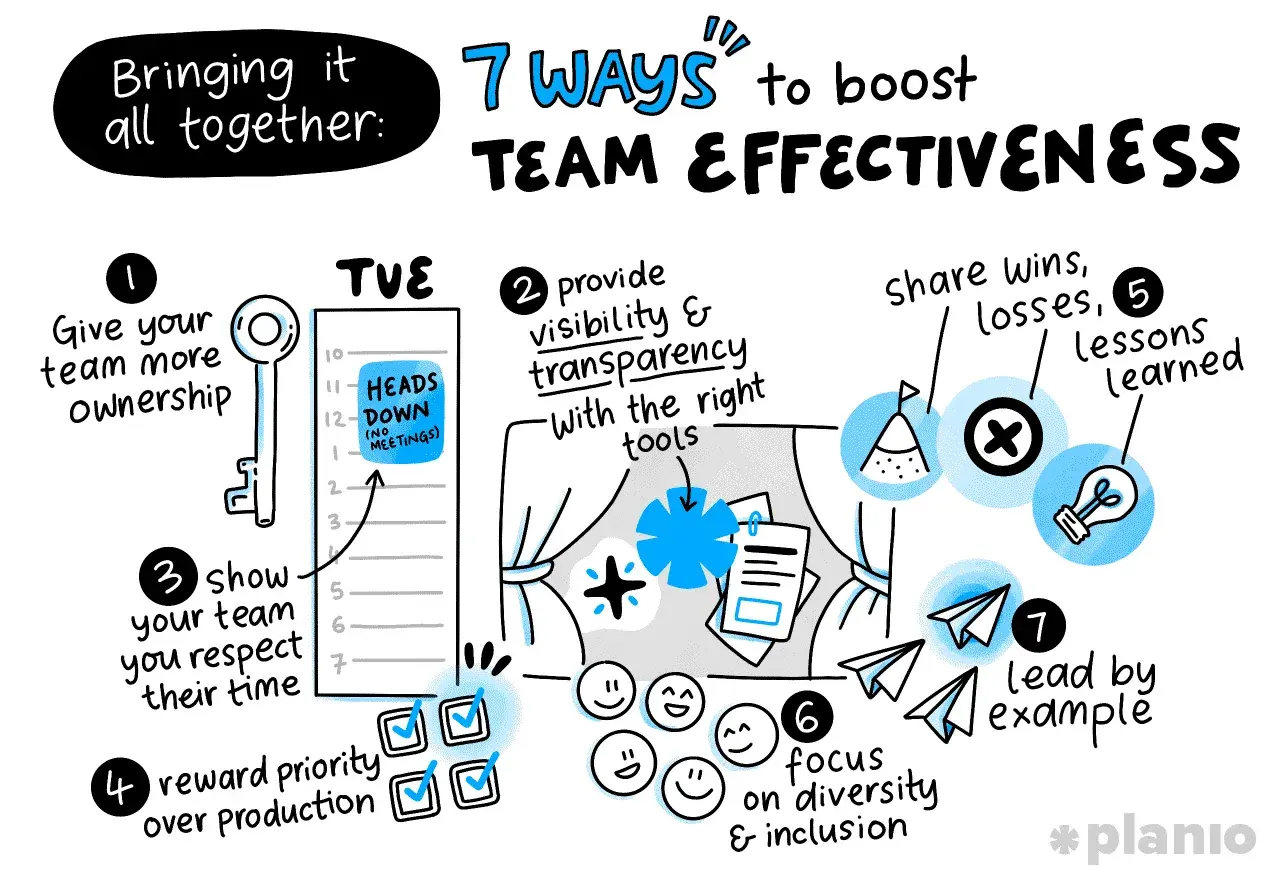
A collaborative team is not just a friendly group of colleagues; it is a working system where people share context, make decisions faster, and reduce avoidable friction. In management, that difference matters because strong collaboration affects delivery, morale, and how much time leaders spend correcting confusion. This article explains what strong collaboration looks like, how to build it day by day, where it usually breaks down, and how to tell whether it is genuinely improving performance.
What matters most if you want collaboration to stick
- Trust is the base layer. People need to feel safe raising risks, asking questions, and disagreeing early.
- Clarity beats enthusiasm. If roles, goals, and decision rights are vague, collaboration becomes noise.
- One shared source of truth prevents duplicated work, conflicting versions, and lost context.
- Healthy disagreement improves decisions; silent agreement often hides problems until they become expensive.
- Good measurement looks at rework, decision speed, and participation, not just how busy everyone appears.
What a collaborative team looks like in management
I judge collaboration less by how cheerful people sound and more by how well work moves when pressure rises. In practice, that means people know what they own, they know who decides what, and they share information before it turns into a problem. A strong team does not need constant supervision because the working rules are clear enough for people to act without guessing.
| Healthy signal | Weak signal | What it means for a manager |
|---|---|---|
| People raise risks early | Problems appear only when they are urgent | Psychological safety is too low for honest reporting |
| Roles are obvious | Two people do the same task, or nobody owns it | Decision rights need to be written down |
| Knowledge is shared in one place | Context is buried in chat threads and private messages | The information flow is fragmented |
| Disagreement is direct and respectful | Silence hides tension | The team is avoiding real decisions |
When these signals are present, collaboration becomes an operating habit rather than a slogan, and that is what managers should aim for next.
Why trust, clarity, and role discipline matter more than enthusiasm
It is easy to mistake friendliness for effective collaboration, especially early on. The harder truth is that a motivated group can still underperform if nobody trusts the process, nobody knows who decides, and everyone assumes someone else is handling the follow-up.
Trust gives people permission to speak before issues escalate. Clarity gives them a shared understanding of the goal. Role discipline keeps the work from drifting into overlap or gaps. I also pay attention to coordination, which simply means the team is sequencing its tasks so one person’s work actually supports the next person’s, and to transparency, which means the right people can see the right information at the right time.
In a management context, the most useful term here is decision rights - who decides, who is consulted, and who only needs to be informed. If that is unclear, even strong communicators spend too much time negotiating process instead of solving the real problem. Once those basics are in place, the practical question becomes how to design the work itself.

How to build it in day-to-day management
If I were setting up a better collaboration system from scratch, I would start with five habits rather than a long training programme. The point is to make the working environment easier to use, not to make people remember a new philosophy.
- Define the outcome in plain English. People collaborate better when they know what success looks like. A vague objective creates debate, while a specific one creates momentum.
- Assign one owner per decision. This does not mean one person does all the work. It means someone is clearly accountable for moving the issue forward and closing the loop.
- Use one shared place for current information. A single source of truth is simply the place everyone checks first for the latest version, the latest action list, and the latest decision.
- Agree on communication rules. Some updates belong in a document, some in chat, and some in a meeting. Not every collaboration problem needs another meeting, especially in hybrid teams where asynchronous updates save time.
- Review the system, not just the tasks. Ask whether handoffs, approvals, and recurring meetings are helping or slowing the work. Small process fixes often do more than motivational speeches.
Where collaboration usually breaks down
Most teams do not fail because people are lazy; they fail because the system makes cooperation harder than it should be. The warning signs are usually obvious once you know where to look.
| Problem | What is usually wrong | Best next move |
|---|---|---|
| Meetings end with vague next steps | No one owned the decision | Name the owner, deadline, and required follow-up before the meeting ends |
| Everyone agrees too quickly | False consensus is hiding objections | Ask people to share concerns in writing before the final call |
| Tasks are duplicated | Ownership is unclear | Map responsibilities visibly and remove overlap where possible |
| Information is scattered across tools | The team has too many places to look | Set one primary system and make it the default reference point |
The term false consensus matters here because it describes a common management trap: the room sounds aligned, but people have not actually committed. If you can spot that early, you can still correct the course before the work gets expensive.
How to tell whether the system is actually working
Good collaboration leaves evidence. If you want to manage it properly, track the signals that show whether the team is becoming easier to work with, not just busier.
| Measure | What it tells you | What to watch for |
|---|---|---|
| Decision turnaround time | How quickly the group can move from discussion to action | Routine questions should not stall for days in inboxes or meeting loops |
| Rework rate | Whether handoffs and expectations are clean | Repeated corrections usually mean the team is sharing too little context |
| Participation balance | Whether a few voices dominate the conversation | Stronger collaboration usually means more than the loudest three people speaking |
| Short pulse feedback | Whether people feel informed and safe | If confidence drops, the issue is often trust or clarity rather than skill |
Numbers are useful, but the clearest signal is often simpler: people leave meetings knowing what changed, what they own, and what happens next. That is the difference between activity and progress.
The first three moves I would make in a UK workplace
In UK organisations, especially where hybrid schedules are common, I would start with the basics that make daily coordination easier for line managers and their teams.
- Write decision rights down. A short RACI-style note - who is responsible, accountable, consulted, and informed - removes more friction than most workshops.
- Choose one shared home for work. Keep plans, actions, and decisions in one place so people are not chasing the latest version through email and chat.
- Normalise early disagreement. If people only raise objections after the meeting, the process is too slow and the team is paying for it later.
Once those three pieces are in place, training and tools start to matter for the right reasons. Without them, even a polished collaboration strategy will struggle to produce consistent results.
