
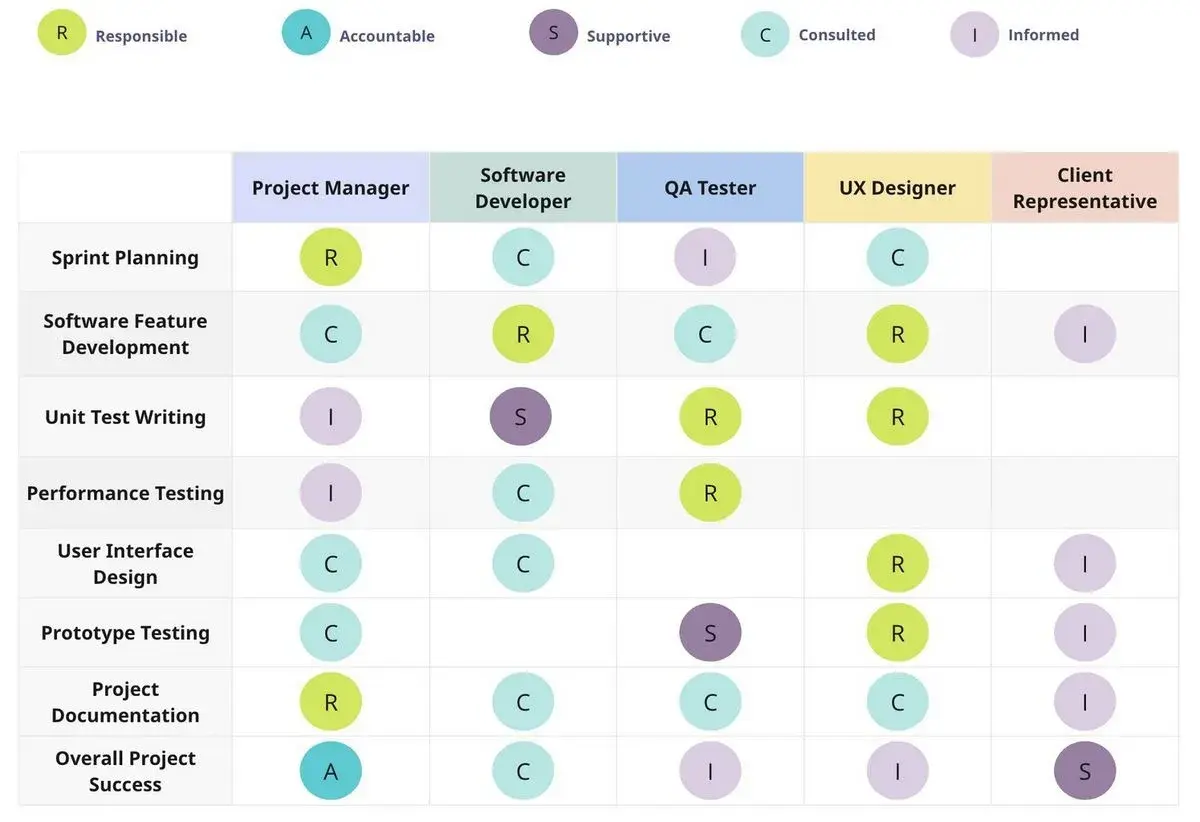
The five roles that remove ownership gaps
- Responsible is the person or team doing the work.
- Accountable is the single owner of the result and final sign-off.
- Support covers people who actively help deliver the task.
- Consulted includes subject experts who give input before action is taken.
- Informed keeps key stakeholders updated without pulling them into execution.
- The framework works best when you map it to deliverables and decisions, not just job titles.
What the matrix fixes in project work
Most projects do not fail because nobody is busy. They stall because too many people assume someone else is in charge, or because the approval path is vague enough to slow every decision. A responsibility matrix makes those gaps visible before they turn into missed deadlines, duplicate work, or awkward escalation meetings.In my experience, the biggest value is not the chart itself. It is the conversation it forces at the start of a project: who owns delivery, who has the final say, who can add useful expertise, and who simply needs visibility. That distinction matters even more in cross-functional work, where marketing, operations, finance, HR, and IT all touch the same deliverable but do not all carry the same weight.
It also protects managers from a common trap: assuming that a senior title automatically means accountability. In reality, a team can have several people contributing strongly while only one person remains accountable for the outcome. Once that is clear, the next step is to assign the roles properly rather than letting the matrix become a decorative document.
What each role means in practice
People often understand the letters individually but still misuse them in real projects. The difference between Support and Consulted, for example, is easy to blur unless you define what each role is supposed to do on the ground.
| Role | What it means | What it should not become |
|---|---|---|
| Responsible | The person or team carrying out the task and producing the deliverable. | Not the same as final approval or executive ownership. |
| Accountable | The single owner of the outcome, quality, and sign-off. | Not a shared role. If two people are accountable, the matrix is already muddy. |
| Support | People or teams providing active help, resources, or hands-on assistance. | Not passive observers and not a catch-all for anyone vaguely involved. |
| Consulted | Subject matter experts whose input is needed before the work moves forward. | Not a copy-and-paste list of everyone who might have an opinion. |
| Informed | Stakeholders who need updates on progress, decisions, or outcomes. | Not people who must approve every step. |
The practical rule I use is simple: if someone is expected to help move the work forward, they are usually Support or Responsible. If they are there to shape the decision before it happens, they are Consulted. If they only need to know what happened, they are Informed. That distinction keeps the matrix from collapsing into a long list of names with no real function.

How to build one without overcomplicating the project
The easiest way to build the matrix is to start with the work, not the people. If you begin with names, the chart usually reflects hierarchy instead of delivery. If you begin with deliverables and decisions, the ownership map becomes much more accurate.
- List the main deliverables, milestones, or decisions that actually matter.
- List the roles involved, not every individual name unless the project is very small.
- Assign Responsible first, then assign a single Accountable person for each item.
- Add Support, Consulted, and Informed only where they genuinely change how the work moves.
- Check for overload, duplication, or missing ownership.
- Review it with the team and stakeholders before work starts.
Two rules matter more than the rest. First, keep one accountable owner per deliverable. Second, do not force every box to be filled. Blank cells are normal when a task does not need support, consultation, or extra visibility. That is not a weakness in the chart; it is a sign that you are being selective rather than theatrical.
For a UK project team, this often means the sponsor owns the strategic decision, the project manager coordinates delivery, the subject expert provides input, and operational leads are kept informed at the right moment. The chart is doing its best work when it mirrors how the team actually makes decisions, not how an org chart looks on paper.
Where teams usually get it wrong
Most weak matrices fail for the same few reasons. None of them are dramatic, but together they create the exact confusion the framework was supposed to remove.
- Two or more people are marked accountable, which makes sign-off a negotiation instead of a decision.
- Consulted is overused, so every task becomes a meeting invitation.
- Support is treated like a vague courtesy role, even when the work needs real hands-on help.
- Names replace roles, so the matrix breaks the moment someone changes position.
- The chart is never updated, which means it reflects the old project, not the current one.
- Hierarchy overrides reality, so the most senior person gets written into every important row whether they should be there or not.
The other mistake I see often is subtle: teams use the matrix to document who they already think should be involved, rather than asking who actually needs to be involved for the work to succeed. That difference matters. If the list is too broad, the tool becomes slower than the project itself.
When this framework is better than a simpler matrix
A basic RACI chart is often enough when the project is small, the decision path is short, and support work is minimal. The extra S in RASCI becomes useful when delivery needs real assistance from people who are not the decision-makers and not merely observers. That is common in implementations, service transitions, change programmes, and cross-department projects.
| Situation | RASCI fits better when | RACI is usually enough when |
|---|---|---|
| Cross-functional rollout | Support work is real, time-consuming, and separate from consultation. | The team is small and the handoffs are straightforward. |
| Operational change | Several teams actively help implement the change. | One team owns delivery and the rest mainly review or approve. |
| Governance-heavy work | You need to show who supports execution as well as who approves. | The main issue is simply clarifying ownership and sign-off. |
My practical view is this: choose the lighter tool unless the work justifies the extra detail. The point is clarity, not complexity. If the support role helps the team avoid confusion, rework, or hidden labour, then the expanded matrix earns its place. If not, the extra layer just gives everyone more rows to ignore.
A UK project example that shows the difference
Imagine a mid-sized UK consultancy rolling out a new client onboarding process across its London and Manchester offices. The project touches operations, compliance, IT, and client-facing teams, so ownership can easily blur. That is exactly the kind of work where this matrix prevents hidden assumptions.
| Task | Responsible | Accountable | Support | Consulted | Informed |
|---|---|---|---|---|---|
| Design the new onboarding flow | Operations analyst | Head of operations | Process improvement lead | Compliance officer | Regional managers |
| Set up the CRM workflow | CRM administrator | IT manager | Vendor support | Client services lead | Service desk |
| Prepare staff training | Learning and development specialist | Change lead | Operations team | Branch supervisors | All client-facing staff |
| Approve go-live | Project manager | Project sponsor | IT support | Compliance and legal | Wider leadership team |
This example shows why the framework is so useful in management. The sponsor owns the decision, the project manager drives coordination, support functions help execution, and relevant experts are consulted before anything is locked in. Nobody has to guess who is supposed to act, and nobody is left wondering why they were invited into a meeting that did not need them.
How I would keep it useful after the first workshop
The matrix only works if it stays alive after the kickoff meeting. My rule is simple: if it is not reviewed when scope changes, team members change, or a decision slows down, then it is just a file in the project folder.
- Keep it to one page per workstream if possible.
- Review it at major stage gates and before go-live decisions.
- Use it when onboarding new team members so ownership is visible immediately.
- Update it when a role changes, not months later when the confusion has already spread.
- Use it alongside a decision log if the project has a formal governance structure.
The best version is the one people can still use on a busy day. If it helps a team make faster decisions, reduces duplicate effort, and makes accountability obvious, then it is doing real work. If it only looks tidy, it is not doing enough.
