
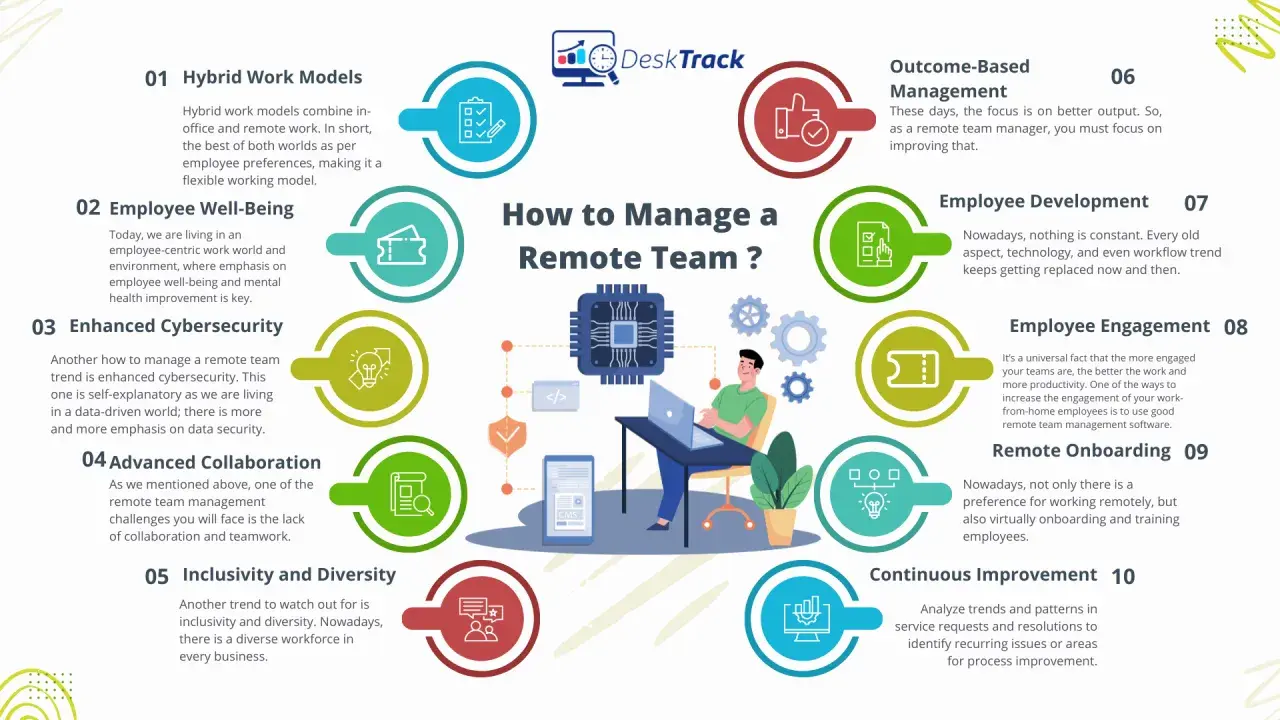
Managing a distributed team is less about chasing people online and more about designing a system that creates clarity, momentum, and trust. In practice, how to manage remote teams comes down to a few repeatable habits: setting expectations in writing, choosing the right communication rhythm, measuring output fairly, and keeping people connected without overloading them with meetings. This article breaks down those habits in a practical way, with enough detail to use immediately in a UK-based management context.
The managers who succeed remotely make clarity the default
- Remote work needs explicit rules for communication, ownership, and response times.
- Short, predictable check-ins work better than constant ad hoc interruptions.
- Good management focuses on outcomes, not presence or activity logs.
- The best tool stack is small: one place for tasks, one for decisions, one for conversation.
- Trust, onboarding, and wellbeing must be managed deliberately, not left to chance.
- Remote performance improves when expectations are written down and reviewed often.
What remote work changes for managers
When a team is in the same office, managers can rely on proximity, overheard context, and quick face-to-face fixes. Remote work removes most of that informal glue. That means the manager’s job changes from “being available” to building a working environment where people can act independently without guessing.
In a UK context, this matters even more because hybrid working is no longer unusual. The leadership challenge is not simply location, but coordination across different schedules, household constraints, and sometimes time zones. The people who struggle most with remote teams usually do not have a motivation problem; they have an ambiguity problem.
- They do not know what good looks like.
- They do not know which decisions they can make themselves.
- They do not know where to find the latest version of a plan.
- They do not know how quickly a reply is expected.
Once you see that pattern, the solution becomes clearer: remove uncertainty first, then optimise for speed and engagement. That leads directly to the communication system you put in place.

Build a communication rhythm people can rely on
Remote teams do not need more communication by default. They need better-timed communication. The goal is to separate urgent coordination from thoughtful work, so people are not forced into constant interruption just to stay informed.
Use the right channel for the right job
| Task | Best channel | Why it works | Watch out for |
|---|---|---|---|
| Quick clarification | Chat | Fast, lightweight, and useful for small blockers | Do not let chat become the place where important decisions disappear |
| Planning and decisions | Shared document or project board | Creates a record and makes ownership visible | Avoid leaving decisions buried in long message threads |
| Complex discussion | Video call | Better for nuance, disagreement, and coaching | Do not default to meetings for issues that could be solved asynchronously |
| Status updates | Project tracker | Lets everyone see progress without asking for manual reports | Keep the tracker updated or it becomes decorative |
| Sensitive feedback | 1:1 conversation | More private, more human, and less likely to be misread | Do not deliver serious feedback in public chat |
A useful rule of thumb is this: if the issue will still matter tomorrow, write it down. If it needs judgment, use a call. If it needs speed, use chat. If it affects the whole team, record it somewhere searchable.
For cadence, I usually prefer a simple pattern: a short weekly planning meeting, a regular 1:1, and a monthly review or retro. Keep the daily touchpoint brief and optional when the work is already stable. The point is not to fill calendars; it is to create reliable touchpoints so people know when they will be heard. Once communication becomes predictable, the next question is whether ownership is equally clear.
Make goals and ownership impossible to miss
One of the biggest mistakes in remote management is confusing activity with progress. People can answer messages all day and still move the wrong work forward. That is why I focus on outcomes, not busyness. Each major piece of work should have a named owner, a deadline, a definition of done, and a visible dependency list.
When those four things are missing, remote teams drift. When they are present, people can move quickly without waiting for permission on every small step.
From tasks to outcomes
- Task: “Update the onboarding guide.”
- Outcome: “New starters can complete their first week without asking three repeated questions.”
- Definition of done: The guide is published, checked by the manager, and used in the next two inductions.
Make handoffs visible
Remote work often fails at the seams, not the centre. A designer finishes a mock-up, a marketer waits for approval, and a product lead assumes someone else has taken the next step. To prevent that, I like to ask three questions on every project:
- Who owns the next action?
- What is blocked right now?
- What decision, if made today, would unblock the most work?
This is also where a shared project board helps. It does not need to be fancy. It just needs to be accurate enough that no one has to ask, “Where are we on this?” more than once. Once ownership is visible, the team can work with less friction, which is exactly where the right tools start to matter.
Choose tools that support the work instead of supervising it
Tools should reduce uncertainty, not create a digital version of micromanagement. The strongest remote teams usually run on a small, boring stack: one chat tool, one task tracker, one document system, and one video platform. Anything beyond that should earn its place.
When tool sprawl grows, people spend more time locating information than using it. That is not a technology problem; it is a management problem disguised as software choice.
- Chat: good for quick coordination and lightweight collaboration.
- Project tracker: good for status, deadlines, and accountability.
- Shared docs: good for decisions, meeting notes, and process clarity.
- Video: good for coaching, complex conversations, and relationship building.
- Whiteboards: good for planning and ideation, but not as the final record.
Be careful with monitoring tools. They rarely solve trust issues, and they often create new ones. If a manager feels the need to track keystrokes or online status obsessively, the team probably has a deeper clarity problem. I would rather improve the work design than add surveillance. Once the tool stack is settled, the real challenge becomes culture: how people feel, learn, and belong when they are not sharing the same room.
Keep trust, culture, and onboarding deliberate
Culture does not disappear when a team goes remote, but it does become easier to neglect. In an office, a lot of culture is absorbed by osmosis. Remotely, it has to be designed into routines, rituals, and decision-making. That includes how people are welcomed, how they get help, and how visible good work becomes.
Trust is built by consistency. If replies are slow one week and instant the next, if one employee gets more context than another, or if decisions change without explanation, remote trust erodes quickly. People do not need perfection; they need predictability.
Onboarding should be staged, not improvised
- Give new starters a 30-60-90 day plan.
- Assign a buddy for informal questions.
- Show them where decisions live, not just where tasks live.
- Schedule early wins so they can feel progress fast.
- Explain the team’s communication norms on day one.
Remote onboarding is also where managers should be careful about social overcompensation. A nice welcome call is useful, but it does not replace context. New people need to know who decides what, what “good” looks like, and when to ask for help. That mix of process and belonging is what keeps remote teams from feeling fragmented. It also sets up the next issue: performance and wellbeing.
Measure performance fairly and protect wellbeing
Remote performance should be judged on outcomes, reliability, and collaboration, not on who looks busiest. A team member who sends 40 messages a day is not automatically productive. A quieter colleague who delivers clean work on time may be doing exactly what you need. The manager’s job is to separate signal from noise.
The most useful indicators are often simple:
- Work is delivered on time, or delays are raised early.
- Quality is stable and rework is not constant.
- People respond when needed without expecting instant replies all day.
- Meetings lead to decisions, not just more meetings.
- Workload feels sustainable rather than permanently stretched.
Read Also: Manager-Employee Communication - Build Trust & Clarity
Use 1:1s for more than status
A good remote 1:1 is part coaching, part risk scan. I like to ask variations of the same questions each time: What is blocked? What feels unclear? What should stop? What support would actually help? That keeps the conversation honest and stops the meeting from becoming a status theatre.
Wellbeing matters here too. Remote work can hide overload until it becomes a performance issue. It can also hide disengagement until someone is already halfway out. In the UK, this is one reason managers should take flexible-working practice seriously; ACAS specifically recommends training managers for working from home and hybrid arrangements, and that advice makes sense because remote supervision is a distinct skill, not an extension of office management.
When performance and wellbeing are handled fairly, the team becomes easier to lead. When they are not, the problems usually show up in small but costly ways, which brings us to the mistakes that quietly damage remote teams.
The mistakes that quietly damage remote teams
Most remote teams do not fail because of one dramatic incident. They fail because of repeated, low-grade friction. The damage is slow, but predictable.
- Overmeeting: people lose focus and start treating meetings as the default work mode.
- Unclear ownership: everyone assumes someone else is handling the next step.
- Presence-based management: managers reward visible activity instead of actual delivery.
- Invisible decisions: important calls are made in calls, then never documented.
- Unequal access: office-based staff get more context than home-based colleagues.
- Ignoring timezone or care constraints: the same people end up paying the inconvenience cost every week.
- Using chat as a memory system: messages scroll away and knowledge gets lost.
My strongest advice is to treat these as design flaws, not personality flaws. If a team keeps missing deadlines, the answer is rarely “try harder.” It is usually “make the work more visible” or “make the decision path shorter.” Once you start thinking that way, remote leadership becomes much more manageable in practice. The final step is turning that thinking into a routine you can actually run.
A simple operating model I would start with
If I had to set up a remote or hybrid team from scratch, I would keep the operating model deliberately plain. Fancy systems tend to collapse under real work. A simple structure survives.
- Monday: publish priorities, blockers, and any deadlines that matter this week.
- Midweek: run a short check-in only if decisions or dependencies need attention.
- Friday: review progress, capture lessons, and note what slipped.
- Monthly: reset goals, discuss workload, and look for patterns in delivery and morale.
- Quarterly: review team structure, skill gaps, and which routines are adding value versus noise.
That rhythm keeps people aligned without forcing them into constant availability. It also gives managers a practical way to improve the team over time instead of reacting only when something has already gone wrong. If you want one principle to keep in view, it is this: remote leadership should reduce uncertainty, not just increase visibility. When people know what is expected, where the work lives, and how success is measured, distance becomes an operating condition rather than a problem.
