
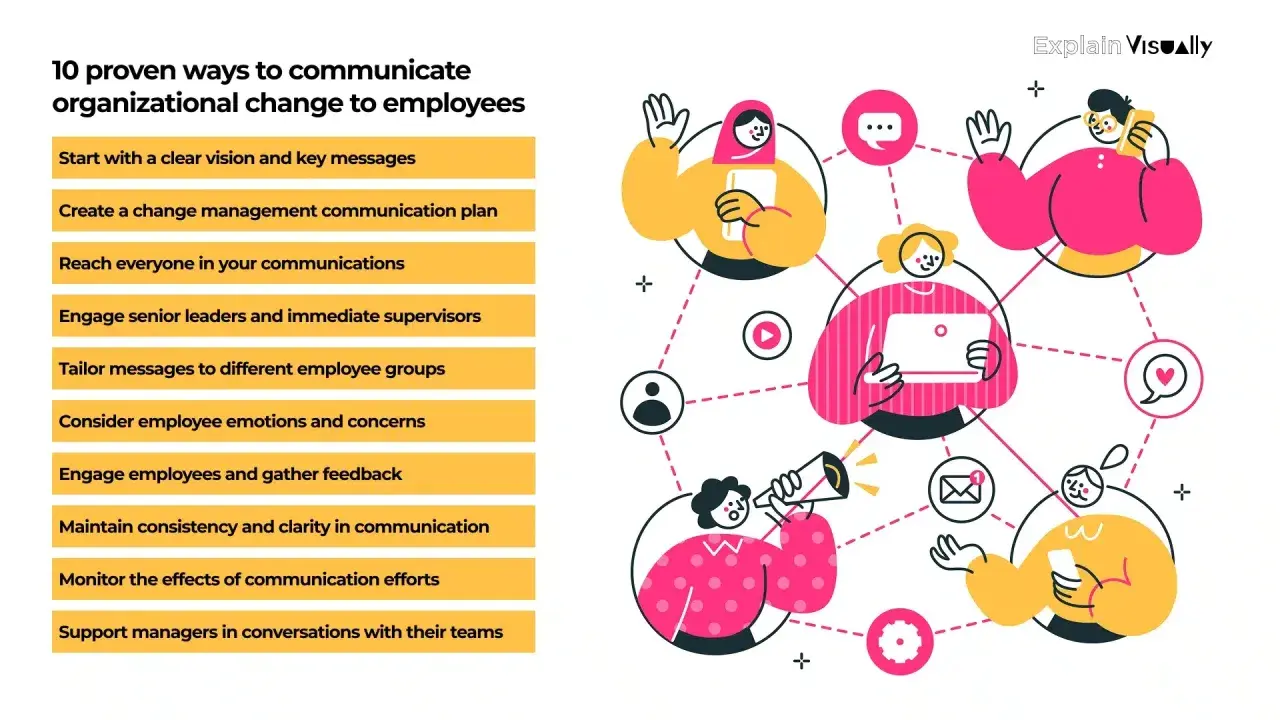
Communicating organizational change is less about sending a polished announcement and more about helping people understand what is changing, why it matters, and how they should respond. In practice, the message has to reduce uncertainty, align managers, and give employees a fair chance to adapt. When that part is rushed, even a sensible decision can feel chaotic.
What leaders need to get right before the first announcement
- Start with the business reason and the human impact, not with the mechanics.
- Map stakeholders by impact and influence, because not everyone needs the same level of detail.
- Use managers as translators, not just forwarding agents.
- Repeat the core message through multiple channels so people can hear it, question it, and remember it.
- Give employees a clear route for feedback, objections, and practical questions.
- If the change affects contracts, headcount, or working arrangements in the UK, treat consultation as part of the process, not an optional extra.
Why change communication shapes adoption, not just awareness
I rarely treat a change message as an information exercise. Awareness tells people that something is happening; adoption tells them what to do next. Those are very different outcomes, and the second one is what actually moves a change forward.
When employees only hear the headline, they fill in the blanks themselves. That is usually where rumours, resistance, and unnecessary anxiety begin. A strong communication approach closes the gap between the decision and the day-to-day reality: what will change, what will stay the same, what support is available, and what is still undecided.
The other reason this matters is consistency. If senior leaders, line managers, and support teams are all telling slightly different stories, trust drops fast. In my experience, people will tolerate bad news more readily than muddled news. The next step, then, is to decide exactly who needs to hear what.

Map stakeholders before you write the message
One of the most useful habits I have learned is to stop thinking about “the workforce” as one audience. Different groups need different levels of detail, and they need it for different reasons. A senior sponsor wants risk and decision points. A line manager wants wording, timing, and answers to likely questions. A frontline team wants to know how the change affects workload, routines, and job security.
| Stakeholder group | What they usually need | Best format |
|---|---|---|
| Senior leaders | Strategic rationale, risks, trade-offs, and what they must say consistently | Briefing deck, leadership call, decision memo |
| Line managers | Talking points, likely questions, escalation route, and timing | Manager toolkit, live briefing, FAQ sheet |
| Affected employees | What is changing, when it happens, what support exists, and how their role may be affected | Team meeting, 1:1 conversation, written follow-up |
| Employee representatives or unions | Detail, evidence, scope of consultation, and room for alternatives | Formal consultation meetings, shared documents |
| Support functions | Dependencies, workload impact, service changes, and what they need to prepare | Cross-functional briefing, project workspace |
| Customers or external partners | Service continuity, timing, and who to contact if something changes | Targeted notice, account-led communication |
I separate audiences by both impact and influence. Someone may not be directly affected, but if they are the person others turn to for answers, they still need a clear briefing. Once that map is in place, the message becomes much easier to shape, because you know which questions matter most.
Build the message in the right order
The strongest change messages usually answer the awkward questions first. That is not a style preference; it is a trust issue. People can cope with difficult news. What they cannot easily cope with is being forced to guess.- Why now - explain the business reason in plain English, without hiding behind jargon.
- What is changing - be specific about the process, structure, system, policy, or role shift.
- What is not changing - this reduces unnecessary fear and prevents over-reading.
- Who is affected - name the teams, roles, locations, or functions involved.
- When it happens - give a realistic timeline, even if some dates are still provisional.
- What support exists - training, transition support, HR help, and escalation routes should be visible early.
- What is still open - if decisions are not final, say so clearly instead of sounding more certain than you are.
There is a difference between being confident and being fake-certain. I would always rather tell people, “This part is confirmed and this part is still under review,” than overstate precision I do not have. The message structure is only half the job, though. The other half is choosing channels that fit the level of change.
Choose channels and cadence that match the level of impact
One email is not a communication strategy. For a small process update, it may be enough to pair a written note with a short team briefing. For a significant reorganisation or system rollout, you need a layered approach: senior announcement, manager cascade, live Q&A, and a written record people can return to later.
| Channel | Best use | Strength | Limitation |
|---|---|---|---|
| All-hands or town hall | Setting the strategic context and showing leadership sponsorship | Reaches many people at once and creates visibility | Too broad for detailed questions |
| Line manager briefing | Translating the change for teams and local realities | Trusted, specific, and close to the work | Fails if managers are underprepared |
| Email or intranet post | Recording the facts, dates, and FAQs | Searchable and easy to revisit | Easy to skim or ignore if used alone |
| Small-group Q&A | Handling practical concerns and local objections | More honest and two-way | Slower and more resource-heavy |
| 1:1 conversations | Sensitive impact on role, workload, or career path | Personal and respectful | Not scalable for large groups |
For a major change, I would normally brief managers within 24 hours of the main announcement, then schedule a second touchpoint in the first week to deal with emerging questions. Weekly updates are often enough once the change is settling, but silence between milestones is risky. If people do not hear from leadership, they assume leadership has stopped listening.
That brings us to the most common failure points, because even a good channel mix can be ruined by weak execution.
The mistakes that erode trust fastest
Most change communication problems are predictable. The issue is rarely a lack of words; it is usually a lack of clarity, timing, or consistency.
- Using jargon to soften the message - technical language may feel safer, but it often sounds evasive.
- Announcing before managers are ready - if the team learns from rumour before their manager can explain it, trust drops immediately.
- Presenting a decision as a consultation - people notice when the outcome is already fixed.
- Overloading the first message - too much detail too early hides the real priorities.
- Ignoring the emotional side - even sensible change can trigger fear, status loss, or fatigue.
- Failing to close the feedback loop - if people raise concerns and never hear back, they stop contributing.
- Changing the story midstream - small inconsistencies become big credibility problems when teams compare notes.
The fastest way to lose credibility is to promise certainty you do not have. The better habit is to be explicit about what is known, what is being worked through, and when the next update will arrive. In the UK, there is also a formal side to this conversation, and that changes the brief quite a bit.
Where UK consultation changes the brief
For organisations in the UK, communication and consultation often run together. ACAS is clear that consultation should be a genuine two-way discussion, not a presentation with a token Q&A. People should be informed, listened to, and given a real opportunity to influence the outcome where that is possible.
If the change touches contracts, redundancy, location, working patterns, or TUPE-related issues, the communication plan has to be handled with extra care. In those cases, I would not treat the message as a simple announcement. I would treat it as part of a fair process: explain the business case, show the options considered, state what is still open, and give people a proper route to respond.
If employee representatives or trade unions are involved, consistency matters even more. A casual line from a manager that contradicts the consultation pack can undo days of careful work. The practical rule is simple: do not share less than you should, and do not share more certainty than the decision really has.
Once that legal and procedural framing is in place, the rollout itself becomes easier to manage.
A rollout sequence I would actually use
When I am planning a significant organisational change, I prefer a sequence that keeps decision-makers aligned before employees hear the news. It is slower up front, but it prevents a lot of damage later.
- Clarify the non-negotiables - decide what is fixed, what is still being tested, and what cannot yet be shared.
- Brief the people who will carry the message - senior leaders, HR, employee representatives, and line managers should hear the same core story first.
- Announce in plain English - lead with the reason, the impact, and the timeline, not the internal project language.
- Open a structured feedback window - collect questions, concerns, and suggestions in one place so patterns are visible.
- Reinforce through support materials - FAQs, manager notes, process guides, and training should arrive before confusion hardens.
- Review understanding and adjust - use attendance, recurring questions, pulse checks, and manager feedback to see where the message is not landing.
I would watch the first 2 to 4 weeks closely. If the same questions keep coming back, that usually means the message is unclear, the timing is wrong, or the managers do not have enough confidence to answer locally. Those signals are often more useful than a neat launch presentation.
The real sign the message has landed
The best sign that a change message has worked is not applause. It is when people can explain the change in their own words, without leaning on a script, and still get the main points right. They know what is changing, what is not, where to go for support, and how the transition affects their work.
That is the standard I use: fewer rumours, fewer surprises, and more useful conversations. If you keep the message plain, the process fair, and the feedback loop open, the change becomes something people can work with rather than something done to them.
