
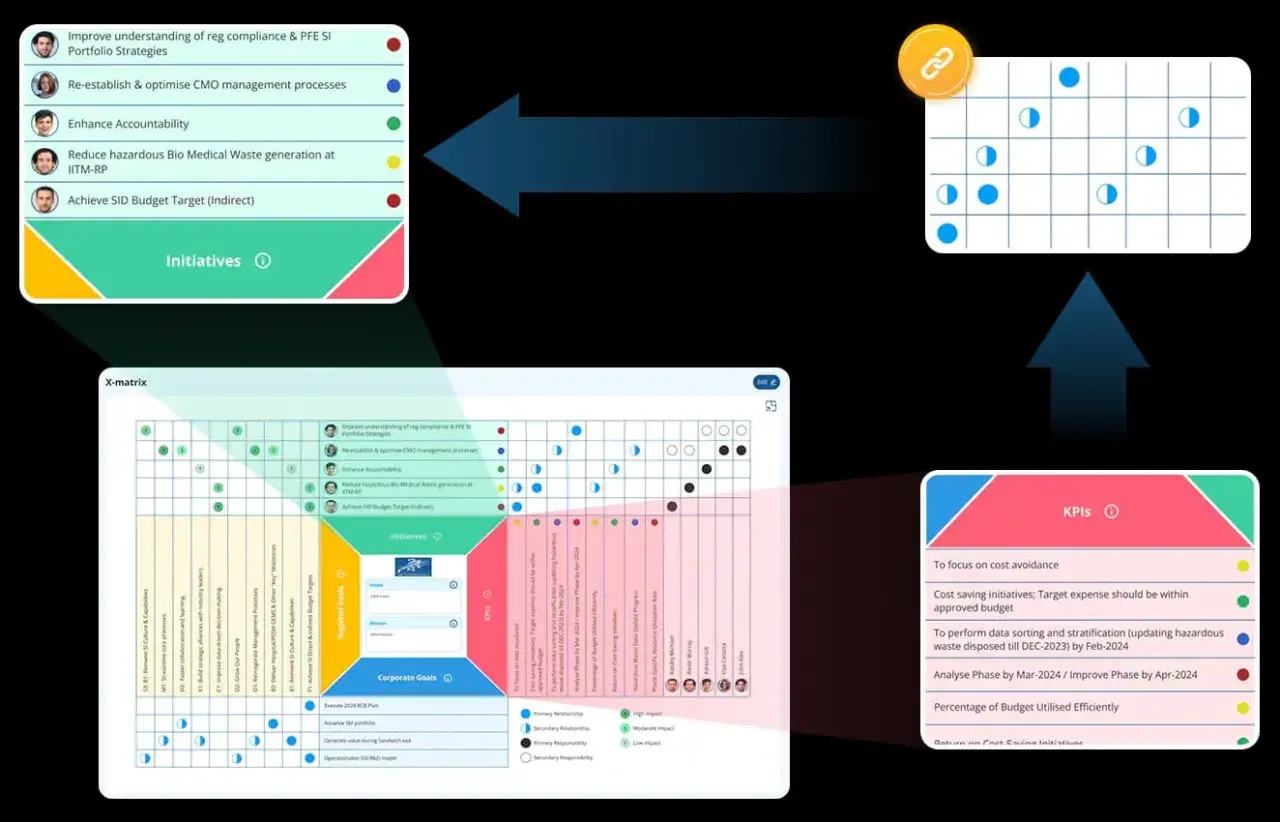
Strong management is not just about setting targets; it is about making them visible enough that people can act without guessing. Line of sight management works when people can see the chain from strategy to task to result, and when managers keep that chain alive in ordinary conversations, not only in annual reviews. In UK teams, especially hybrid ones, that clarity is often the difference between busy work and meaningful progress.
What matters most when goals need to stay visible
- Clear line of sight links company priorities, team goals, and individual work in one understandable chain.
- It improves performance because people make faster decisions when they know what matters most.
- The practical version is simple: a few priorities, a visible measure of success, and regular check-ins.
- It fails when managers overload teams with goals, hide trade-offs, or treat dashboards like a substitute for leadership.
- Hybrid and matrix teams need more deliberate clarity, not more meetings.
What clear line of sight means in a team
At its core, this is the point where a person can explain why their work exists, what it supports, and how success will be judged. It is not the same as having a long list of objectives in a shared folder. A team may be informed without being aligned, and that difference matters more than many managers realise.
I usually think of it as three layers: the organisation’s direction, the team’s current priority, and the individual’s contribution. When those three layers line up, people stop asking, “What am I doing?” and start asking better questions such as, “What is the best way to do it?” That shift is where performance improves.
A useful test is simple. If someone can explain the goal, the reason for it, and the trade-off it implies, the line of sight is probably working. If they can only repeat the task, the management system is still too fuzzy. That difference becomes even more important once we look at the impact on performance.
Why it improves performance and accountability
Clear goal visibility does more than make communication cleaner. It reduces the time people spend second-guessing priorities, and it gives managers a better basis for coaching. In practice, that means fewer unnecessary escalations, fewer duplicate efforts, and less energy wasted on work that looks productive but does not move the business forward.
It also changes accountability. When a person understands the outcome they are supporting, they are more likely to take ownership of decisions instead of waiting for permission. That matters in 2026, when many UK organisations are still operating with hybrid structures, cross-functional projects, and shorter in-person windows. The manager’s job is no longer to pass on instructions. It is to make the work legible.
| Signal | Weak version | Stronger version |
|---|---|---|
| Priorities | Everything is urgent | Three to five priorities, clearly ranked |
| Decision-making | People keep asking what to do next | People can decide within agreed guardrails |
| Progress tracking | Status updates with little context | Visible measures tied to outcomes |
| Accountability | Blame when deadlines slip | Ownership of the next action and the blocker |
| Engagement | Work feels disconnected | People can see how their effort matters |
For career growth, this is also valuable at the individual level. People who can connect their work to business outcomes are usually easier to trust with bigger responsibilities. That makes line of sight a leadership issue, but also a development issue. The next step is translating that idea into a working rhythm.

How to build it into your weekly management rhythm
The simplest way to create clarity is to stop trying to communicate everything. I prefer a smaller structure: one business outcome, a handful of team priorities, and a visible measure of progress. Anything more elaborate tends to confuse people before it helps them.
- Start with one business outcome. State what the team is trying to improve, protect, or deliver. “Improve customer retention” is better than “do better this quarter” because it gives people something concrete to work towards.
- Reduce it to 3-5 team priorities. Too many priorities dilute the message. If every item is important, nothing is. Ranked priorities force honest trade-offs.
- Translate the priorities into individual ownership. Each person should know what they own, what they influence, and where they need support. This is where many managers are vague, and the vagueness costs time later.
- Attach an evidence point. A number, a milestone, a customer signal, or a quality standard helps people know whether they are winning. The measure does not need to be perfect, but it does need to be visible.
- Review it on a regular cadence. I would rather see a 15-minute weekly check-in and a 30-minute monthly review than one big quarterly conversation that arrives too late to matter.
When I work through this with managers, I ask them to write the objective in one sentence, the main trade-off in another, and the measure of success in a third. If that feels hard, the strategy probably needs simplification before the team can execute it well. Once that rhythm exists, the next question is what to use to support it.
Tools that keep goals visible without turning management into surveillance
Tools should support clarity, not replace it. A dashboard can help, but only if people understand what the numbers mean. A team charter can work well, but only if it is actually used in meetings. The right tool depends on the culture, the pace of work, and how much cross-team coordination is involved.
| Tool | Best use | Main risk |
|---|---|---|
| Team charter | Clarifying purpose, boundaries, and responsibilities | Becoming a document nobody opens again |
| OKRs | Linking outcomes to measurable results | Too many objectives, not enough focus |
| Shared dashboard | Making progress and blockers visible | Tracking numbers that do not reflect real value |
| 1:1 agenda | Connecting daily work to bigger goals | Turning the meeting into a status report only |
| RAG review | Showing which areas are healthy, at risk, or blocked | Oversimplifying a complex situation |
One important boundary: visibility is not the same as surveillance. People need enough transparency to make good decisions, but not a sense that every move is being monitored. In regulated, confidential, or commercially sensitive settings, you may need selective visibility, yet the principle remains the same: the team should know enough to work confidently. That balance is where many teams struggle, and it leads straight into the mistakes I see most often.
The mistakes that quietly break alignment
The most common failure is not bad intent. It is overload. Managers often create confusion by adding one more goal, one more metric, or one more update channel. The result is a noisy system that feels active but does not create understanding.
- Too many priorities make it impossible to know what matters this week.
- Vague language such as “improve collaboration” or “raise standards” sounds good but gives little guidance.
- Changing direction without explanation damages trust, even when the change is justified.
- Measuring activity instead of outcomes rewards motion rather than progress.
- Ignoring dependencies creates frustration when one team’s success depends on another team’s timing.
- Using visibility as control makes people defensive instead of accountable.
I see this most often when managers assume a shared slide deck or project tracker equals shared understanding. It does not. A team can repeat the objective and still not know how to make decisions against it. The real test is whether the work changes behaviour, not whether the words are familiar. With that in mind, it helps to know what good looks like in ordinary day-to-day management.
What strong alignment looks like on a normal working week
When the system is working, the signs are practical and fairly boring in the best way. People know what matters, they know what has changed, and they know when to escalate. There is less ambiguity and fewer pointless debates about priorities.
- People can explain the top priority without reading from a document.
- Team meetings focus on decisions, blockers, and trade-offs rather than long status monologues.
- Progress is visible early, so small problems are fixed before they become expensive.
- Managers spend more time coaching judgement and less time chasing updates.
- Individuals can connect their own development to bigger business outcomes.
A simple scenario makes this clearer. In a sales operations team, a manager may decide that qualified pipeline matters more than raw activity. That choice gives the team a cleaner standard: not just “do more”, but “do more of the right work”. In a customer service team, the priority may shift towards first-contact resolution rather than speed alone. The exact metric depends on the goal, but the principle is the same: people perform better when the target is visible and the trade-off is honest.
That is the real value here. Clearer goals do not make management louder; they make it sharper. When people can see where they are going and why it matters, they work with more judgement, less friction, and a lot less wasted effort.
