
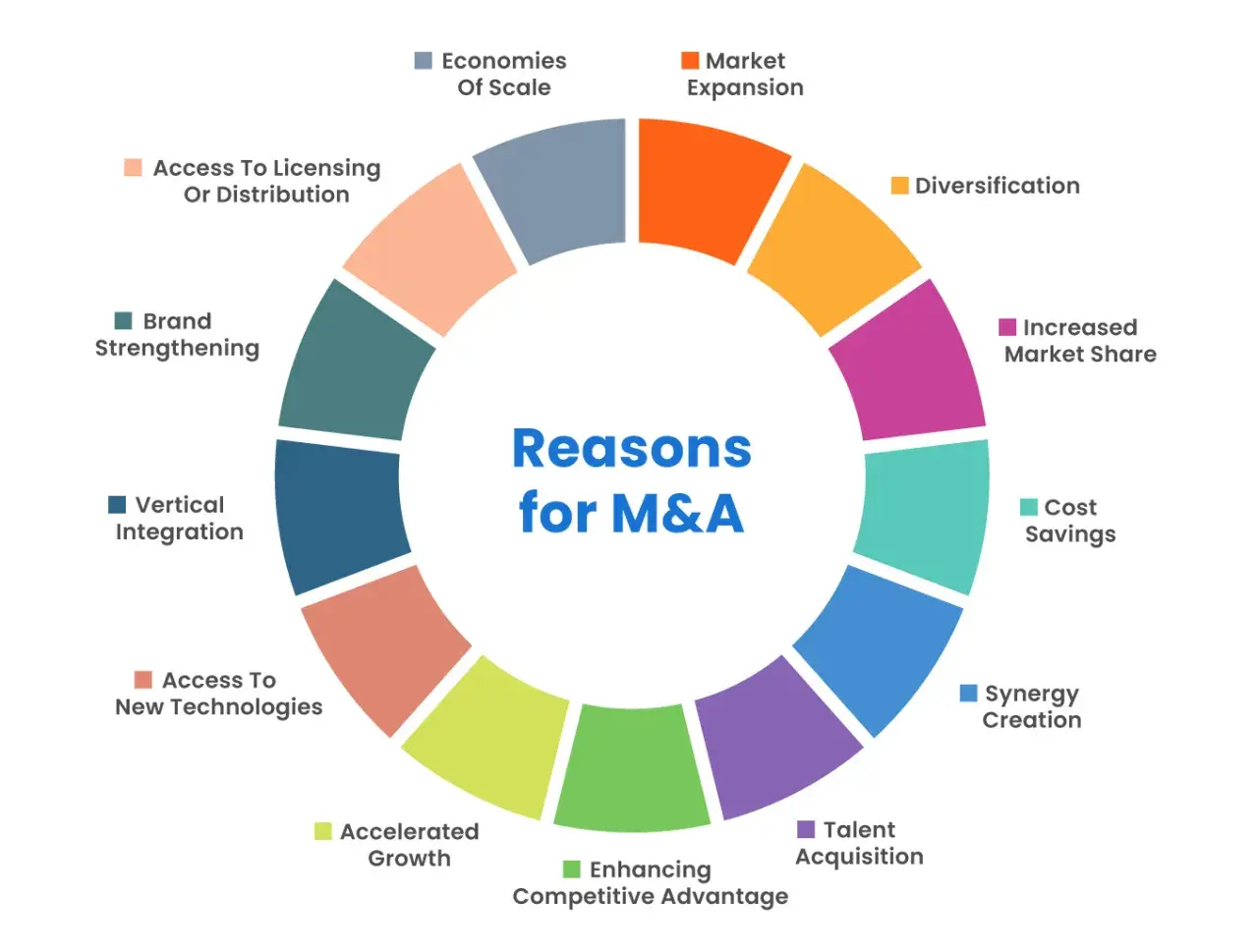
A merger usually makes sense only when two companies can solve a strategic problem together better than they can alone. In management terms, the real motive is rarely just size; it is usually about cost, growth, capability, or risk. In the UK, that business logic also has to survive competition scrutiny, so it pays to separate the headline story from the real value case.
The main motivations behind most mergers
- Synergies can cut costs or lift revenue, but the numbers must survive integration.
- Market share can improve bargaining power and competitive position, especially in fragmented sectors.
- New markets become accessible faster when a target already has customers, channels, or local credibility.
- Capabilities and talent are often the real asset when the target owns technology, data, or specialist teams.
- Diversification can smooth earnings, but only when the businesses are not exposed to the same risks.
- Execution usually decides whether the deal creates value or just adds complexity.

The five motives at a glance
| Reason | What it means in practice | Where it fits best | Main risk |
|---|---|---|---|
| Synergies | The combined business should cost less, earn more, or both. | Overlapping functions, shared suppliers, similar products. | Savings look easy on paper, then turn expensive to capture. |
| Market share | The firm wants a stronger position against rivals, suppliers, or both. | Fragmented markets and direct competitors. | Competition concerns and customer pushback. |
| New markets | The deal buys entry into a geography, segment, or channel faster than organic growth. | Markets with local trust, licences, or distribution barriers. | Speed becomes expensive if integration is weak. |
| Capabilities and talent | The target brings technology, data, IP, or a team the buyer cannot build quickly. | Fast-moving or knowledge-heavy sectors. | Key people leave after the deal closes. |
| Diversification | The merged business spreads revenue across different products, customers, or regions. | Cyclical businesses and concentrated revenue models. | False diversification if the same shock hits both firms. |
I use this kind of snapshot with management teams because it quickly shows whether the deal is really about efficiency, scale, access, or resilience. Most mergers blend motives, but one normally dominates, and that is the one the board should pressure-test first.
Why synergies usually lead the board discussion
Synergy is the classic merger argument: the combined business should be worth more than the two firms separately. That usually means shared overhead, better purchasing, smoother logistics, or revenue that rises because the firms can sell more effectively together.
Cost synergies
Cost synergies are the easiest to model because they come from duplicated functions: finance, HR, IT, premises, procurement, and supply chain. Economies of scale means the fixed cost base is spread across more revenue, but those savings are only real when the integration plan is specific.
Read Also: Manager-Employee Communication - Build Trust & Clarity
Revenue synergies
Revenue synergies come from cross-selling, bundling, broader distribution, and a stronger brand proposition. I usually treat these more cautiously than cost savings, because they depend on customer behaviour, not just internal control.
The problem is not that synergies are fake. The problem is that many teams count them too early, too confidently, and without a clear owner. That efficiency story is compelling, but some mergers are less about cheaper operations and more about a stronger position in the market.
Why market share still matters
A merger can also be about market share, pricing power, and bargaining strength. In plain terms, management may be trying to give the combined business enough scale to influence price, secure better terms from suppliers, or blunt a competitor's advantage. Market power means the ability to shape commercial terms without immediate pressure from rivals.
This motive is strongest in horizontal mergers, where the businesses already compete in the same market. It can be a defensive move as well as an offensive one, especially when a smaller firm worries that rivals are getting too strong or the market is becoming too concentrated.
In the UK, that logic needs careful handling because a larger market position can attract scrutiny if the deal reduces choice or weakens competition. When scale is not the main point, the next question is whether the deal opens a market the firm could not reach quickly on its own.
Why mergers can open new markets faster
Some mergers are really a shortcut into a market that would take years to build organically. The prize can be geographic reach, a new customer segment, or access to a distribution network that the acquirer cannot replicate quickly. That is especially true when local trust, brand recognition, or regulatory approvals matter.
For management teams, this is often the most seductive motive because it sounds like growth without delay. The danger is that speed looks attractive right up until the combined business has to integrate two sales models, two brands, and two ways of serving customers.
There is also a strategic comparison worth making: organic expansion is slower, but it is usually cleaner and cheaper to control. A merger makes sense when the shortcut is genuinely valuable, not just when leaders are impatient. Of course, a faster route into growth is only useful if the target also brings something hard to copy, which is where capabilities become the real prize.
Why capabilities and talent are often the hidden prize
In a lot of deals, the asset is not revenue today but capability tomorrow. The target may bring technology, patents, data, engineering depth, or a team that knows how to execute better than the buyer's existing organisation. Sometimes the whole rationale sits in a single product platform or a very small group of people who can move faster than the larger firm.
An acqui-hire is the extreme version, where the real goal is to keep the people rather than the product. That can work, but only when the buyer has a believable retention plan and a culture that does not push those people out after the ink dries.
This is the part of merger strategy that leaders often underestimate. Buying a capability is not the same as absorbing it. If the tech stack, incentives, or management style clash, the supposed advantage can evaporate quickly. Even a strong capability play can disappoint if the merged business does not change its risk profile, which brings diversification into view.
Why diversification can help, but only under the right conditions
Diversification sounds less dramatic, but it is often a serious management motive. A merger can spread revenue across products, customers, or geographies so that one shock does not hit the whole business at once. For a company with cyclical earnings or heavy customer concentration, that can be a real strategic benefit.
I am sceptical when diversification is used as a vague excuse for buying something unrelated. It only works when the risk profile actually changes. If both businesses depend on the same macroeconomic trend, the same supply chain, or the same customer base, the deal may be larger, but it is not necessarily safer.
A merger that simply stacks two fragile businesses does not reduce risk, it can magnify it. That is why boards should ask whether the combined portfolio really behaves differently in stress conditions. Still, a sound reason on paper is not enough if integration is weak, and that is where many deals lose value.
Why good merger stories still fail in execution
A sound motive does not guarantee a sound outcome. I have seen otherwise sensible mergers lose value because leaders overpaid, integration teams were under-resourced, or key people left before the promised benefits arrived. The problem is rarely one dramatic failure. It is usually a series of smaller ones that compound.
- Overpaying turns a good strategic idea into a weak financial return.
- Culture clash slows decisions and pushes talent away.
- Integration overload distracts management from customers and operations.
- Customer churn appears when service quality dips or the offer becomes confusing.
- Regulatory remedies, meaning the changes or divestments a regulator may require, can weaken the original economics.
This is why I prefer a disciplined merger case over a glamorous one. The best deal logic is the logic that still works after delays, staff turnover, and operational friction. For UK leaders, there is also a separate question: can the deal survive competition review without destroying the economics?
What UK leaders should keep in mind
As of 2026, UK leaders should assume merger control is part of the strategy conversation, not a legal afterthought. The Competition and Markets Authority can review deals that may lessen competition, so the commercial case should also explain why customers will be better off, not just why the combined company will be bigger.
That is where management discipline matters. If the main claim is cost reduction, the team should be able to show where the savings come from. If the main claim is market access, it should show why the target's channel or local position is hard to build alone. If the main claim is capability, it should show how the people or technology will be retained. Any claimed upside should be tied to the transaction itself, not to hopes that could have been achieved anyway.
My rule is simple: if the merger only works under perfect conditions, it is not ready for approval. Once those checks are in place, the final test is whether the merger is genuinely worth the complexity.
The test I would use before approving the deal
If I had to compress the decision into one question, I would ask whether the merged company will be stronger in a way that customers can feel and competitors can respect. If the answer relies on vague scale benefits or heroic assumptions, the case is weak. If the answer rests on measurable synergies, a clear market position, a real capability gain, or a genuinely better risk profile, the merger has a defensible strategic reason.
Before signing off, I would want the executive team to answer three things cleanly: what changes after integration, what breaks if one assumption slips, and whether the same result could be achieved through a partnership or internal investment with less risk. That is usually the clearest way to separate a strategic merger from a deal that only looks impressive on paper.
