
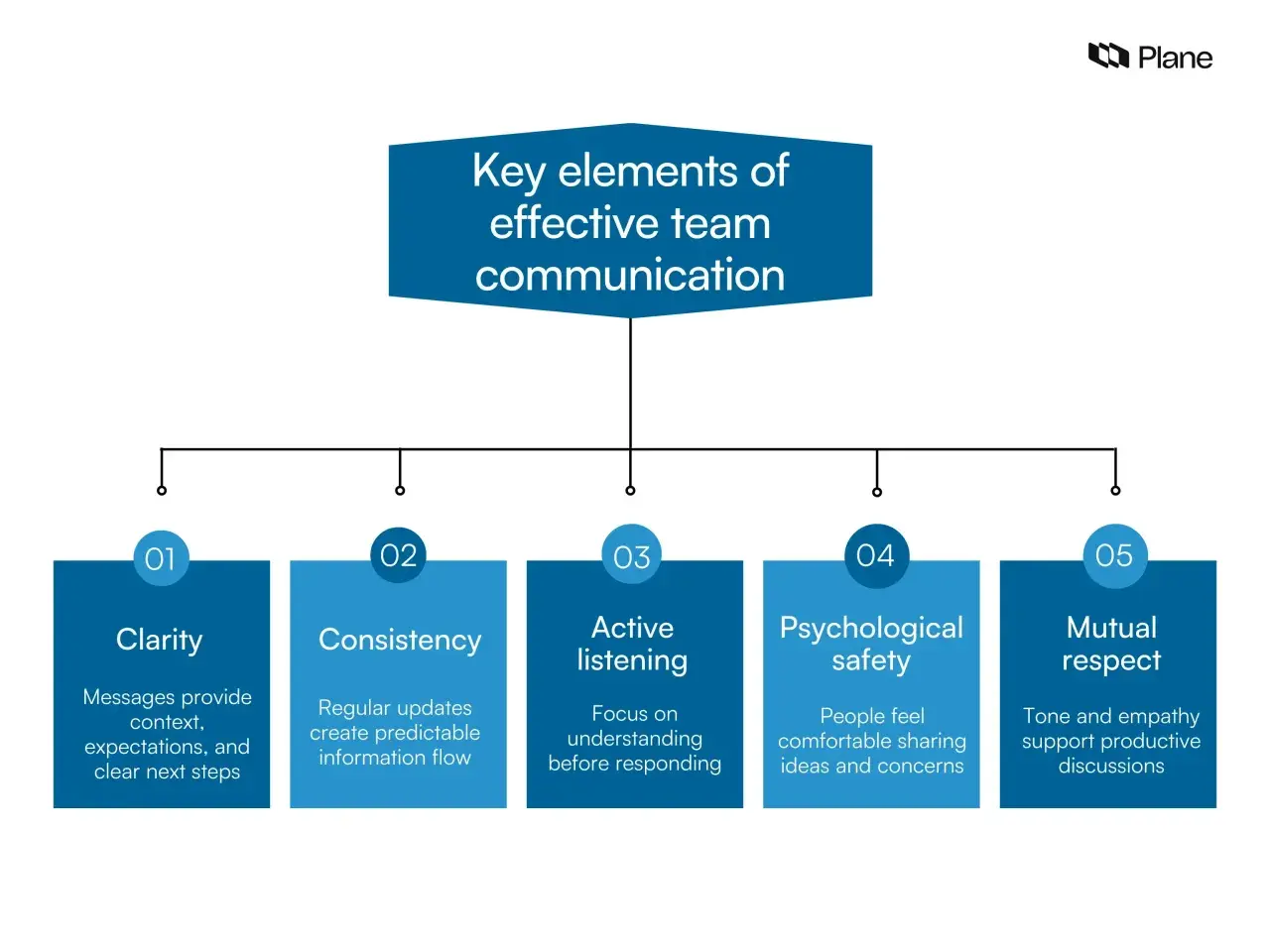
Strong workplace communication is not about sounding polished; it is about making work easier to do. When people talk about the keys of communication, they usually mean the habits that turn a message into understanding, action, and trust. In a UK workplace, where teams often split time between office and remote settings, those habits matter even more because context disappears quickly when people are busy.
The short version is that strong communication depends on a few repeatable habits
- Clarity beats clever wording when the real goal is action.
- Listening is not passive; it is how you catch missing context early.
- Channel choice matters as much as the message itself, especially in hybrid teams.
- Feedback and follow-through stop small misunderstandings from becoming bigger problems.
- Respectful tone keeps difficult conversations productive instead of defensive.
What good workplace communication is trying to achieve
At work, communication has three jobs: to make sure people understand the message, to align them around what happens next, and to reduce avoidable friction. It is not just “sharing information”. It is helping someone act on what you said without guessing, filling gaps, or chasing you for clarification.
I usually think of it this way: if a message does not change understanding, behaviour, or a decision, it was probably incomplete. That is close to the practical advice in CIPD’s employee communication guidance, which puts planning and tailoring messages at the centre of good internal communication. The point is not to sound formal; the point is to make the message fit the audience and the moment.
- Understanding means the other person knows what the message is really about.
- Alignment means they know how it connects to the wider goal.
- Action means they know what to do, by when, and who owns it.
Once those outcomes are clear, the next step is choosing the habits that make them happen consistently.
The five communication keys I rely on most
If I had to reduce workplace communication to five habits, I would start here. These are the parts that most often decide whether a message lands cleanly or turns into confusion later.
Clarity comes first
Clarity is the foundation because vague messages create extra work for everyone else. Say the point early, use concrete verbs, and avoid hiding the request in a long introduction. If you need three things from someone, list them as three items. If there is a deadline, put it in the first half of the message, not at the very end.
A useful test is this: could a colleague repeat the request back in one sentence? If not, the message probably needs tightening.
Listening creates the context
Listening is not waiting for your turn to speak. It is checking for what has not been said yet: hesitation, disagreement, confusion, or a missing assumption. In meetings, I often pause after making a point and ask, “What am I missing?” That question is simple, but it surfaces issues that polite silence would otherwise hide.
Good listening also means reflecting back what you heard. A short recap such as “So the priority is to finalise the client version by Thursday, and the legal review comes after that” can save an hour of back-and-forth later.
Know the audience
The same message should not be written the same way for everyone. A senior leader usually wants the implication and the decision. A colleague in another team wants the context and the next step. A new starter may need background that feels obvious to everyone else. When you ignore that difference, you either overwhelm people or leave them under-informed.
In practice, this means cutting jargon unless the whole group genuinely uses it every day. It also means choosing a level of detail that fits the reader, not your own comfort with the topic.
Timing changes the meaning
Even a well-written message can land badly if it arrives at the wrong time. Sensitive feedback is usually better in a private conversation than in a channel full of other people. A request sent at 4:55 p.m. on a Friday can feel very different from the same request sent during working hours with enough notice.
For routine updates, I like a simple rule: acknowledge within one working day. For urgent matters, state the response window up front. Timing is not just logistics; it shapes how respectful the message feels.
Read Also: Internal Communications Consultant - Do You Need One?
Close the loop
Communication is not finished when you send the message. It is finished when the next person knows what to do and you have a shared record of the decision if needed. That is where follow-through matters. Ask for a short confirmation, summarise key decisions in writing, and name the owner and deadline before the conversation ends.
This is especially important in hybrid teams, where people may not share the same room and can easily walk away with different interpretations of the same discussion.
Once these five habits are in place, the next question is not what to say, but where to say it.

Choosing the right channel for the job
One of the fastest ways to weaken a message is to send it through the wrong channel. A tricky conversation over chat, a long policy by voice note, or a decision buried in a meeting all create friction that could have been avoided. In a hybrid workplace, the channel is part of the message.
| Channel | Best for | Watch out for | My rule of thumb |
|---|---|---|---|
| Face-to-face or video call | Feedback, conflict, complex decisions, anything sensitive | Nuance can still disappear if you rush or multitask | Use it when emotion, ambiguity, or trust is involved |
| Instructions, decisions, formal records, project updates | Too much detail can hide the main ask | One subject, one purpose, one clear action | |
| Chat | Quick coordination, status checks, short clarifications | It gets messy fast when the topic is sensitive | Use it for speed, not for debate |
| Meeting | Alignment, brainstorming, trade-offs, live problem-solving | It can turn into a status dump with no decision | Only meet if discussion will change the outcome |
| Written brief or document | Policies, proposals, plans, background material | People ignore it if the first page is too long | Lead with the decision, the ask, or the summary |
I find that most communication failures are channel failures before they are people failures. If the message needs judgement, use a live conversation. If it needs a record, write it down. If it only needs speed, keep it short. Once the channel is right, the remaining risk is usually the message itself.
Where workplace communication breaks down in real teams
Most communication problems are surprisingly ordinary. They are rarely dramatic. More often, they start as a vague request, an assumed understanding, or a conversation that ends without a decision.
| Common breakdown | What it looks like | What to do instead |
|---|---|---|
| Vague asks | “Can you handle this?” with no scope, deadline, or outcome | State exactly what is needed, by when, and what good looks like |
| Too much information | Long messages where the real point is buried halfway down | Put the decision or request first, then add detail only if needed |
| Assumed agreement | Everyone nods in a meeting, but people leave with different interpretations | Ask for a recap, a written action list, or explicit confirmation |
| Wrong tone | A message sounds abrupt, defensive, or overly casual for the topic | Match tone to stakes, relationship, and audience |
| No follow-up | Decisions are made, then forgotten because nobody closed the loop | Send a brief recap with owner, deadline, and next step |
When communication starts to go wrong, I prefer to address it early and informally rather than letting frustration build. That fits the spirit of Acas advice in Britain, which generally encourages resolving workplace problems informally first where possible. In practice, that means a short check-in, a plain question, and a willingness to correct the record before the issue hardens into a bigger conflict.
Once you can spot these breakdowns, the fix becomes much more systematic.
A simple playbook for managers and teams
The best communication systems are not complicated. They are repeatable. If I were coaching a manager or team lead, I would start with a process that people can use every day without thinking too hard.
- Write the outcome in one sentence. Decide whether you need information, a decision, a review, or action.
- Separate who needs to know from who needs to act. Not everyone needs the same level of detail.
- Choose one main channel and one backup. For example, a live call for the discussion and a written recap for the record.
- Put the action, owner, and deadline first. If people have to hunt for the key point, you have already lost time.
- Check understanding before the conversation ends. Ask for a one-line recap or a brief confirmation.
- Document decisions that matter. A short recap is often enough: what was decided, who owns it, and what happens next.
For everyday work, I also like two small habits: a regular one-to-one rhythm for team conversations, and a short written recap after any decision that affects other people. Those two habits reduce drift without creating unnecessary bureaucracy.
That structure becomes most valuable when deadlines tighten, because pressure tends to expose every weak habit you already had.
What holds up under pressure and what does not
When work gets busy, people usually do less communicating, not more. That is exactly when the basics matter most. The teams that cope best are rarely the loudest; they are the ones that stay clear, calm, and predictable.
In my view, the communication habits that survive pressure are the ones that make work easier for other people: fewer assumptions, shorter messages, clearer owners, and faster confirmation. Those habits do more than prevent mistakes. They build credibility. Over time, they make you look organised, trustworthy, and ready for more responsibility.
If you want to strengthen workplace communication quickly, start with one change this week: write the outcome first, listen for what was left unsaid, and end every important discussion with an owner and a deadline. That is usually enough to improve trust, speed, and clarity without overcomplicating the way the team works.
