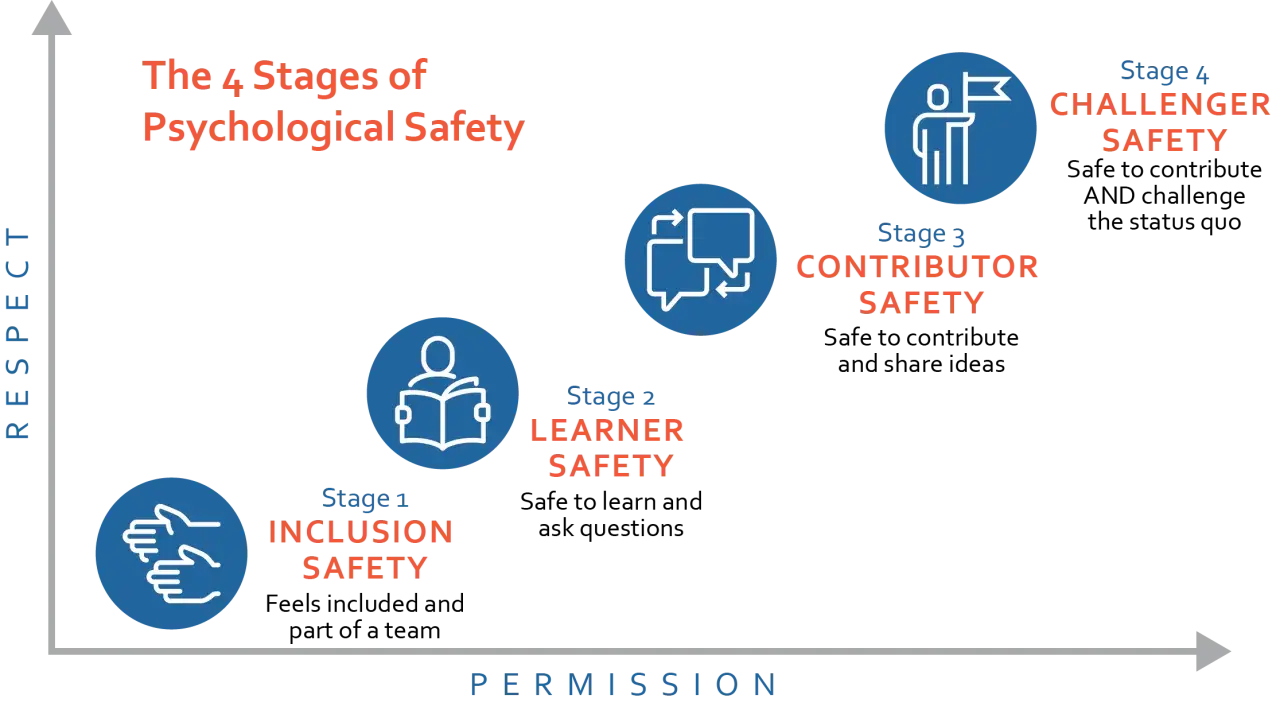
What makes people feel safe enough to speak up at work
- Consistency matters more than slogans. People watch how managers react to bad news, disagreement, and mistakes.
- Leaders set the floor. Curiosity, fairness, and calm responses do more than motivational language.
- Meetings shape culture. If people cannot question ideas in the room, they will not do it later.
- Small routines beat one-off training. Check-ins, retrospectives, and private follow-ups make safety visible.
- Measure behaviours, not just feelings. Track speaking up, follow-through, and how quickly problems surface.
- Pressure exposes the truth. A culture that is safe on quiet weeks but harsh under stress is not stable.
What psychological safety actually looks like at work
In plain English, psychological safety means people believe they can take interpersonal risks at work without being humiliated, ignored, or punished for it. They can ask a question, disagree with a senior colleague, admit a mistake, or say “I am not sure” without feeling that they have damaged their standing. It is not the same as comfort, politeness, or lowered standards. A team can be demanding and still be psychologically safe.
I would separate it from “being nice” because that distinction matters. Nice teams can still be unsafe if they avoid hard feedback, tolerate vague decisions, or punish the first person who says, “This plan has a flaw.” Real safety shows up when people can be direct without being diminished.
- Questions are welcomed early.
- Bad news is surfaced quickly.
- Disagreement stays focused on the work.
- Mistakes are discussed, not hidden.
- Silence is not mistaken for agreement.
Once that distinction is clear, the next question is why the effort matters so much in everyday workplace culture.
Why it matters for culture, performance, and retention
Teams do not just become more pleasant when psychological safety improves; they become more usable. People share half-formed ideas earlier, escalate risks sooner, and stop spending energy on self-protection. The CIPD’s evidence review links psychologically safe environments with people being less defensive and more willing to speak up, which is exactly what a healthy culture should produce.
That has practical consequences. Innovation gets better because ideas are tested instead of buried. Execution improves because errors are caught sooner. Retention also improves, especially in roles where pressure, client contact, or ambiguity are constant. In many UK workplaces, the real problem is not the absence of talent; it is the amount of talent that stays quiet because the social cost of speaking up feels too high.
There is also a fairness issue here. When only the most confident voices dominate, you do not get the best thinking, just the loudest thinking. That is why psychological safety is closely tied to inclusion, not as a side benefit but as a condition for real participation.
With the why clear, the next step is to look at the behaviours leaders actually control.
What leaders need to do first
If I had to reduce this to one point, it would be this: people watch what leaders do under small pressure, not what they say in a values deck. A manager who stays calm when someone raises a problem creates room for honesty; a manager who gets sharp, defensive, or dismissive teaches the team to self-censor.
| Leadership move | What employees experience | Why it works |
|---|---|---|
| Admit uncertainty early | People see that they do not need to pretend competence in order to contribute | It lowers the social risk of asking questions |
| Invite disagreement by name | The room understands that challenge is expected, not punished | It turns dissent into part of the process |
| Respond to bad news calmly | People stop hiding problems until they become bigger | It reduces fear and speeds up escalation |
| Share context, not just instructions | People understand the decision logic and can spot real risks | It makes accountability clearer and more shared |
| Close the loop | People know their input was heard and acted on | It builds trust through follow-through |
I also think line managers matter more than senior slogans. In day-to-day work, they are the ones who decide whether a concern is treated as useful information or as a nuisance. If a senior leader says the right thing but a manager rolls their eyes in a meeting, the culture still feels unsafe.
Once leaders are modelling the right behaviour, the team still needs routines that make that behaviour normal.

How to create psychological safety through daily team habits
One-off training rarely changes culture on its own. What actually shifts behaviour is a set of repeatable habits that make speaking up less awkward and less dramatic.
Start meetings with a small invitation
Use the first 60 seconds to ask a question like, “What is one risk, blocker, or concern we should surface before we decide?” That question matters because it gives quieter people a legitimate entry point instead of forcing them to interrupt later. In hybrid meetings, I would put it on the agenda in writing so remote attendees are not left guessing when to jump in.
Build in structured disagreement
Before a decision is final, ask one person to play devil’s advocate or run a short pre-mortem: “If this fails in three months, what will have gone wrong?” This is not about being negative. It is a practical way to make hidden assumptions visible while the cost of changing course is still low.
Use one-to-ones as a safety valve
Some people will never raise a concern in a group. That is normal, not a failure. A weekly or fortnightly one-to-one with one open question, for example, “What are you not saying in the team room?”, often reveals issues that would otherwise stay buried. The key is to listen without overexplaining or immediately defending the current plan.
Read Also: Employee Engagement: Beyond Perks - Real UK Workplace Change
Make mistakes discussable
After a miss, run a blameless review focused on the process, the assumptions, and the warning signs that were missed. The point is not to erase accountability; it is to separate learning from shame. When people see that errors are examined fairly, they stop hiding them and start reporting them earlier.
A useful term here is surface acting, which means people suppressing how they really feel so they can perform the mood the room expects. If your meetings reward that behaviour, you will get polite silence instead of useful friction.
That leads to the next problem: the small habits that quietly undo all of this.
What quietly destroys safety even in well-meaning teams
Most teams do not lose psychological safety in one dramatic moment. They lose it through repeated small signals: a sarcastic reply, a manager who only wants good news, a decision that was supposedly open but was already made, or a mistake that gets used as a warning story for months. People notice patterns fast.
| What breaks it | Why it causes damage | Better alternative |
|---|---|---|
| Sarcasm or public correction | People learn that being seen is risky | Correct privately when possible, and focus on the work |
| Inconsistent rules | Fairness disappears and people start guessing what is safe | Apply standards consistently and explain exceptions |
| Performative vulnerability | Sharing a personal story without changing behaviour feels manipulative | Pair openness with visible action and follow-through |
| Selective listening | Only certain voices get airtime, so others stop trying | Use structured turn-taking and explicit invites |
| Blame after pressure | People hide problems to protect themselves | Review process gaps first, then accountability |
The fastest way to damage a culture is to punish the messenger. The second fastest is to say “my door is always open” while never changing course when someone walks through it. If you want candour, you have to make it worth the risk.
That leads naturally to the harder question: how do you know whether the culture is actually improving, rather than merely sounding better?
How to measure progress without turning it into theatre
You cannot measure psychological safety perfectly, but you can see the pattern of it. I like simple measures that combine perception, behaviour, and follow-through, because any one of those on its own can be misleading.
| Signal | What to look for | How to read it |
|---|---|---|
| Short pulse questions | “I can raise a concern without negative consequences.” “My manager listens and follows up.” | Look for trend, not a one-off score |
| Meeting participation | Who speaks, who stays quiet, and whether dissent is invited | Low participation can mean fear, fatigue, or poor meeting design |
| Issue escalation | How quickly problems surface and how often people use formal channels | Faster escalation usually means higher trust in the system |
| Idea flow | How many suggestions make it into discussion or testing | More ideas do not always mean more safety, but zero ideas is a warning sign |
| Manager follow-through | How often questions and concerns are closed out with action | Trust rises when people see that speaking up changes something |
If I were setting this up for a team, I would start with three questions in a monthly pulse, one meeting observation, and one follow-up log for concerns raised. That is enough to show whether behaviour is shifting without burying the team in measurement fatigue. A culture that needs a 40-question survey to prove it feels safe is already telling you something.
Even with the right metrics, pressure can pull teams backwards, which is why maintenance matters as much as the initial change.
What to protect when pressure starts to rise
When pressure rises, teams tend to drop the very habits that were making them safe: they shorten meetings, stop asking dissenting questions, and reward speed over honesty. That is exactly when psychological safety matters most. If the culture survives only in calm weeks, it is not yet a culture.
- Keep one predictable speaking-up ritual. Even a 10-minute weekly review can preserve candour.
- Protect the response standard. No eye-rolling, no public shaming, no sarcastic punishment for bad news.
- Keep decision context visible. People cope better with hard calls when they understand the trade-off.
- Reinforce fairness under stress. When workloads rise, unfairness becomes more visible, not less.
If you want the fastest practical win, start with the moment people are most likely to stay quiet: a tense meeting, a missed deadline, or a difficult one-to-one. Change the response there, and the rest of the culture starts to move with it.