
The short version is that ERGs are employee-led groups that can strengthen inclusion, voice, and retention
- ERGs are usually voluntary and organised by employees rather than imposed by HR.
- In the UK, the same idea is often called a staff network or employee network.
- The best groups do more than socialise; they surface issues, support people, and influence decisions.
- They matter most when they are linked to action, not just internal messaging.
- A weak ERG becomes symbolic quickly if it has no budget, sponsor, or feedback loop.
What ERG means inside a workplace
In practice, an ERG is not just a neat acronym attached to a company newsletter. It is a structured way for employees to connect around something they share and to make that shared perspective useful to the organisation. That could mean a network for women in leadership, LGBTQ+ colleagues, Black employees, neurodivergent staff, working parents, or people who want to build allyship around a specific issue.
CIPD uses the broader language of ERGs and staff networks when it talks about employee voice and inclusion, which is a good reminder that the label is less important than the purpose. In UK settings, these groups are often more effective when they are seen as part of organisational culture, not as a side project for people who happen to care about inclusion.
| Term | What it usually means | How it is often used in the UK |
|---|---|---|
| Employee Resource Group | An employee-led group focused on identity, experience, or shared interest | The most recognisable formal term, especially in larger organisations |
| Staff network | A similar group with a slightly more practical or public-sector tone | Very common in UK workplaces and often preferred internally |
| Employee network | A broad label for a group that connects employees and channels feedback | Often used when the organisation wants a simpler, less corporate term |
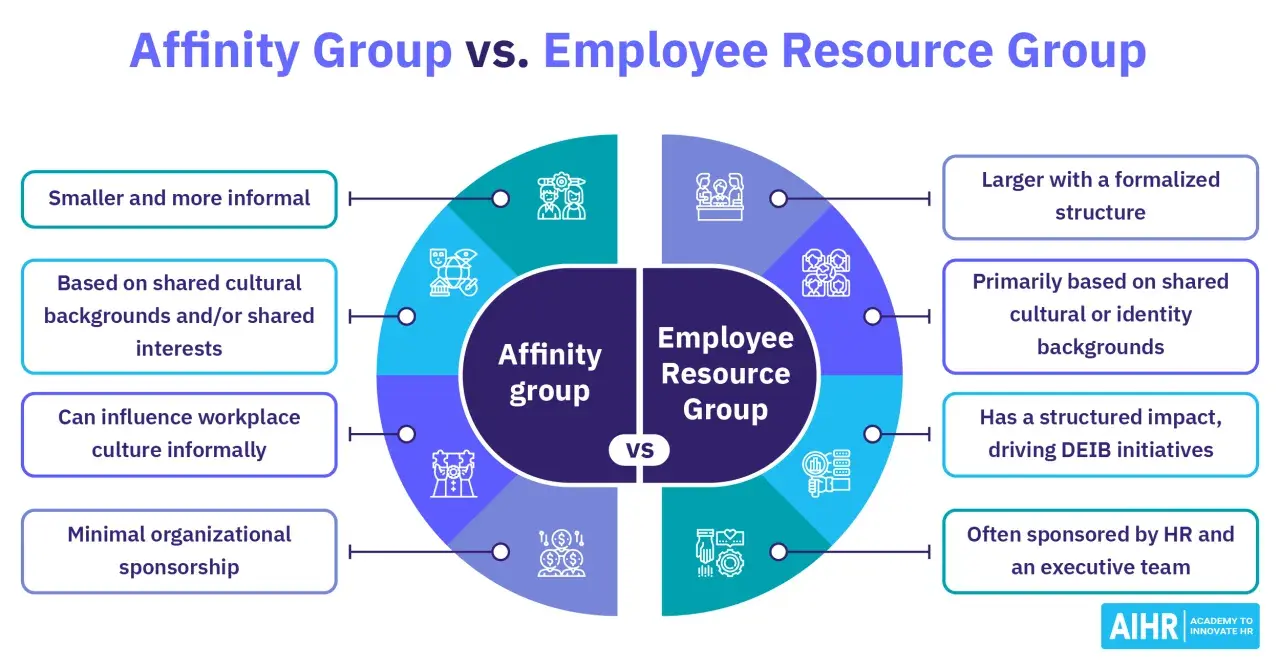
| Affinity group | A group formed around shared identity or lived experience | Sometimes used in more informal or community-oriented settings |
| Business resource group | A version that emphasises organisational value and business outcomes | Used when leaders want to signal strategic relevance |
The practical takeaway is simple: if the group helps people speak up, build connections, and influence how work is done, it is serving the same core function regardless of the name. Once that baseline is clear, the more useful question is why these groups matter so much to culture.
Why ERGs matter to culture, not just communication
I see ERGs as a test of whether inclusion is real or merely decorative. A company can publish values and still leave people feeling invisible; an active network gives employees a channel to share what work feels like from the inside. That is where ERGs become valuable, because they do not just support individuals, they expose patterns.
Acas notes that inclusive workplaces are more successful, keep employees motivated, reduce the risk of bullying, harassment, and discrimination, and improve ideas and problem-solving. ERGs help in that process because they make it easier to hear what different groups experience before issues turn into disengagement or conflict.
- Belonging increases when people see peers with similar experiences and know they are not the only ones navigating a challenge.
- Voice improves when employees have a recognised way to raise concerns or propose changes.
- Retention tends to strengthen when people feel their identity and contribution are both respected.
- Leadership development often follows because ERG leads learn to run meetings, influence stakeholders, and manage projects.
- Decision quality improves when leaders get sharper feedback from a wider range of lived experience.
The mistake is to treat all of that as soft value. In reality, it affects how people stay, how they speak up, and how confidently they build careers inside the organisation. That only works, though, if the group has structure rather than goodwill alone.

What separates a useful ERG from a token one
The difference between a meaningful network and a decorative one is usually easy to spot once you know what to look for. A serious ERG has a purpose, a sponsor, a route to decision-makers, and enough time or budget to do something with what it learns. A token group has a logo, a launch post, and very little power.
| What you should see | A useful ERG | A token ERG |
|---|---|---|
| Purpose | Clear focus on employee voice, support, or a specific culture issue | Vague mission that sounds good but changes nothing |
| Leadership support | An executive sponsor who removes blockers and opens doors | A senior name attached for optics only |
| Time and budget | Members have some protected time and a realistic budget | Volunteers are expected to do everything on top of their day job |
| Influence | Feedback reaches people who can change policy, practice, or behaviour | Feedback disappears into an inbox or a slide deck |
| Measurement | Success is tracked through participation, impact, and outcomes | Only attendance is counted, so activity is confused with progress |
How to build one that works in a UK organisation
When I help teams think about this, I start with a basic rule: build for voice first, visibility second. If the network exists mainly to look progressive, it will drain energy quickly. If it is designed to listen, connect, and influence, it can become one of the most practical tools in the culture toolkit.
Define the purpose and the boundary
Decide what the group is for and what it is not for. Is it meant to support a particular community, improve inclusion data, advise leaders, or connect people across departments? The more precise the purpose, the easier it is to avoid drift.
Choose support that matches the ambition
Pick an executive sponsor who will actually engage, not just sign off the launch. In UK organisations, it also helps to align the network with the wider EDI strategy, and with any employee consultation or representative structures that already exist. A network should complement those channels, not compete with them.
Make participation realistic
Members should not be expected to do high-value culture work in their spare time forever. A small budget, clear meeting cadence, and protected time for leads can make a bigger difference than glossy branding. If the workload is hidden, the best people burn out first.
Read Also: No Accountability? Rebuild Trust & Performance Now
Close the feedback loop
Every good ERG needs a visible route from insight to action. If a group flags a problem, leaders should be able to say what will happen next, who owns it, and by when. That is how trust grows. Without that loop, the group becomes a place where people vent but stop expecting change, which is usually the point where momentum starts to fade.
Common mistakes that quietly weaken ERGs
The problems usually do not come from bad intentions. They come from underestimating how much structure a healthy network needs. I see the same mistakes repeatedly, and they are predictable enough to avoid if leaders are honest about them.
- Using the ERG to fix everything. Volunteers cannot repair a broken promotion process, a poor manager culture, and a weak policy framework on their own.
- Overloading the same people. The most engaged employees often end up doing the most unpaid culture labour, which creates a quiet fairness problem of its own.
- Measuring activity instead of impact. Headcount at events is useful, but it does not tell you whether people feel safer, more supported, or better represented.
- Ignoring intersectionality. People can belong to more than one underrepresented group, so a single network may not capture the full picture of their experience.
- Letting leaders stay distant. If senior sponsors never attend, never respond, and never remove barriers, the group learns that it is being watched rather than heard.
These mistakes matter because they turn a potentially valuable mechanism into a symbolic one. When they are avoided, the ERG starts to function as a practical signal of how healthy the culture really is.
The ERG model that actually changes culture
The version of ERG I trust is the one that can name a real change it helped create. That might be a better onboarding experience, a more inclusive meeting norm, a policy fix, or a clearer path for speaking up. If the group can point to one decision it improved and one audience it helped leaders understand, it is doing meaningful work.
For me, that is the real value of the acronym in workplace culture. It is not the label, and it is not the launch event. It is the mechanism that helps an organisation hear itself more accurately, then respond before small issues become expensive ones. That is what makes an ERG worth supporting in the first place.
