
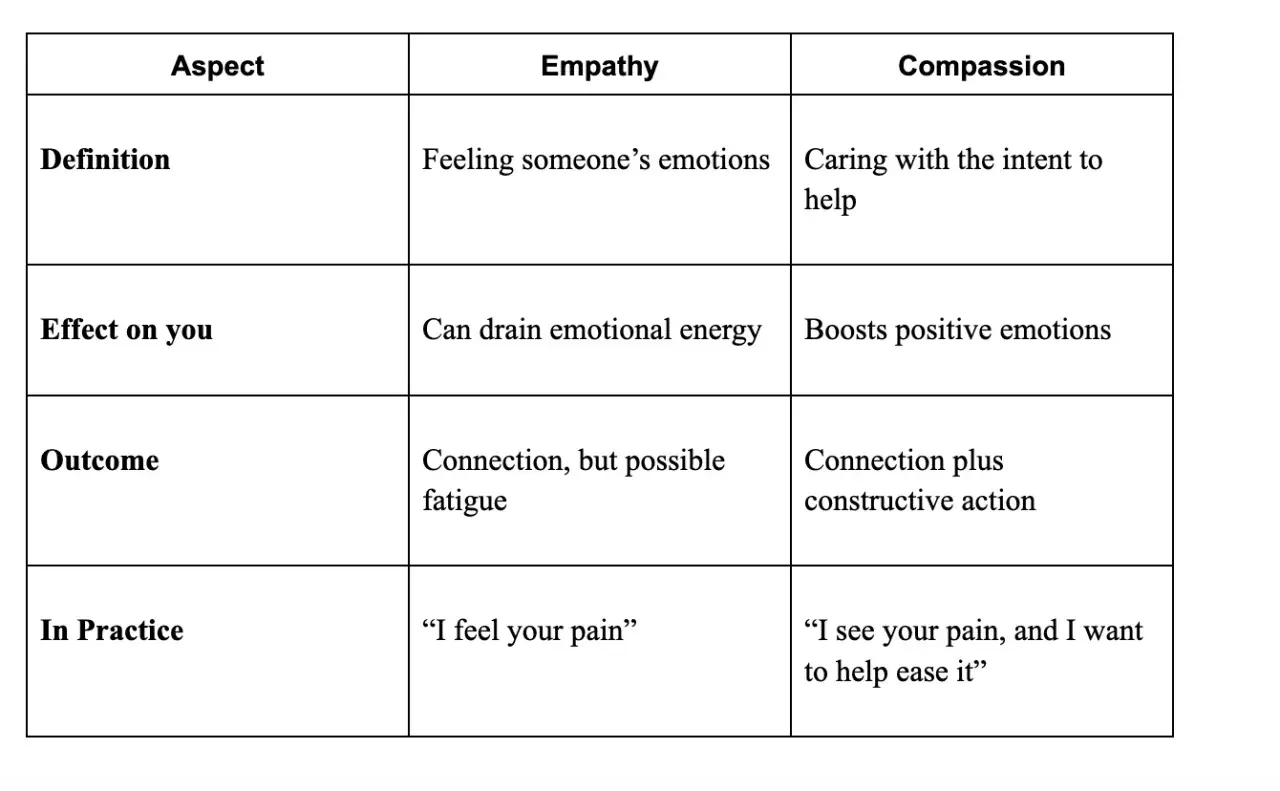
The difference between compassion and empathy matters most in moments that call for more than polite concern. In a team meeting, a performance review, or a difficult one-to-one, the two can look similar on the surface, but they do different jobs: one helps you understand what someone is experiencing, the other pushes you to respond in a useful way. In workplace communication, that distinction changes how managers give feedback, handle pressure, and support people without becoming vague or overinvolved.
Key points to keep in mind
- Empathy is about recognising and understanding another person’s experience.
- Compassion adds a wish to ease that person’s difficulty, usually through action.
- In the workplace, empathy improves listening; compassion improves follow-through.
- Too much empathy without boundaries can leave managers emotionally drained.
- Compassion without clarity can sound soft but still fail to solve the problem.
- The best communication at work usually combines both, especially in feedback, conflict, and support conversations.
What empathy and compassion mean in everyday work
I usually frame empathy as understanding what someone is feeling from their point of view. The APA describes it that way: seeing the situation through the other person’s frame of reference rather than your own. Compassion goes one step further. It is not just recognising the strain someone is under; it includes the intention to help reduce it.
That is why these two ideas are related but not interchangeable. Empathy helps you notice the human reality behind the behaviour. Compassion helps you decide what support, adjustment, or next step is appropriate. In plain English, empathy says, “I can see this is hard.” Compassion says, “I can see this is hard, and I want to do something constructive about it.”
| Aspect | Empathy | Compassion |
|---|---|---|
| Core focus | Understanding another person’s experience | Understanding plus a desire to help |
| Typical question | “What is this like for them?” | “What can I do that would genuinely help?” |
| Best use | Listening, reading the room, managing conflict | Support, follow-up, problem-solving, leadership decisions |
| Main risk | Absorbing too much of other people’s distress | Sliding into pity, performative care, or weak boundaries |
| Workplace result | People feel heard | People feel supported and less stuck |
The King's Fund describes compassionate leadership as careful listening, understanding, empathising with, and supporting people. I think that sequence matters. It starts with awareness, but it does not stop there. That is the point most teams miss when they treat empathy as the whole answer.
Why the distinction changes the quality of a conversation
The difference matters because a conversation at work is not just an emotional exchange. It is also a decision point. If I only use empathy, I may understand a colleague’s frustration but still leave them with no clarity. If I only jump to compassion without empathy, I may offer a fix that misses the real issue entirely.
That becomes obvious in leadership. CIPD has long noted that a lack of empathy in leadership can damage morale and engagement. I would go a step further: in most organisations, poor communication is rarely caused by harsh words alone. It is often caused by people feeling either unheard or unmanaged. Empathy reduces the first problem. Compassion reduces the second.
In practical terms, the distinction changes four things:
- Listening quality - empathy keeps you from interrupting too soon or making the issue about yourself.
- Tone - compassion helps you stay calm and respectful even when the situation is messy.
- Boundaries - empathy helps you connect; compassion helps you support without overpromising.
- Follow-through - compassion turns a good conversation into something the other person can actually use.
That is why the best managers do not choose one and ignore the other. They use empathy to understand the signal, then compassion to shape the response. Once you see that sequence, the everyday examples become much clearer.

How they show up in common workplace moments
The easiest way to understand the difference is to watch it play out in real situations. In each of the examples below, empathy is the first move, but compassion is what makes the conversation useful.
A missed deadline
An empathetic response sounds like this: “You seem under real pressure. Tell me what got in the way.” That opens the door to honesty. A compassionate response adds structure: “Let’s work out what needs to change, what can be reset, and what support you need to finish this properly.”
The value here is not softness for its own sake. It is accuracy. A missed deadline may point to workload, unclear priorities, or a capability gap. Compassion keeps the discussion practical instead of personal.
A colleague struggling with illness or bereavement
This is where empathy alone can feel inadequate. You need to recognise the human reality first, but then you also need to act with care. A compassionate manager might adjust timings, reduce non-essential meetings, or agree a temporary handover. That is not charity; it is sensible communication that protects both dignity and delivery.
In this kind of conversation, words matter less than consistency. If the support sounds warm but nothing changes, people notice immediately.
A conflict between team members
Empathy helps each person feel heard without immediately being judged. Compassion helps you move the discussion away from blame and towards repair. The goal is not to decide who feels most upset. It is to create a workable next step that respects both people and the wider team.
I find this is where managers often rush. They want the tension to disappear fast, so they skip the listening stage. Usually that only makes the conflict harder to resolve later.
Read Also: Calm Communication at Work - Master Your Tone, Boost Impact
A remote or hybrid check-in
In a distributed team, empathy is often about noticing what is not being said. A quiet colleague may not be disengaged; they may simply be overloaded, isolated, or unsure how to raise a problem. Compassion shows up when you follow the check-in with something tangible: clearer priorities, a shorter meeting, or a better communication rhythm.
This is one of the most important distinctions in modern workplace communication. Remote teams rarely need more friendly language. They need more accurate reading of signals and more deliberate follow-through.
When these moments are handled well, people do not just feel understood. They feel that understanding led somewhere useful. That leads directly to a more important question: when is empathy enough, and when do you need compassion to take over?
When empathy helps and when compassion is the better tool
Empathy is especially valuable at the start of a conversation. It helps you slow down, listen properly, and avoid jumping to conclusions. Compassion becomes more important once the problem is clear and a response is needed. If you stop at empathy, you may create a nice atmosphere without solving anything. If you go straight to compassion, you risk fixing the wrong problem.
A simple way to think about it is this:
- Use empathy when someone needs to be understood, heard, or emotionally settled enough to speak honestly.
- Use compassion when someone needs practical support, a boundary, an adjustment, or a next step.
- Use both when a conversation involves pressure, disappointment, conflict, or personal difficulty.
There is also a limit to empathy that many managers underestimate. If you absorb too much of other people’s stress, you can become reactive, avoidant, or emotionally flat. That is one reason people sometimes talk about burnout in caring roles. Compassion can be healthier because it keeps the focus on helpful action rather than emotional imitation. In other words, you can care deeply without carrying everything.
This matters a lot in the UK workplace, where line managers are often expected to balance wellbeing, performance, and consistency in the same conversation. Empathy helps them keep the human side intact. Compassion helps them avoid turning concern into confusion.
Once you understand that balance, the next challenge is spotting the mistakes that make both concepts sound fake in practice.
The mistakes that make support feel hollow
Most people do not fail because they lack good intentions. They fail because they confuse warmth with usefulness. In my experience, these are the most common errors:
- Performing concern - saying the right words while making no real adjustment or follow-up.
- Rushing to fix - offering solutions before the other person has finished explaining the issue.
- Using empathy as agreement - assuming that understanding someone means endorsing every view they hold.
- Using compassion as softness without boundaries - avoiding accountability because the conversation feels uncomfortable.
- Explaining away poor behaviour - using someone’s stress as a reason to ignore impact on the team.
These mistakes usually happen when managers want to appear supportive but do not want the awkwardness that real support involves. Real compassion is not indulgent. It can include honest feedback, firm limits, or a difficult decision, as long as it is delivered with basic human respect.
That is the standard I would aim for: understanding without passivity, care without vagueness, and boundaries without coldness. With that in place, the final step is turning the idea into a usable habit.
A practical way to use both in your next conversation
If I were coaching a manager, I would give them a very simple sequence to use in almost any difficult conversation.
- Notice - pause long enough to pick up the emotional tone, the facts, and what may be driving the behaviour.
- Name - reflect back what you see in a calm, neutral way: “It sounds like the workload has become unmanageable.”
- Ask - check what the other person needs before suggesting your own fix.
- Act - agree a next step that is specific enough to matter.
That pattern works because it keeps empathy and compassion in the right order. Empathy helps you read the situation accurately. Compassion turns that understanding into something useful, respectful, and concrete. If you keep that sequence in mind, you will communicate more clearly, lead more steadily, and handle difficult conversations without making them colder than they need to be.
