
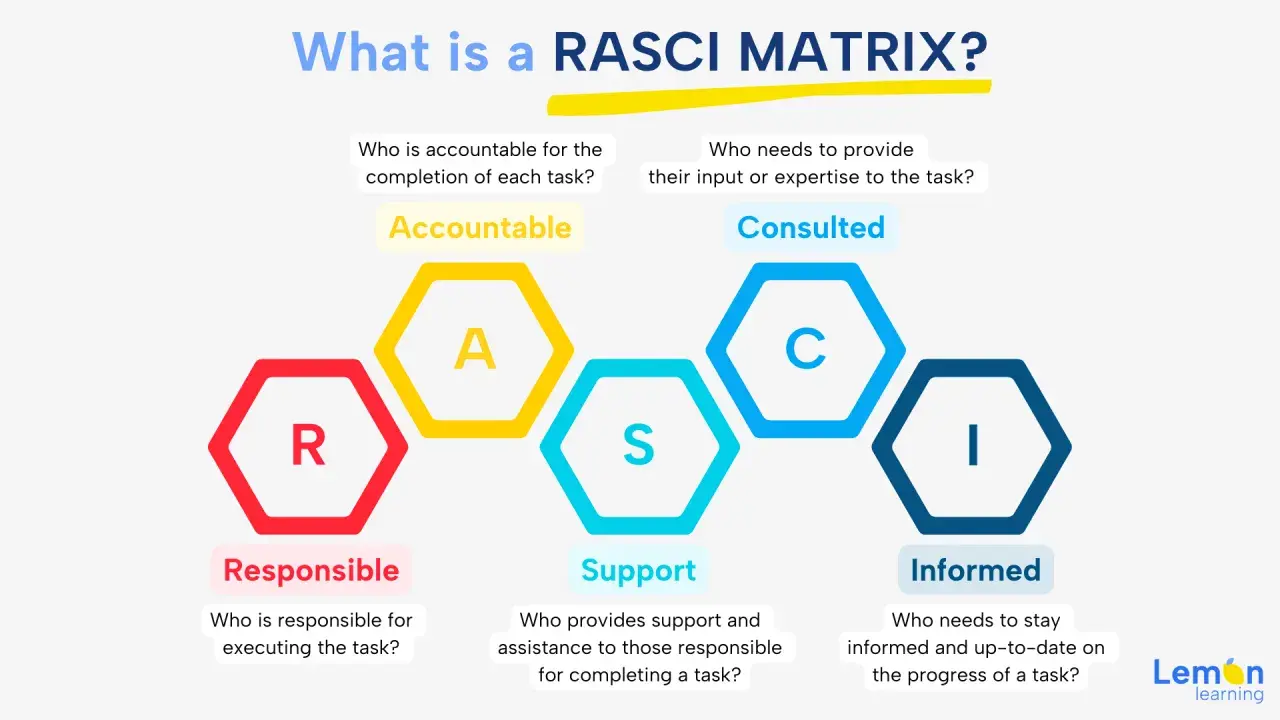
Choosing between RACI and RASCI is usually not about methodology; it is about whether your team needs a lean ownership map or a fuller picture of how work gets done. RACI keeps the focus on one owner, clear input, and clean handoffs, while RASCI adds a Support role when delivery depends on people who actively help but do not own the outcome. In management work, that small difference can either sharpen accountability or create unnecessary noise, so the better model is the one your team will actually use.
The practical difference is whether support needs its own line
- RACI is the simpler option and works well when one person owns delivery.
- RASCI is useful when helpers are doing real work, not just giving opinions.
- RACI usually wins on speed, readability, and maintenance.
- RASCI can reduce handoff confusion in multi-team projects, change programmes, and service transitions.
- The wrong choice is the one that adds names without improving decisions.
What RACI and RASCI are solving in the first place
I use responsibility assignment matrices for one reason: to stop people from guessing who owns what. A good matrix answers four simple questions - who does the work, who owns the result, who gives input, and who needs to stay informed. That may sound basic, but in real management settings it is often the difference between steady delivery and a project that keeps drifting back into debate.
RACI is the classic version of that idea, and it works best when the task structure is reasonably clear. RASCI keeps the same foundation but adds a Support role for people who materially help the task move forward. The important point is that this is not an org chart and it is not a stakeholder list; it is a tool for decision clarity. Once you see that, the comparison becomes much easier to judge in practice.
RACI vs RASCI at a glance
Here is the version I keep in mind when I am deciding which matrix belongs on the wall and which one should stay in the notebook.
| Aspect | RACI | RASCI |
|---|---|---|
| Core roles | Responsible, Accountable, Consulted, Informed | Responsible, Accountable, Support, Consulted, Informed |
| Main idea | Keep ownership clean and easy to read | Show who helps the work as well as who owns it |
| Best fit | Projects with straightforward handoffs and one clear owner per task | Projects where support work is repeated, visible, and important |
| Complexity | Lower | Moderate |
| Main risk | Too many consulted voices or vague ownership if the matrix is badly designed | The support column can become a second responsibility column if it is not governed tightly |
| My default use | Most team plans, project plans, and change work | Multi-team programmes, transition work, and operational delivery |
The headline difference is simple, but the practical effect is not. RACI is easier to scan and easier to maintain, while RASCI gives you more detail where the work depends on hands-on help from other people. If that extra detail does not change behaviour, it is usually just decoration. If it reduces confusion around who is actually supporting the task, it can be worth the extra column.
When RACI is the cleaner choice
I reach for RACI when the main problem is ownership drift, not delivery complexity. If one person can clearly drive the work, one other person can approve or own the outcome, and the rest of the team only need input or updates, RACI is usually enough. It keeps the conversation sharp, which matters in UK organisations where cross-functional work already has enough friction without adding another layer of administration.
- The task has one obvious owner and a small number of stakeholders.
- Consulted people are giving input, not doing the work themselves.
- The team needs a document that stays readable at a glance.
- Decisions need to move quickly and not get buried under process.
- The project is early-stage, small, or still finding its operating rhythm.
In those situations, RACI does the important job: it removes ambiguity without over-engineering the workflow. Once work starts to depend on repeated support from other teams, though, the simpler model may no longer be enough.
When RASCI earns its extra column
RASCI makes sense when support work is not incidental. I see that most often in implementation, onboarding, service transition, IT change, compliance-heavy delivery, and programmes where the core owner cannot succeed without help from operations, specialist teams, or external partners. In that setting, naming support is useful because it makes resourcing and coordination visible instead of leaving them implied.
- Support is recurring, not occasional.
- The same helpers keep appearing across multiple tasks.
- The team keeps asking who is actually backing the Responsible person.
- There is a real handover between delivery and operations.
- The work depends on specialists who are not the owner, but are more involved than a typical consultant.
The caution is just as important as the advantage. Support must mean active help, not vague availability. If the person only needs to be informed, they do not belong in Support. If the person is effectively co-owning the task, then the row probably needs to be split or redefined instead of being padded with extra letters.
How to build a matrix your team will actually use
I have seen too many matrices fail because they were written around people instead of work. The better approach is to start with the task or decision, then layer roles on top. When I do that, I usually test each row by reading it aloud and asking, “Who does the work, who owns the result, who gives meaningful input, who needs updates, and who is genuinely helping execute this?” If that sentence gets messy, the row is probably too broad.
- Start with a short list of tasks, deliverables, or decisions.
- Assign one Accountable person per row. I do not treat this as optional.
- Mark the person or people doing the work as Responsible, but keep it focused.
- Keep Consulted to the people whose input can actually change the outcome.
- Add Support only when the help is active, repeatable, and visible.
- Review the draft with the team and remove anything that does not change how work is done.
The rule I use when the choice is not obvious
If I am advising a manager, I start with RACI unless there is a clear reason not to. It is the better default because it keeps responsibility visible without turning the matrix into a mini-operating model. I only move to RASCI when support work is frequent enough, important enough, and repetitive enough to deserve its own place on the page.
If the extra column does not change how the team plans, escalates, or allocates help, I remove it. A strong responsibility matrix should make delegation easier, not harder; it should shorten conversations, not create new ones. That is the real measure I use, and it is usually the fastest way to decide whether RACI or RASCI is the better fit for the work in front of you.
