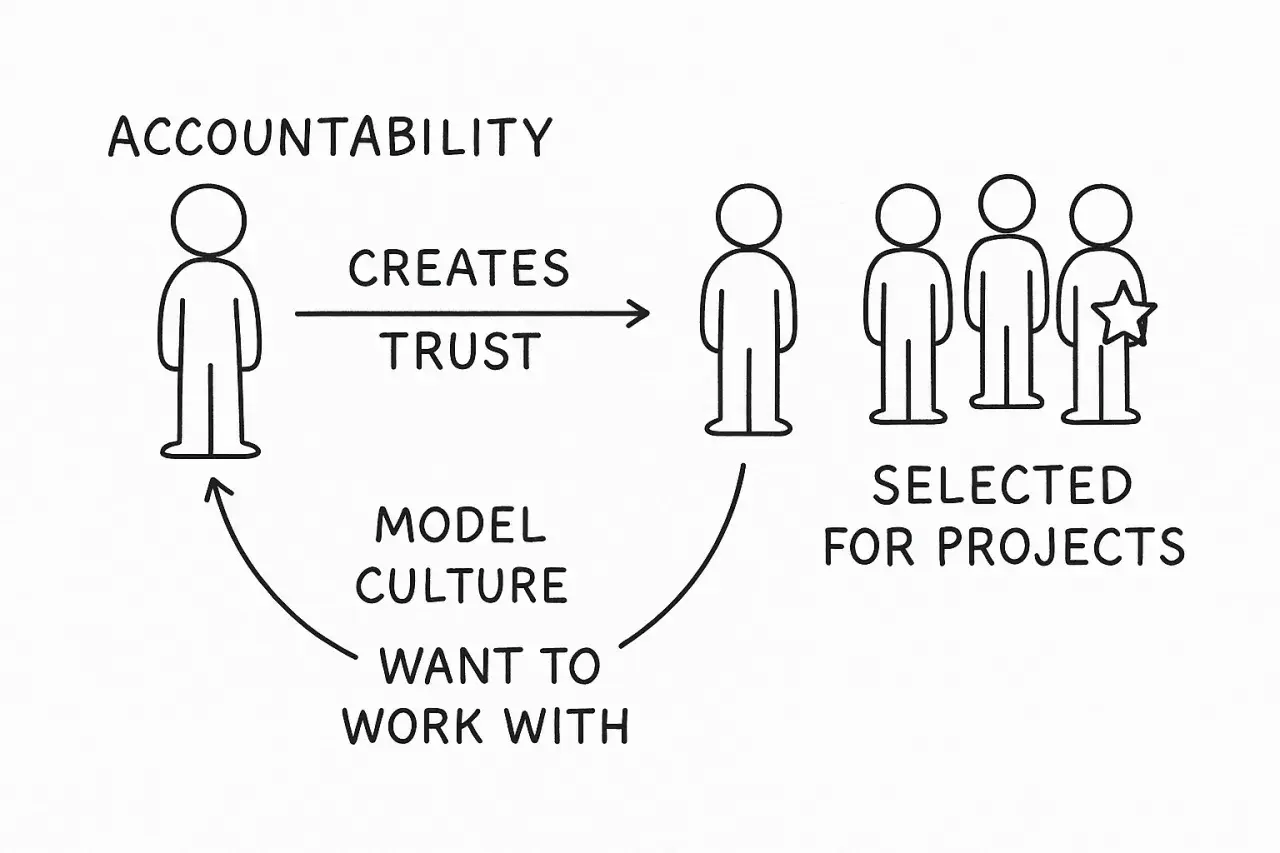
Healthy workplace culture is not built on more messages; it is built on clearer expectations, cleaner handovers, and leaders who follow through. The real challenge is not sending more updates, but building a system where communication and accountability reinforce each other instead of competing. In practice, that means people know what changed, who owns the next step, and how decisions are reviewed when something goes wrong.
What this means for everyday teamwork
- Information only helps when it leads to action. A message should make the next step, owner, and deadline obvious.
- Healthy accountability is visible. People speak up early, issues are logged, and follow-up actually happens.
- Leaders set the tone. If managers are vague, defensive, or inconsistent, the whole culture drifts in that direction.
- Small routines matter. Short check-ins, written decisions, and quick reviews reduce confusion far more than big speeches.
- Hybrid work raises the stakes. When people are not in the same room, expectations for response times and escalation need to be explicit.
- The goal is not blame. Strong cultures combine candour, fairness, and ownership without making people afraid to report problems.
Why information alone does not create accountability
Information is cheap. Ownership is not. A team can sit through five meetings, read three update emails, and still miss the point if nobody has been named as the person responsible for moving work forward. That is why I treat accountability as a behavioural outcome, not a slogan: it shows up when people know what they are responsible for, what good looks like, and what happens if they do not act.
The problem starts when communication is treated as a broadcast instead of a working tool. If a manager shares a change but does not explain the impact, people fill in the blanks themselves. If a deadline is announced but no one checks progress, the deadline becomes a hope, not a commitment. And if errors are discussed only after the damage is done, people learn to hide risk instead of surfacing it early.
The strongest teams I have seen are not the ones with the most polished updates. They are the ones where messages lead to decisions, decisions lead to action, and action is visible enough that no one can pretend confusion was harmless. That is where the culture starts to shift, because people can finally see the difference between being informed and being responsible.
Once that distinction is clear, the next question is what a healthy culture actually looks like in day-to-day behaviour.
What a healthy workplace culture looks like
HSE treats communication as one of the main influences on organisational culture, alongside management commitment, employee involvement, and learning. That matches what I see in practice: culture is not a statement on a wall, it is the pattern people experience when they ask questions, raise risks, or admit they need help. CIPD describes employee voice as the way people share views, concerns, and suggestions that influence decisions at work, and that is exactly where healthy accountability begins.| Culture signal | Healthy version | Warning sign | What to do |
|---|---|---|---|
| Expectations | Every task has a clear owner, deadline, and quality standard. | “Someone will handle it” is good enough. | Name one owner, one reviewer, and one due date. |
| Updates | People report progress and blockers early. | Updates arrive only when asked for, or when something has gone wrong. | Use a simple weekly check-in format and ask for risks, not just achievements. |
| Mistakes | The team looks at process, context, and prevention. | Blame, defensiveness, or silence. | Review what failed and what needs to change within 48 hours. |
| Decisions | Key choices are written down and easy to revisit. | Decisions are made in a meeting and forgotten by the next day. | Keep a short decision log with the rationale and the owner. |
| Speaking up | People can challenge a plan without being punished for it. | Employees stay quiet until they are already disengaged. | Create a visible route for raising concerns and respond in public where appropriate. |
How leaders make ownership visible
Leaders often think accountability is about pressure. In reality, it is mostly about clarity. A manager who says, “Can you look into this?” has not yet created ownership. A manager who says, “Please confirm the cause, update the client by 3 p.m., and send me the revised plan before 2:30 p.m.” has. The difference is not style; it is precision.
I usually look for five behaviours that turn vague responsibility into real ownership:
- Set outcomes, not just tasks. People need to know what success looks like, not only what activity is expected.
- Make the owner visible. One person should be clearly responsible for progress, even if several people contribute.
- Put the deadline in writing. Spoken deadlines drift; written ones create a reference point.
- Close the loop. If someone raises a problem, they should hear back with a decision, next step, or explanation.
- Reward early honesty. The person who flags a risk early should be treated better than the person who hides it until the last minute.
There is also a distinction worth making here: accountability is not the same as punishment. If every mistake is treated as a personal failure, people become careful in the wrong way. They protect themselves instead of the work. Good leaders keep standards high, but they also make it safe to report a miss before it becomes a crisis. That is where the discipline of the team actually improves.
Once leaders are modelling that behaviour, the question becomes how to make it routine rather than occasional.
The everyday habits that keep teams aligned
Most organisations do not fail because they lack talent. They fail because their routines are sloppy. I find that a few small operating habits usually do more for alignment than a dozen culture workshops. The point is not to create bureaucracy. It is to create a steady rhythm that keeps people from drifting apart.
| Routine | Best cadence | What it prevents | Why it works |
|---|---|---|---|
| Short team stand-up | 10 to 15 minutes, 3 to 5 times a week | Hidden blockers and duplicate effort | It forces quick visibility on priorities and dependencies. |
| One-to-one check-in | 20 to 30 minutes every week | Managers discovering problems too late | It gives people space to raise concerns they would not say in a group. |
| Decision log | Updated whenever a material choice is made | Memory drift and contradictory instructions | It records what was decided, why, and who owns the next step. |
| After-action review | Within 48 hours of a miss, incident, or close call | Repetition of the same mistake | It turns a failure into a learning moment before the detail fades. |
| Weekly written update | Once a week for cross-functional work | People assuming silence means progress | It creates a simple record of progress, risks, and decisions. |
I especially like the weekly written update for cross-functional work. In a busy organisation, verbal agreements disappear fast, and the first thing to vanish is usually the part that mattered most. A written note does not have to be long. Three lines are often enough if they answer: what moved, what is blocked, and what needs a decision.
These routines become even more important when the team is not working in one place every day.

Where hybrid work makes the gap wider
Hybrid work does not weaken accountability on its own, but it exposes weak systems very quickly. When people are remote part of the week, casual correction disappears. Nobody catches the half-finished handover by the coffee machine, and nobody notices a confused look that would have triggered a quick explanation in the office. That means the organisation has to replace accident-prone informality with deliberate structure.
In hybrid teams, I would make three things explicit. First, define which channel is used for what: instant messaging for quick coordination, email or task tools for decisions, and meetings for complex discussion. Second, set response expectations so that silence does not become a source of anxiety. Third, document escalation paths so that people know exactly when a blocker needs a manager, a peer, or a project owner.
For UK employers, the policy side matters too. If the organisation is formalising flexible working, the working pattern, supervision, communication method, and performance expectations should be written down. CIPD notes that formal flexible working requests in the UK still sit within a statutory two-month response window unless an extension is agreed, and I would treat that as a useful reminder that delay itself can damage trust. The faster a team can turn a request or a concern into a clear answer, the less room there is for suspicion.Hybrid culture works best when managers measure output without making people feel watched, and when employees know how to raise problems before they turn into missed work or missed deadlines.
The signals I would watch over the next 30 days
If you want to know whether a culture is improving, do not start with slogans. Start with behaviour. The next month usually tells you a great deal about whether the relationship between information sharing and responsibility is getting healthier or just better packaged.
- People raise risks earlier instead of waiting until the last possible moment.
- Managers ask better follow-up questions because they can see the work, not just the status.
- Meetings get shorter because decisions are written down and revisited.
- Fewer tasks are dropped because ownership is named clearly from the start.
- Errors lead to process changes, not just frustrated conversations.
- Employees speak more plainly because they expect to be heard, not punished.
If those signals start showing up, you are not just improving communication. You are building a workplace where people can be honest, finish what they start, and learn from misses without fear. That is the practical version of a strong culture, and it is the version that lasts.