
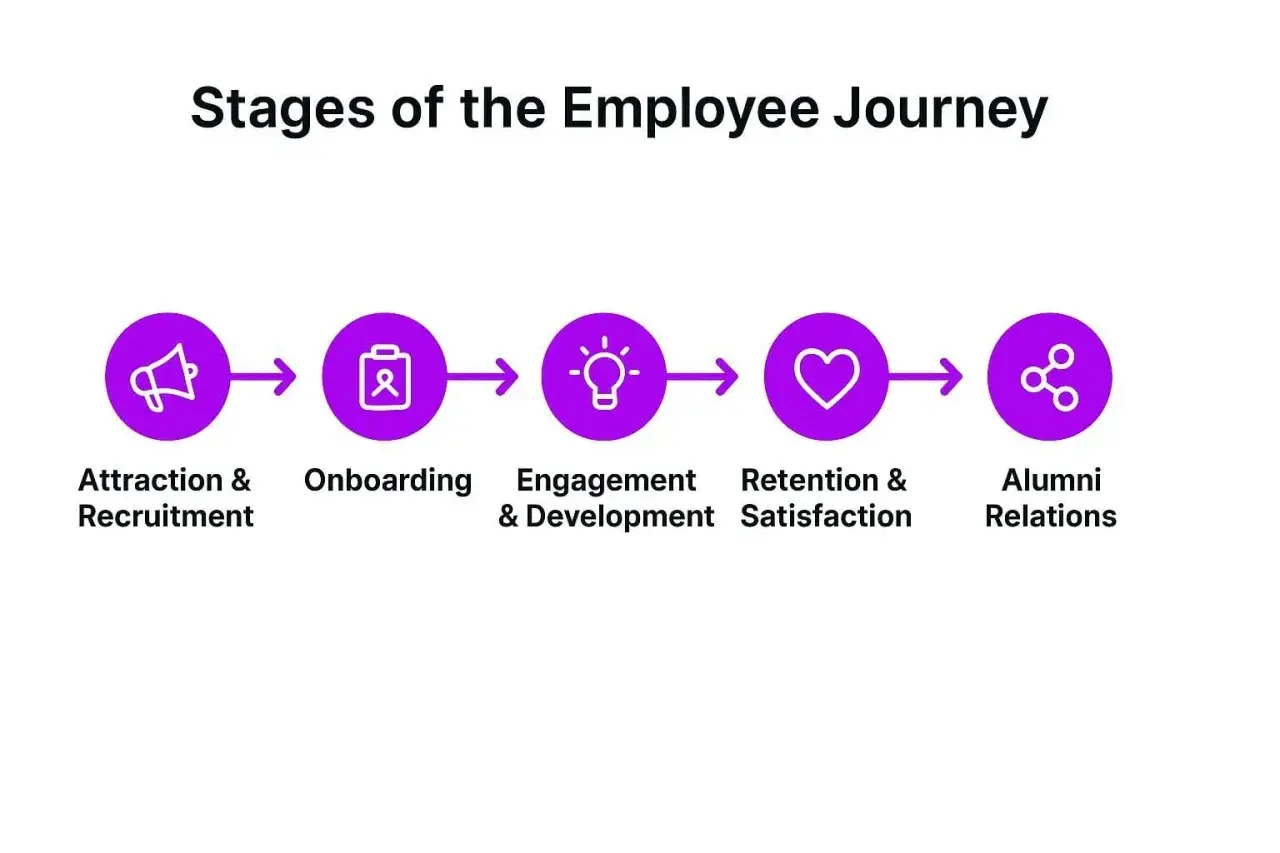
The employee journey is never just a hiring process. It starts before someone applies, continues through onboarding, performance, development, and eventually ends in the way they leave. When those moments are handled well, culture feels credible; when they are handled badly, even a strong employer brand starts to look thin.
In this article, I break down the stages of employee experience, show what people need at each point, and explain why workplace culture matters more than policy documents. I also look at the practical signals that tell you whether your organisation is building trust, growth, and retention, or just managing administration.
The employee journey works best when each stage reinforces the same promise
- Attraction and recruitment set expectations long before day one.
- Onboarding should remove confusion, not just hand out forms and systems.
- Managers shape daily culture through feedback, fairness, and follow-through.
- Flexibility, development, and wellbeing now belong in the core employee deal.
- Exit handling matters because it affects referrals, reputation, and rehiring.
What the employee journey really includes
When I talk about employee experience, I am not talking about a perk programme or a glossy set of HR initiatives. I mean the full run of interactions someone has with an employer: what they see before joining, what they feel in the first week, how they are managed, whether they can grow, and how they are treated when they decide to move on.
The reason this matters is simple. People rarely judge a workplace on one big moment. They judge it on repeated signals: whether communication is clear, whether promises are kept, whether managers behave consistently, and whether the organisation makes it easy to do good work. That is why the stages of employee experience are useful as a map, even though real life is messier than a neat sequence.
I usually compress the journey into a few questions employees keep asking themselves: Do I trust this place? Do I know what is expected? Can I do my best work here? Can I grow here? Will I be treated well if I leave? Once you can answer those questions honestly, the rest becomes much easier to design. That leads naturally to the stage-by-stage view.

The stages that matter most and what each one needs
A practical employee lifecycle is less about labels and more about the decisions that matter at each point. The table below is the version I find most useful because it connects the stage to the employee’s real question and the cultural signal behind it.
| Stage | What the employee is asking | What good culture looks like | Where it usually breaks |
|---|---|---|---|
| Attraction | Can I see myself working here? | Clear employer brand, honest job ads, realistic expectations | Overpromising, vague roles, a gap between marketing and reality |
| Recruitment | Am I being treated fairly and promptly? | Structured interviews, quick communication, respectful feedback | Silence, bias, long delays, inconsistent messaging |
| Onboarding | Can I get up to speed here? | Role clarity, tools on day one, manager check-ins, social welcome | Information overload, poor planning, no follow-through |
| Early performance | What does good look like? | Regular feedback, clear priorities, psychological safety | Annual-only reviews, unclear standards, reactive management |
| Development and progression | Can I grow without leaving? | Learning plans, stretch work, internal mobility, coaching | No visible career path, training with no application |
| Retention and wellbeing | Will I stay energised and valued? | Recognition, flexibility, healthy workloads, fair pay decisions | Burnout, inconsistency between teams, weak recognition |
| Exit and alumni | Will I leave with respect? | Thoughtful handover, honest exit feedback, professional offboarding | Leavers are ignored, rushed out, or treated like a problem |
The table looks linear, but in practice the stages overlap. A new hire may already be judging development opportunities, and a high performer may be quietly testing whether the organisation still feels fair. That overlap is exactly why culture matters so much, which is the next piece of the puzzle.
Why workplace culture changes the outcome
Culture is not the posters in reception, the values on the website, or the one good town hall people remember for a week. Culture is what happens when priorities clash, when a manager is under pressure, when a deadline slips, or when someone asks for flexibility. That is the point where the organisation’s real standards show up.
In my view, culture becomes visible in small decisions long before it appears in formal policy. Do people get a fast, respectful response to a question? Are expectations explained clearly, or are employees left to guess? Are good behaviours rewarded consistently, or only when the leadership team is watching? Those details shape trust far more than most employers admit.
In the UK, flexibility has become part of that cultural test. Employees can request flexible working from day one, so a manager who treats it as an inconvenience is already sending a message about how the organisation sees adult life, wellbeing, and trust. The same is true of psychological safety: people will not raise issues, ideas, or mistakes if they believe the response will be defensive or punitive.
Managers translate policy into reality
I would go further and say that line managers are the main interface between strategy and experience. A sensible policy can still feel harsh in the wrong team, while an imperfect policy can feel workable when a manager is clear, fair, and consistent. That is why EX work fails when it stays in HR and never reaches day-to-day management habits.
Read Also: What ERG Means - Build Impactful Employee Networks
Consistency matters more than perfection
Employees do not expect every problem to disappear. They do expect a reasonable process, a human response, and a sense that similar cases are treated similarly. If one team gets flexibility, coaching, and development while another gets silence and friction, people notice quickly. Once they notice inconsistency, engagement drops even if the headline policies still look strong.
When culture is weak, the same lifecycle starts to produce avoidable damage, and the symptoms are usually predictable. That is what I would look at next.
The mistakes that quietly damage the journey
Most organisations do not ruin employee experience through one dramatic failure. They do it through a series of small, repeatable mistakes that feel manageable in isolation but become toxic in combination.
- They treat onboarding as an event instead of a process. A first-day presentation is not onboarding. Real onboarding covers the first 30, 60, and 90 days, with repeated check-ins and room for questions.
- They rely on annual reviews to carry performance conversations. By the time feedback is saved for a yearly meeting, it often feels generic, late, or unsafe to hear.
- They expect managers to create culture without training them. Good intentions are not enough. Managers need simple routines for feedback, workload discussions, and development conversations.
- They collect feedback and then disappear. Pulse surveys and exit interviews lose credibility when employees never see any action or explanation.
- They apply flexibility unevenly. A culture that says yes to one team and no to another without a clear reason looks arbitrary, not strategic.
- They ignore the exit stage. Offboarding that feels cold or rushed damages referrals, alumni relationships, and future hiring more than many leaders realise.
The common pattern here is not bad intent. It is weak design. Once you recognise that, the fixes become more practical than expensive, which is where I would spend my effort in a UK organisation.
How I would improve it in a UK organisation
If I were improving employee experience from scratch, I would avoid launching a huge, abstract transformation. I would start with the moments that carry the most emotional weight and the most operational risk.
- Map the moments that matter. I would speak to recent hires, line managers, and leavers to find the points where people feel confident, confused, or overlooked.
- Fix the first 90 days. I would make sure every new joiner has a clear role description, a named manager check-in cadence, access to tools, and a realistic probation plan.
- Make manager habits visible. A short weekly one-to-one, a monthly workload conversation, and a quarterly development discussion do more for culture than most internal campaigns.
- Build flexibility into the employee deal. In the UK, I would make flexible working expectations clear in job ads, onboarding, and team norms so people do not have to guess how the organisation really works.
- Create a path for growth inside the business. If people cannot see how to learn, move, or broaden their role, they will eventually look outside.
- Close the loop on feedback. Every survey or exit interview should trigger either a fix, a decision not to act, or a clear explanation of why the issue is being parked.
I would also keep the scope tight. A single team that improves onboarding, feedback, and flexibility consistently is more persuasive than a company-wide programme that looks impressive and changes little. That practical mindset is important because the best way to know whether the work is real is to measure it properly.
What to measure so the work stays real
One of the easiest mistakes in employee experience work is measuring too much of the wrong thing. A single engagement score can hide very different experiences across teams, locations, and manager styles. I prefer a small set of stage-specific indicators that tell me where the journey is helping and where it is fraying.
| Metric | What it tells you | Why it matters |
|---|---|---|
| Offer acceptance rate | Whether your promise matches what candidates want | Weak attraction or poor communication shows up early here |
| Time to productivity | How quickly new starters become confident in the role | Useful for judging onboarding quality and manager support |
| 90-day attrition | Whether new hires are settling in or leaving fast | Often exposes unrealistic role descriptions or poor induction |
| Internal mobility rate | Whether people can grow without changing employer | Strong indicator of development, progression, and retention |
| Pulse survey movement by team | Where the employee climate is improving or slipping | Lets you spot manager-level variation instead of hiding it |
| Exit reasons by category | Why people leave in practice, not just in theory | Shows whether pay, growth, workload, or culture is the real issue |
The point is not to drown people in dashboards. It is to connect one stage to another. If onboarding improves but retention does not, the problem is somewhere later in the journey. If recruitment is strong but people leave during their first year, the promise is not being sustained. Once you read the data this way, the whole employee lifecycle starts to make sense as a system rather than a series of disconnected HR tasks.
When employee experience becomes part of the culture
The strongest organisations do not talk about employee experience as if it were a separate initiative. They build it into the way people are hired, supported, developed, and respected. You can usually spot that kind of organisation because employees know what is expected, managers give honest feedback, flexibility is handled consistently, and leavers are treated with the same professionalism as new joiners.
That is the standard I would aim for in a healthy workplace culture: clarity, consistency, and follow-through. Not perfection, and not a polished story for external audiences. Just a workplace where the employee journey feels credible at every stage, from first impression to final conversation.
If you are improving this in your own team, start small, but do not stay small for long. One better onboarding process, one better manager habit, and one better feedback loop can change how people experience the entire organisation.
