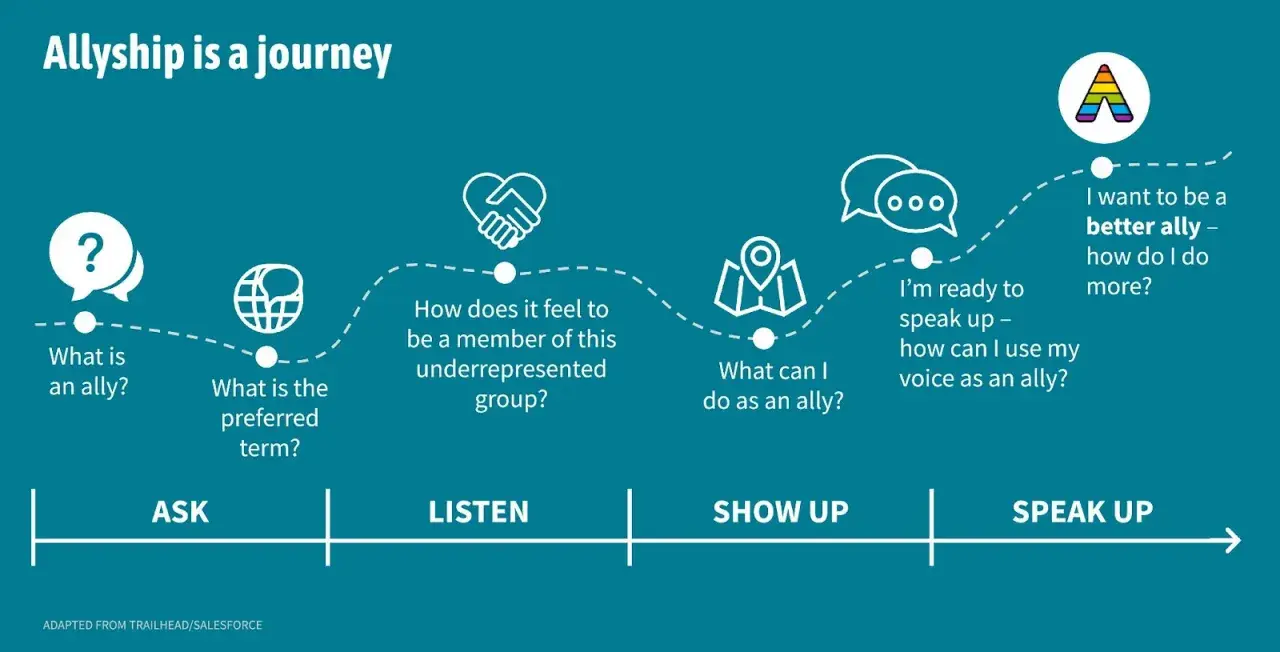
When a colleague is interrupted, overlooked for credit, or left out of an important conversation, good intentions are not enough. A practical allyship definition starts with supporting people from marginalized groups, but the real work is turning that support into consistent action at work. This guide explains what allyship means, how it differs from performative support, and what employees, managers, and leaders can do every day.
Allyship turns good intentions into workplace action
- Allyship is active, not simply an identity or personal belief.
- Listening comes first, especially when someone describes discrimination or exclusion.
- Use your influence to share credit, challenge bias, and improve access to opportunity.
- Center the affected person instead of seeking praise for helping.
- Consistency matters more than visibility, especially when support is inconvenient.
What allyship means in a workplace
Allyship is the ongoing practice of supporting people from a marginalized or underrepresented group and helping remove the barriers they face. An ally may have greater social, professional, or institutional power and chooses to use it to promote fairness, belonging, and equal opportunity.
The word “ally” describes a person, while allyship describes the behavior and process. Someone can support racial equity, gender equality, LGBTQ+ inclusion, disability access, religious freedom, or another cause, but that support becomes meaningful only when it appears in daily decisions.
In practical terms, allyship can mean making sure a colleague receives credit, questioning a biased hiring practice, challenging an offensive comment, or backing a reasonable accommodation. It can also mean listening without becoming defensive when someone explains that a familiar process disadvantages them.
I consider accountability the dividing line between genuine allyship and good public relations. An ally does not need to be perfect, but they do need to remain open to correction and willing to change their behavior.
Allyship is not the same as rescuing
Effective support does not turn the ally into the hero. The goal is not to speak for marginalized employees, take control of their story, or receive recognition for solving a problem they identified.
Strong allies ask what support is wanted, respect confidentiality, and avoid making assumptions. Sometimes the best action is public advocacy. In other situations, it is quietly removing an obstacle, sharing access to a decision-maker, or giving someone the space to lead.
The principles that make support credible
Allyship looks different across workplaces, but several principles appear consistently. They help transform a vague commitment to inclusion into behavior that colleagues can actually experience.
| Principle | What it looks like | Why it matters |
|---|---|---|
| Listen | Take concerns seriously without immediately debating intent. | People are more likely to speak openly when they feel heard. |
| Learn | Study relevant history, language, policies, and workplace patterns. | Employees from marginalized groups should not carry all the educational labor. |
| Act | Challenge bias, share opportunity, and improve unfair processes. | Change requires more than awareness. |
| Share risk | Support inclusion when it may affect your comfort, reputation, or convenience. | Solidarity is clearest when there is something real at stake. |
| Stay accountable | Accept feedback and follow through after making a commitment. | Trust grows from consistent behavior over time. |
One principle deserves special attention: center lived experience. A policy may look neutral on paper while producing unequal results in practice. Listening to the employees affected by it often reveals problems that data or good intentions alone will miss.
That does not mean every individual experience should automatically determine company policy. It means personal experience deserves respectful attention, serious investigation, and a response that does not place the entire burden of proof on the person raising the concern.
How to practice allyship in everyday work
Most workplace allyship happens in ordinary moments rather than dramatic public statements. The following actions are small enough to use immediately, yet meaningful enough to change how work gets done.
Make meetings more equitable
Notice who gets interrupted, who is asked to take notes, whose ideas receive attention, and who rarely gets invited into the discussion. You can redirect credit with a simple sentence such as, “That builds on the idea Jordan raised earlier.”
If someone is interrupted, try saying, “I want to hear the rest of their point”. If the same people dominate every meeting, suggest a structure that gives everyone time to contribute instead of expecting less-heard employees to compete for airtime.
Challenge bias without creating a spectacle
When a colleague makes a dismissive comment, respond clearly and proportionately. You might say, “That assumption could exclude qualified candidates,” or “Let’s focus on the work rather than making a generalization about the group.”
Public correction is appropriate when harm is public or ongoing. A private conversation may work better when the issue appears to be a mistake and the person is likely to learn from direct feedback. The aim is better behavior and safer conditions, not winning an argument.
Share access to opportunity
Allyship is often visible in who gets stretch assignments, introductions, speaking opportunities, and informal mentoring. Before recommending the same familiar colleague again, look for qualified people who have been overlooked.
Be specific when giving support. Instead of saying, “I will keep you in mind,” offer an introduction, nominate the person for a project, or recommend them for a role. Access is more useful than encouragement alone.
Respect names, pronouns, and access needs
Use a person’s stated name and pronouns, correct yourself briefly if you make a mistake, and move on without turning the moment into a performance. For disability inclusion, do not assume what someone needs or treat an accommodation as special treatment.
Practical steps may include sharing accessible documents, describing visual content during presentations, choosing meeting spaces that everyone can enter, or offering more than one way to participate. These changes often improve the working experience for the whole team.
What managers and leaders can do with their power
Individual behavior matters, but managers shape the systems that determine whose work is noticed and whose career progresses. A leader’s allyship therefore has a wider reach than a peer’s supportive comment.
Managers can review promotion criteria, examine who receives high-visibility assignments, and use structured interviews to reduce inconsistent evaluation. They can also track patterns in hiring, pay, retention, performance ratings, and access to development opportunities.
Numbers do not explain everything, but they can reveal a pattern worth investigating. If employees from one group leave at higher rates or remain concentrated in junior roles, a leadership team should examine workload, management quality, advancement paths, and psychological safety rather than assuming the issue is a lack of ambition.
Mentorship is helpful, but sponsorship goes further
Mentorship usually focuses on advice, feedback, and skill development. Sponsorship involves using your influence to recommend someone for a role, invite them into a strategic project, or make their achievements visible to decision-makers.
Both are valuable, but sponsorship changes access to power. Leaders should avoid offering it only to people who remind them of themselves. A fairer approach is to define the criteria for advancement clearly and look deliberately for talent outside established informal networks.
Build systems that do not depend on individual goodwill
A workplace cannot rely on a few enthusiastic employees to carry inclusion efforts indefinitely. Policies should explain how concerns are reported, how retaliation is addressed, and who is responsible for reviewing outcomes.
Training can help, but a one-time workshop rarely changes culture by itself. The strongest programs combine education with clear expectations, manager follow-through, accessible reporting channels, and regular review of results. Culture improves when supportive behavior is reinforced by the system.
Common mistakes that weaken allyship
Many people want to help and still create problems because they focus on appearing supportive rather than understanding what support requires. Recognizing these mistakes makes it easier to correct them.
Performative support
Performative allyship happens when a person makes a visible statement but avoids the less visible work that could create change. Posting a message about inclusion while ignoring biased promotion decisions sends a confusing signal.
Public statements are not automatically meaningless. They become credible when they are connected to specific commitments, resources, and follow-through.
Making the conversation about yourself
When someone describes discrimination, an ally may respond with guilt, defensiveness, or a story about their own intentions. That reaction shifts emotional labor back onto the person who raised the concern.
A better response is to listen, acknowledge the impact, ask what would be useful, and take appropriate action. You can process your feelings later with someone who is not being asked to educate or comfort you.
Expecting marginalized colleagues to teach everything
Learning directly from lived experience has value, but it should not become an unpaid obligation. Before asking a colleague to explain a basic concept, make a reasonable effort to learn independently through reliable workplace resources and established educational materials.
When you do ask for guidance, be precise, respect the person’s time, and accept that they may not want to answer. No one owes personal disclosure in order to make a workplace more inclusive.
Speaking over the people you intend to support
An ally may have more authority in a meeting and still not be the right person to lead every conversation. Taking over can erase the expertise of the people most affected by the issue.
Use your influence to open doors, remove barriers, and amplify someone’s contribution. Then allow them to decide how much visibility and control they want.
Read Also: Employee Engagement: Beyond Perks - Real UK Workplace Change
Treating allyship as a short campaign
Support that appears only during awareness months or after a public controversy often feels conditional. Marginalized employees experience workplace culture every day, including during routine decisions about pay, workload, feedback, and promotion.
Reliable allyship is usually less dramatic. It appears in repeated choices that make fairness part of normal work rather than an occasional statement of values.

The standard I use for honest allyship
When I evaluate whether allyship is working, I look beyond language and ask three practical questions. Who benefits from the action? What barrier has been reduced? Would the behavior continue if no one praised the person responsible?
The answers do not need to be perfect, but they should point toward greater voice, access, safety, and opportunity for the people affected. If the main result is that the ally appears compassionate or progressive, the work probably needs to be refocused.
For an individual employee, a useful starting point is one specific commitment for the next month: interrupt bias when it appears, share credit more deliberately, sponsor someone outside your usual network, or ask your manager how inclusion is measured on your team. Allyship becomes credible through repeated action, especially when it is thoughtful, accountable, and connected to the real conditions of working life.