
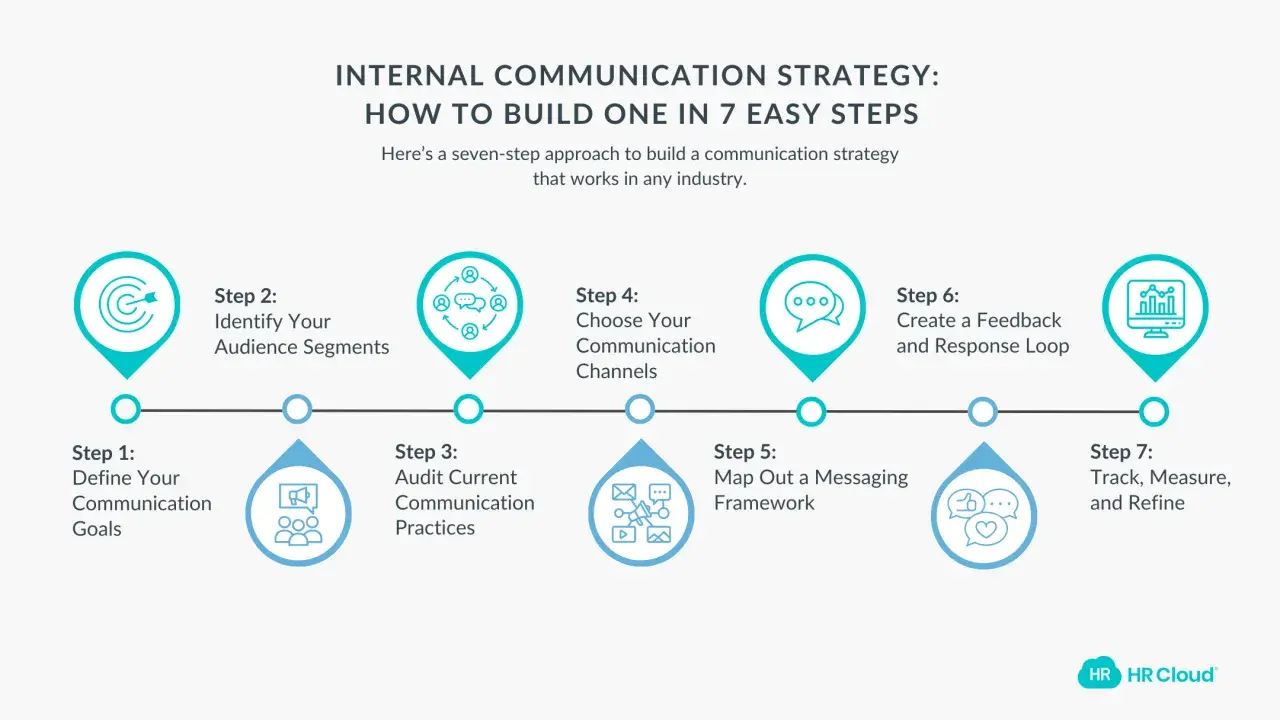
The essentials in one place
- Start with purpose, not channels. The system should support business goals, culture, and day-to-day work.
- Segment audiences carefully. Executives, line managers, office staff, and frontline teams need different levels of detail.
- Give each message a job such as informing, teaching, deciding, or driving action.
- Use the right mix of push and pull channels so urgent updates, reference material, and two-way discussion are not forced into one format.
- Make line managers part of the design. They translate strategy into everyday understanding.
- Measure understanding and behaviour, not just opens, clicks, or attendance.
What a good communication system is really for
I usually treat workplace communication as an operating system, not a series of announcements. If people only receive messages, but never understand priorities, question decisions, or see how their work connects to the bigger picture, the organisation is not communicating well enough.A practical communication system does six things well: it helps leaders define and align people around direction, keeps staff informed, supports learning, drives action, improves decision-making, and makes collaboration easier. That is the real job. A long email, a polished intranet page, or a town hall meeting only matters if it serves one of those jobs clearly.
In UK organisations, that also means respecting employee voice. People want to know what is changing, why it is changing, and how they can respond before the decision is already sealed. When communication is one-way for too long, trust usually erodes faster than leaders expect. Once that purpose is clear, the structure beneath it becomes much easier to design.
The pieces that need to line up
Before writing messages, I would map the framework around six building blocks. Each one answers a different question, and if one is missing, the whole thing becomes harder to use.
| Building block | What it answers | Why it matters |
|---|---|---|
| Purpose | Why are we communicating at all? | Prevents random updates that do not support business priorities. |
| Audience map | Who needs to know, decide, act, or simply stay aware? | Stops everyone receiving the same message at the same depth. |
| Message hierarchy | What is the core message, what is supporting detail, and what is optional? | Keeps communication consistent across leaders and managers. |
| Channel rules | Which channel is used for urgency, depth, discussion, or reference? | Reduces overload and makes the system easier to trust. |
| Ownership | Who drafts, approves, sends, and follows up? | Prevents delays, contradictions, and the classic “someone else is handling it” problem. |
| Feedback loop | How do we know the message was understood? | Turns communication into a conversation instead of a broadcast. |
I find this structure especially useful because it forces clarity early. If leaders cannot explain the audience or the action they expect, the message is not ready yet. With those parts aligned, the build becomes straightforward rather than improvised.

How I would build it step by step
The cleanest way to build a communication system is to work from the organisation’s real moments, not from a generic template. I would keep the sequence tight and practical.
- Map the critical moments. Start with the moments that matter most: strategy shifts, policy changes, performance cycles, restructures, product launches, safety updates, and hiring or onboarding. Those are the situations where communication either builds confidence or creates confusion.
- Separate audiences by need. Ask what each group must know, what they must do, and what they should be able to ask back. A manager needs a different version of the message than a frontline team or a senior leader.
- Write the message once, then layer it. Build a core message, a manager version, a frontline version, and a detail pack for reference. That keeps the story consistent while still making it usable.
- Assign the channel by task. Put urgent action in a direct channel, durable information in a reference channel, and discussion in a live forum. One channel rarely does all three well.
- Set a cadence. A workable rhythm is often weekly manager briefings, monthly all-staff updates, and a quarterly review of what is landing and what is not. That cadence is not fixed law, but it keeps communication from becoming purely reactive.
- Build consultation into the workflow. In UK workplaces, this matters when changes affect working patterns, contracts, or team structures. A proper consultation route is not a courtesy add-on; it should be part of the design.
My rule here is simple: if a message needs interpretation, the manager layer must be ready before the broadcast goes out. That leads naturally to the question of which channel should do which job.
Choose channels by function, not habit
Most communication problems come from using a familiar channel for the wrong job. Email is fast, but it is not always memorable. The intranet is useful, but it is rarely where people think first. Team meetings create conversation, but they can become repetitive if they carry every single update.
| Channel | Best for | Use with caution | My practical view |
|---|---|---|---|
| Urgent updates, short instructions, links to next steps | Complex change, emotional topics, long background | Good for push communication, but easy to skim and forget. | |
| Intranet or knowledge hub | Policies, reference material, FAQs, evergreen guidance | Time-sensitive decisions | Best as a pull channel, meaning people go there when they need the detail. |
| Team meetings | Discussion, clarification, local context | One-way broadcasting for everything | Useful when managers need to translate message into action. |
| Manager cascades | Explaining impact on each team, reinforcing priorities | Using managers as a copy-and-paste relay | Works only if managers are briefed properly and given room for questions. |
| Chat tools | Fast nudges, informal coordination, quick follow-up | Policy decisions, sensitive issues | Helpful for speed, but poor as the sole record of what was agreed. |
| Forums and pulse surveys | Listening, sense-checking, surfacing concerns | Trying to replace genuine dialogue | Best when leaders actually respond to what they hear. |
In practice, I would often use a mix: one broadcast channel for the headline, one reference channel for detail, and one live channel for questions. That combination works far better than trying to force everything into a single message. The next step is proving that people understood it.
How to know whether it is working
Too many teams measure communication with vanity metrics alone. Open rates, impressions, and attendance figures are useful, but they do not tell the full story. A message can be read and still fail if people do not understand it, believe it, or act on it.
| What to measure | How to check it | Healthy signal | Warning sign |
|---|---|---|---|
| Reach | Open rates, attendance, page views | Most of the intended audience sees the message | Large gaps in specific teams or locations |
| Understanding | Short pulse question, manager check-ins, quick quizzes | People can explain the message in their own words | Repeated questions about the same basic point |
| Action | Completion rates, policy adoption, deadline compliance | People do what the message asked them to do | Delayed follow-through or inconsistent implementation |
| Trust | Employee voice forums, survey comments, follow-up meetings | People ask questions openly and challenge without fear | Silence, rumours, or defensive reactions |
| Speed | Time from decision to first useful update | Information reaches managers quickly enough to be useful | People hear about changes late or from informal channels first |
If I had to choose only one test, I would choose behaviour change. Did the team act sooner, make fewer avoidable errors, or handle the change with less confusion? That is the clearest sign that the system is doing its job. The final piece is what stops those problems from returning.
The mistakes that quietly undo the work
- Broadcasting everything. When every update is treated like a company-wide announcement, people stop paying attention.
- Giving managers no real briefing. If line managers are expected to explain change, they need context, talking points, and a chance to ask questions first.
- Writing for the organisation, not the audience. Dense corporate language may sound polished, but it often makes the message harder to use.
- Ignoring the feedback loop. If questions never make it back to the top, the same confusion will keep reappearing.
- Using the same message depth for everyone. Senior leaders, team leads, and frontline staff rarely need identical detail.
- Launching once and moving on. A framework that is never reviewed becomes outdated the moment priorities shift.
These failures are common because they feel efficient in the short term. They are not. They usually create more clarification work later, and that is exactly what a good framework is supposed to reduce.
What I would keep in place after launch
Once the structure is live, I would protect four habits. First, I would keep one named owner responsible for the whole communication system. Second, I would keep a manager toolkit that can be updated quickly when priorities change. Third, I would review the main channels at least quarterly and remove anything people no longer use. Fourth, I would keep listening channels open, because employee voice is where the weak spots show up first.
The healthiest systems are not the most elaborate ones. They are the ones leaders can actually use on a busy Tuesday, when the business is changing and nobody has time for a perfect process. If you can keep the message clear, the channel appropriate, the managers prepared, and the feedback visible, the framework will keep paying back long after the first rollout.
