
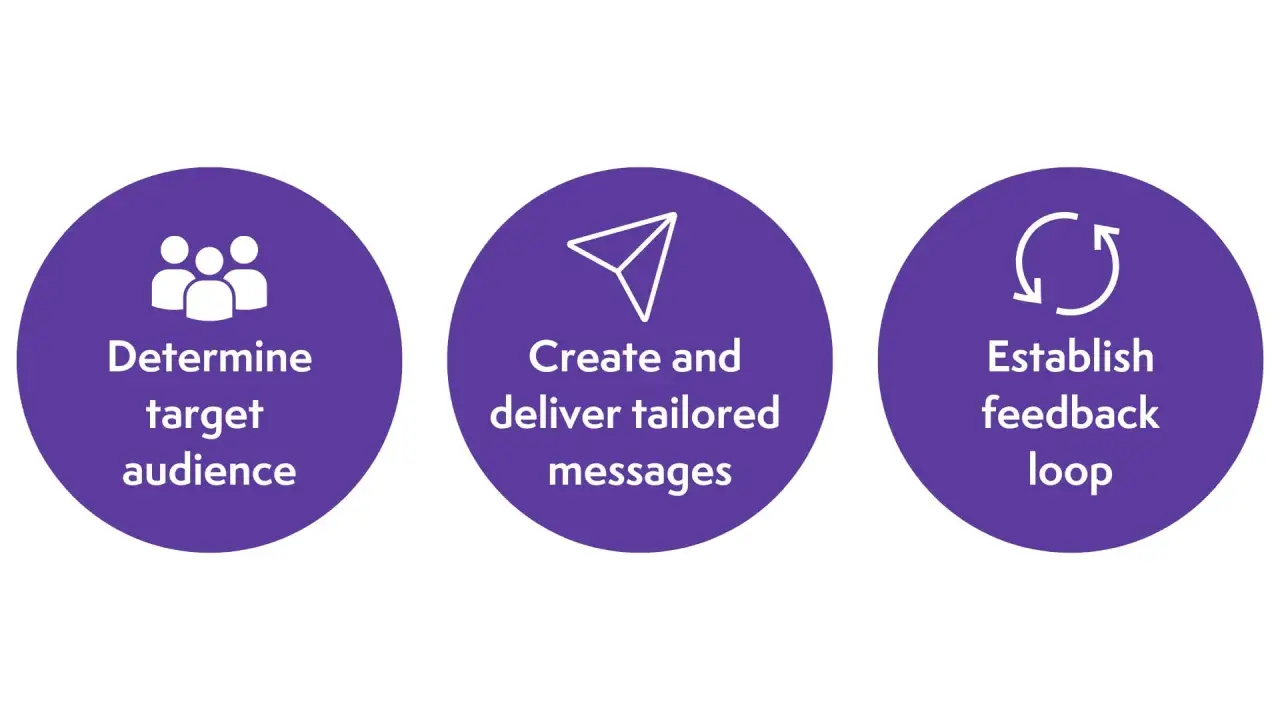
What matters most if you want communication people actually use
- Start with the employee problem, not the channel or the announcement.
- Use a mix of blog-style updates, manager briefings, and two-way dialogue, especially in hybrid teams.
- Write for clarity and action: one message, one owner, one next step.
- Measure understanding and behaviour, not just opens or clicks.
- Close the loop so employees can see how feedback changed the decision.
What an internal communications blog should do
I do not see internal communication as a news feed. I see it as a decision-support tool for employees. Its job is to translate business decisions into something useful: why the change matters, who owns it, what happens next, and how people can respond without guessing.
That matters because silence fills gaps quickly. If a message is vague, people do not wait patiently for clarification. They ask their manager, message a colleague, or build their own version of the story. A good blog or intranet channel reduces that drift by giving everyone the same source of truth.
The CIPD’s 2025 employee communication factsheet puts line managers, tailored messages, and multi-directional dialogue at the centre of good practice, and that matches what I see in real organisations. A polished update from leadership is useful, but it becomes far more effective when managers can explain it locally and employees can ask questions back.
Once you think of the blog as a translation layer, the next question is obvious: what do employees actually need answered first?
The questions employees need answered first
Whenever I draft a major update, I run it through the same five questions. If a paragraph does not answer one of them, I rewrite it or cut it.
What changed
People need the plain version first. Not the policy language, not the strategic framing, just the change itself. If the company is moving office attendance rules, reshaping teams, or changing benefits, say that early and clearly.
Why now
This is where context earns trust. Employees do not need a speech; they need the reason. If the business is changing because of cost pressure, customer demand, or growth, say so. If there is uncertainty, say that too. Honest uncertainty is usually better than fake certainty.
What does it mean for me
This is the question most internal messages avoid, and it is the one people care about most. A leadership note about a new operating model means very different things to a manager, a frontline colleague, and someone in support functions. If the message does not explain local impact, it is unfinished.
What should I do now
Strong communication ends with action. That may be reading a policy, booking training, updating a process, joining a town hall, or speaking to a line manager. I try to make the next step visible and specific, because vague calls to “stay informed” rarely move behaviour.
Read Also: Influence at Work - Master the Triangle of Influence
Where can I ask questions
People rarely need a perfect answer on the first read. They need a safe way to ask follow-up questions. That might be a manager briefing, an inbox for the comms team, a live Q&A, or an anonymous form. When that route is missing, uncertainty turns into noise.
When those five answers are present, the message is much easier to carry through the organisation, which is where channel choice starts to matter.
Choose the right channel mix for office, hybrid, and frontline teams
In UK organisations, mixed working patterns are now normal enough that one channel rarely fits everyone. I usually plan from the audience backward: desk-based staff, frontline teams, managers, and senior leaders each need a slightly different route to the same message.
| Channel | Best for | Strength | Limitation |
|---|---|---|---|
| Intranet or blog | Evergreen guidance, policy detail, change background | Searchable, editable, and good as the source of truth | Easy to ignore unless it is linked to action |
| Time-sensitive updates and direct announcements | Fast reach across the organisation | Overuse creates fatigue and skimming | |
| Teams or Slack | Quick coordination and short clarifications | Feels immediate and conversational | Poor as a record and easy to fragment |
| Manager briefing | Local context, team-specific questions, cascade messaging | Trusted and highly adaptable | Depends on how well managers are supported |
| Town hall or live Q&A | Big decisions, change stories, leadership visibility | Human, visible, and good for tone-setting | Weak if it is one-way or followed by no action |
I still prefer a central blog or intranet page as the reference point, because it gives people a place to return to when they need the detail again. But the real reach comes from pairing that page with a short email, a manager pack, and a live question route. That combination works far better than sending one long message to everyone and hoping the right people read it closely.
That takes care of distribution. The next issue is rhythm: what belongs in the blog regularly, and what should remain a one-off announcement?
What to publish week to week
Good internal communication is a publishing discipline, not a single announcement. I prefer a rhythm that mixes evergreen guidance with time-sensitive updates, because that keeps the channel useful after the original news has passed.
| Content type | Purpose | Practical cadence | Example |
|---|---|---|---|
| Strategic update | Connect business priorities to everyday work | Monthly or quarterly | Progress against annual goals |
| Change brief | Explain a decision and the next steps | As needed | Policy change, restructure, new tool rollout |
| Manager toolkit | Help line managers cascade the message locally | With each major change | Talking points, FAQs, examples |
| Recognition story | Reinforce behaviour and values | Weekly or fortnightly | Team wins, customer impact, learning moments |
| Employee voice round-up | Show what people said and what changed | Monthly | Survey themes, actions taken, unanswered issues |
This mix matters because it stops the channel from becoming either too dry or too reactive. A blog that only posts policy updates starts to feel like paperwork. One that only posts feel-good stories quickly loses credibility. The useful middle ground is a channel that explains, informs, and shows follow-through.
But even strong content can fail if the tone is wrong, which is where many well-meaning teams quietly lose their audience.
How to keep tone human without losing authority
I like direct language because it respects the reader’s time. Authority does not require stiffness. In fact, stiffness often makes a message less believable, especially when employees are already dealing with change or pressure.
My rule is simple: write as if you are explaining the message to a capable colleague who has 90 seconds and no background context. That usually leads to shorter sentences, fewer abstract nouns, and much clearer calls to action.
A few habits make a noticeable difference:
- Use plain verbs instead of corporate filler.
- Separate facts from requests so people can see what is confirmed.
- Keep one paragraph to one idea.
- Avoid hiding important news in the middle of a long update.
- Write for one reader first, then expand if needed.
That also helps line managers. If they can read the update once and explain it without reinterpreting half of it, the message is much more likely to survive the handoff. Once tone is working, I move to measurement, because communication that cannot be checked is only a guess.
How to measure whether it is working
Open rates are a start, not a verdict. A message can be opened and still misunderstood, ignored, or quietly resented. Gallup’s 2025 update on employee engagement reported that U.S. engagement fell to 31% in 2024, which is one reason I do not trust surface metrics as proof that people are truly aligned.
I usually look at five signals instead:
- Reach - Did the intended audience actually see the message?
- Comprehension - Can people explain the change back in their own words?
- Action - Did deadlines, forms, behaviours, or attendance patterns change?
- Feedback quality - Are the questions getting more specific and less confused?
- Manager confidence - Can line managers cascade the message without guessing?
The most useful check is often a simple one: two weeks after a major announcement, ask a small sample of employees what they think the message meant. Then check again after 60 days to see whether behaviour actually changed. If understanding is weak, the problem is usually clarity, not attitude.
Those signals usually expose the same handful of mistakes, and they are worth naming directly because they show up in a lot of organisations.
The mistakes that undermine trust
The fastest way to lose credibility is to communicate like a broadcaster and behave like a black box. Employees can tolerate bad news more easily than they can tolerate being left in the dark.
- Broadcasting without dialogue - If people cannot ask questions, they will invent answers.
- Letting managers improvise - A weak cascade from one team leader can distort the whole message.
- Using one channel for everything - Urgent, complex, and routine messages need different treatment.
- Writing in policy language - Legal precision is useful; unreadable prose is not.
- Announcing change before impact - People need to know what it means for their day, not just the org chart.
- Measuring clicks only - Visibility is not the same as understanding.
- Failing to close the loop - If feedback disappears, employees stop offering it.
The biggest trust leak is the last one. If people take time to speak up and never see what changed, they learn that participation is decorative. That is why the final part of the model is not another message, but a habit.
The habits that keep communication useful over time
The strongest internal communication systems are boring in the best way. They are predictable, clear, and easy to maintain. I would rather see one well-run rhythm than five noisy campaigns that nobody can follow.
For a practical operating model, I usually recommend four habits:
- Assign one owner for each major message.
- Keep one shared calendar for planned updates.
- Build a manager pack whenever the change matters locally.
- Review feedback after every campaign and say what you changed because of it.
For UK organisations with office, hybrid, and frontline teams, that discipline matters even more, because people are not all reading the same channel at the same time. The organisations that handle this well are not louder; they are clearer, and they prove that communication is a management tool rather than a cosmetic one. That is the standard I would set for any internal communications strategy that deserves the name.
