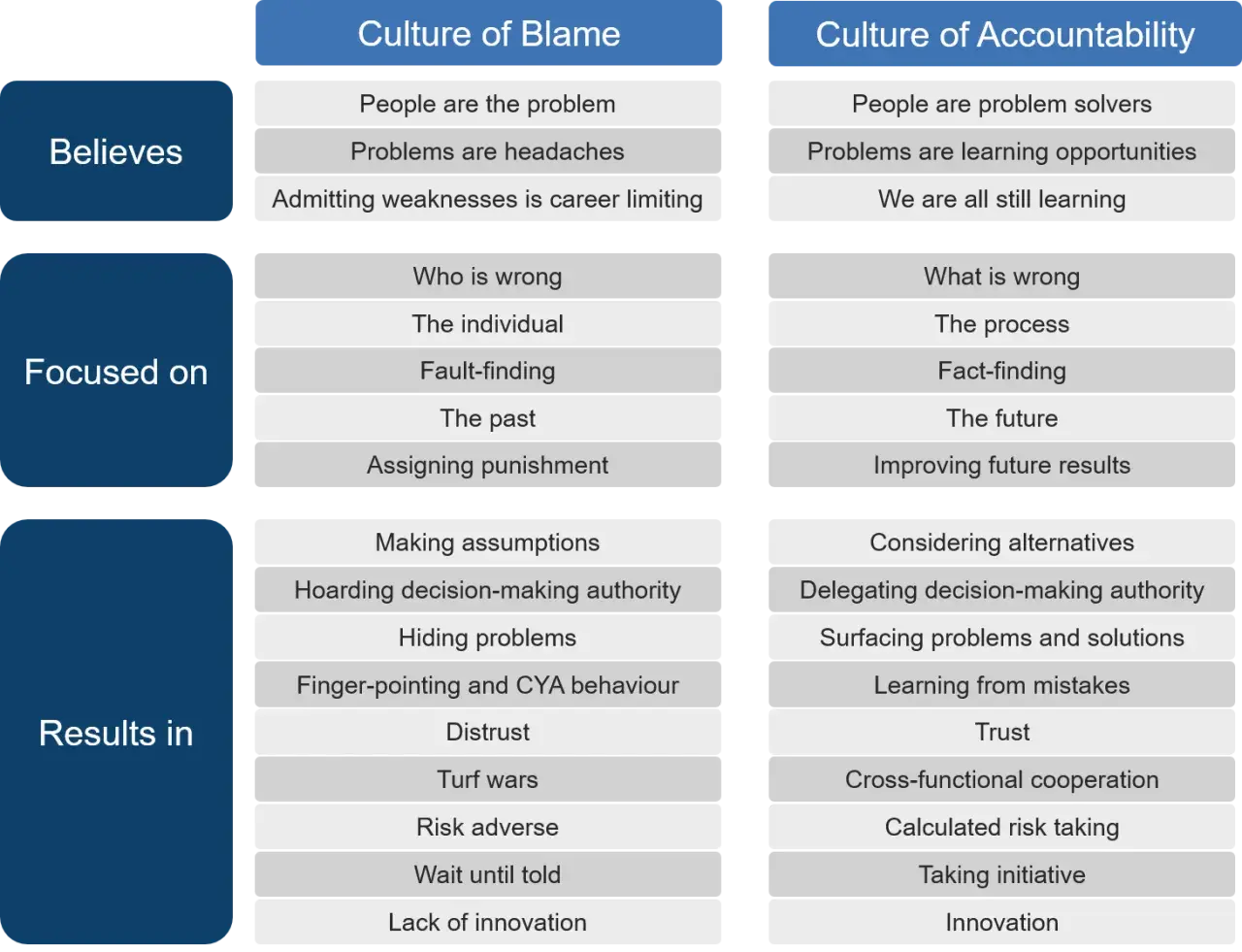
What matters most if you want accountability to actually work
- Accountability works best when it is built on clarity, not pressure.
- Trust and accountability reinforce each other; one without the other tends to fail.
- Coaching is what turns standards into ownership instead of compliance.
- Regular check-ins matter more than occasional hard conversations.
- Leaders have to model the standard themselves, especially when things go wrong.
What accountability looks like when you are the leader
Accountability is not the same as control, and it is definitely not the same as blame. When I work with leaders, I usually separate those three ideas very quickly because the distinction changes how a team responds. Accountability says, “Here is the outcome, here is the deadline, and here is how we will track it.” Blame says, “Who caused this?” Control says, “I will do it myself because I do not trust anyone else to do it properly.”
| Approach | What it sounds like | What it creates |
|---|---|---|
| Accountability | “Here is the outcome, here is the deadline, and here is how we will track it.” | Ownership, clarity, and calmer follow-through |
| Blame | “Why did you let this happen?” | Defensiveness, hiding, and late bad news |
| Micromanagement | “I need to approve every step.” | Dependence and slower decisions |
The difference matters because teams do not rise to pressure; they rise to clarity. If people know what success looks like, what resources they have, and when they will be checked in with, they are far more likely to own the result. That distinction leads directly into trust, which is where accountability either gains traction or collapses.
Why trust and clarity determine whether it works
Gallup reports that less than half of leaders rate themselves as outstanding at creating accountability, and it also found that employees who trust their leaders are 61% more likely to stay. The same research links daily feedback to trust being 2.1 times as likely to be strong, and a manager who is always willing to listen to work-related problems to trust being 4.2 times as likely to be strong. Those are not soft metrics; they are signals that accountability is tied to everyday leadership behaviour, not just to annual reviews.
In UK organisations, the practical side of this is even clearer. CIPD’s guidance is consistent: people need to understand what is expected of them and be given the motivation, skills, resources, and support needed to succeed. That is why strong line managers do not wait for appraisals to surface problems. They make expectations visible early, then check whether the team has what it needs to deliver.
Once trust is in place, coaching is what turns standards into habits rather than one-off demands.
How coaching turns standards into ownership
Coaching is where accountability becomes useful instead of punitive. I prefer a simple sequence: clarify the outcome, ask what the person thinks success looks like, identify blockers, decide what support is needed, and agree the next check-in. That keeps the conversation practical and gives people room to think for themselves.
- Start with the result, not the excuse.
- Ask one diagnosing question: “What is the real barrier here?”
- Separate effort from outcome; both matter, but they are not identical.
- Leave with one owner, one deadline, and one visible next step.
I have found that most people do not resist accountability; they resist surprise, unfairness, and public embarrassment. Coaching avoids that trap because it makes the standard explicit while still giving the person a chance to explain, adapt, and improve. The next step is to make that discipline regular enough that it does not depend on memory or mood.

A weekly rhythm that keeps follow-through visible
Accountability fades fast when it is only discussed in crisis. I prefer a rhythm that keeps commitments visible before they become problems: a short planning touchpoint, a midweek progress check, and a brief review of what was learned. That is usually enough to stop small issues from turning into deadline failures.
| Cadence | What I check | Why it matters |
|---|---|---|
| Start of the week | Top priorities, deadlines, and dependencies | Aligns effort before people drift in different directions |
| Midweek one-to-one | Progress, blockers, and decisions needed | Catches problems early enough to still fix them |
| End of week | What was delivered, what slipped, and what needs resetting | Reinforces learning instead of letting the same issue repeat |
| Monthly review | Patterns across tasks, people, and priorities | Shows whether the system is working or simply producing noise |
The point is not to add meetings for their own sake. A 10-minute check-in can prevent a week of hidden drift, and a short monthly review is often enough to spot repeated blockers. Once that rhythm exists, holding people accountable becomes less emotional and more routine.
How to hold people accountable without creating fear
High standards and psychological safety are not opposites. People are more honest about missed deadlines, risks, and mistakes when they believe they will be challenged fairly rather than humiliated. That is the difference between a team that reports problems early and one that waits until everything is on fire.When I need to address underperformance, I keep the conversation direct but calm. I describe the gap, ask what happened, and then move quickly to next action. The tone matters, but the structure matters more.
- Use “What got in the way?” instead of “Why did you fail?”
- Describe the impact before you describe the mistake.
- Be specific about the standard, not vague about the disappointment.
- Agree consequences privately, not theatrically.
- Praise follow-through as consistently as you correct drift.
If you want a simple test, ask yourself whether the conversation leaves the person clearer or simply quieter. Quiet is not the same as commitment. Real accountability should end with ownership, a next step, and a shared understanding of what happens if the issue repeats.
The mistakes that quietly weaken accountability
Most leadership failures in this area are not dramatic. They are small, repeated habits that slowly teach people that standards are negotiable.
- Setting goals too late or too vaguely, which leaves people guessing about success.
- Changing priorities without resetting expectations, which makes follow-through impossible to judge fairly.
- Rescuing people before they own the problem, which creates dependence instead of growth.
- Applying standards differently across the team, which destroys credibility fast.
- Saving feedback for formal appraisals, which turns learning into a delayed surprise.
- Using accountability only when something goes wrong, which makes it feel punitive instead of normal.
If any of those patterns are familiar, the fix is usually not harsher language. It is cleaner management: tighter expectations, steadier check-ins, and a more consistent standard from the leader. That leads to the final question, which is what strong accountability actually feels like when it is working well.
What strong accountability feels like on an ordinary week
When accountability is working, the team does not feel watched. It feels oriented. People know what matters, surface risks sooner, and follow through without needing constant pressure. In the best teams I see, colleagues remind one another of commitments because the standard is shared, not imposed.
- Deadlines are discussed early, not after they slip.
- Feedback is ordinary, not dramatic.
- Owners are clear before work starts.
- Mistakes surface sooner because people feel safe enough to speak.
- The leader is visible in the same standard they ask of everyone else.
That is the real test of leadership accountability: not whether people feel controlled, but whether they can do better work with less friction. If you want to strengthen it, start with one unclear expectation and one overdue follow-up this week, then make both of them visible.