A strong workplace culture does not run on slogans; it runs on people doing what they said they would do, explaining misses honestly, and fixing problems before they spread. Accountability matters because it turns expectations into action, and action into trust. In UK teams, especially where hybrid work and cross-functional projects are common, that reliability is often the difference between calm delivery and constant firefighting.
This article looks at what accountability really means, why it improves performance and morale, and how leaders can build it without creating a blame culture. I will also show the practical signals that tell you whether accountability is becoming part of the culture, not just part of the policy.
Key things to know about accountability at work
- Accountability is ownership of outcomes, not just completion of tasks.
- It improves clarity, trust, and speed when people know who owns what.
- Healthy accountability is firm and fair; blame culture makes people hide mistakes.
- Leaders set the tone by modelling follow-through, not by micromanaging every detail.
- Short check-ins, clear ownership, and early correction keep accountability real.
What accountability actually means in practice
Responsibility and accountability are related, but they are not the same thing. Responsibility is the task; accountability is the answerability for the result. I can assign someone to prepare a report, another person to review it, and a third to present it, but if the report is late or inaccurate, someone still has to own the outcome and put it right.That distinction matters because many teams become busy without becoming effective. Tasks are handed out, meetings happen, messages are sent, but the work itself drifts because nobody is clearly answerable for the final result. In my experience, that is where culture starts to fray: not in dramatic failures, but in small gaps that no one feels responsible for closing.
- Accountable people know what success looks like.
- They flag risks early instead of hiding them until the deadline.
- They close the loop, so colleagues are not left guessing what happens next.
Once that distinction is clear, the next question is why it changes performance so quickly.
Why it matters for speed, trust and performance
The simplest answer is that accountability reduces uncertainty. People know what they are supposed to deliver, who owns the next step, and when a problem should be raised. The CIPD has long linked positive, aligned cultures with stronger performance, more knowledge-sharing, better responsiveness, and greater trust, and accountability is one of the habits that makes those outcomes possible.
When accountability is present, teams usually gain four things very fast:
- Fewer delays because handovers are clearer.
- Less rework because issues are surfaced before they become expensive.
- Better engagement because reliable people are not constantly carrying other people’s gaps.
- Stronger learning because mistakes can be discussed without so much defensiveness.
I also see accountability improve effort and collaboration more reliably than it magically fixes weak systems on its own. If the process is messy, accountability will expose the mess; it will not automatically tidy it up. That is useful, because it forces the real problem into view instead of hiding it behind effort and goodwill. But the cultural test is still crucial: does accountability make people more open, or just more cautious?
What healthy accountability looks like compared with blame
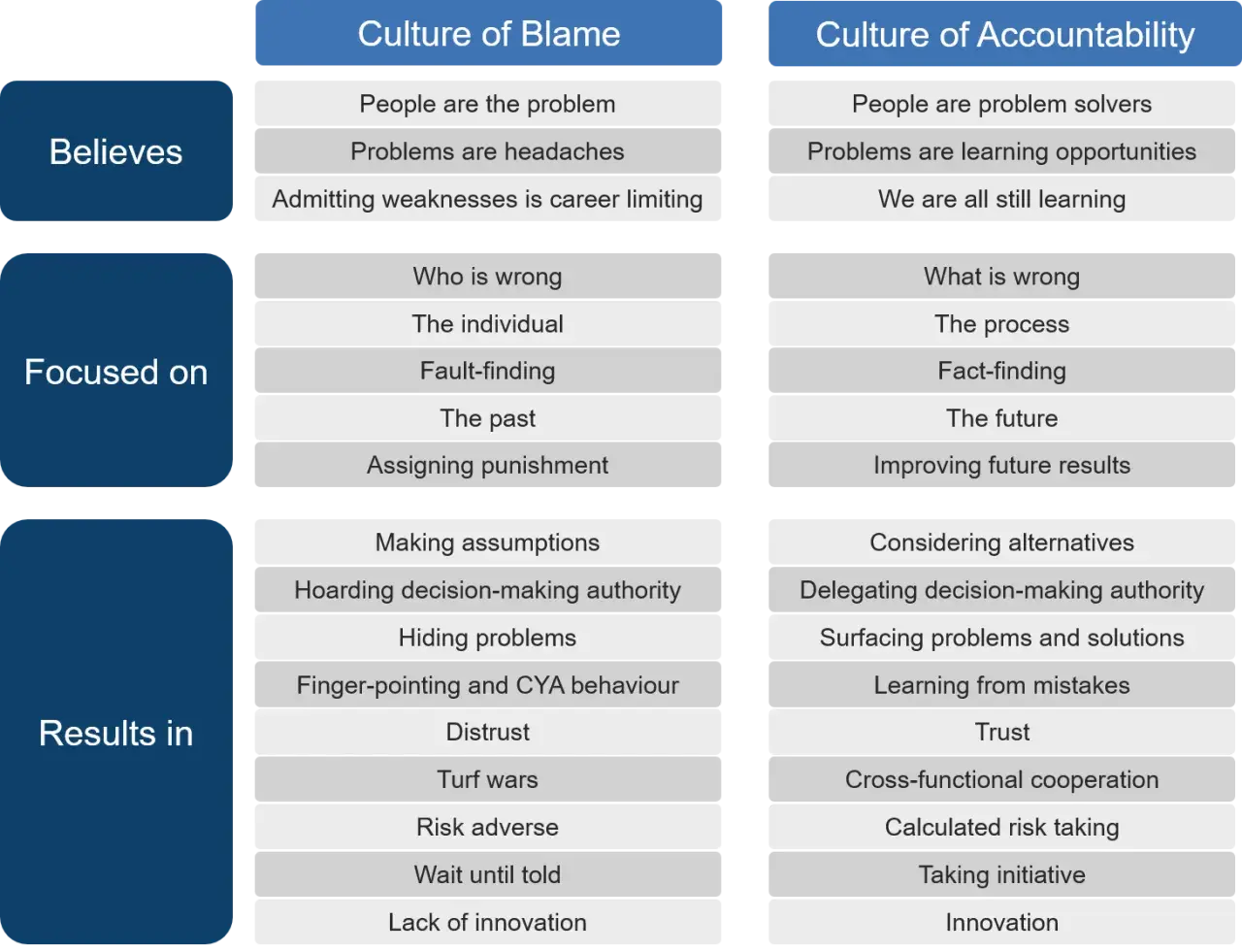
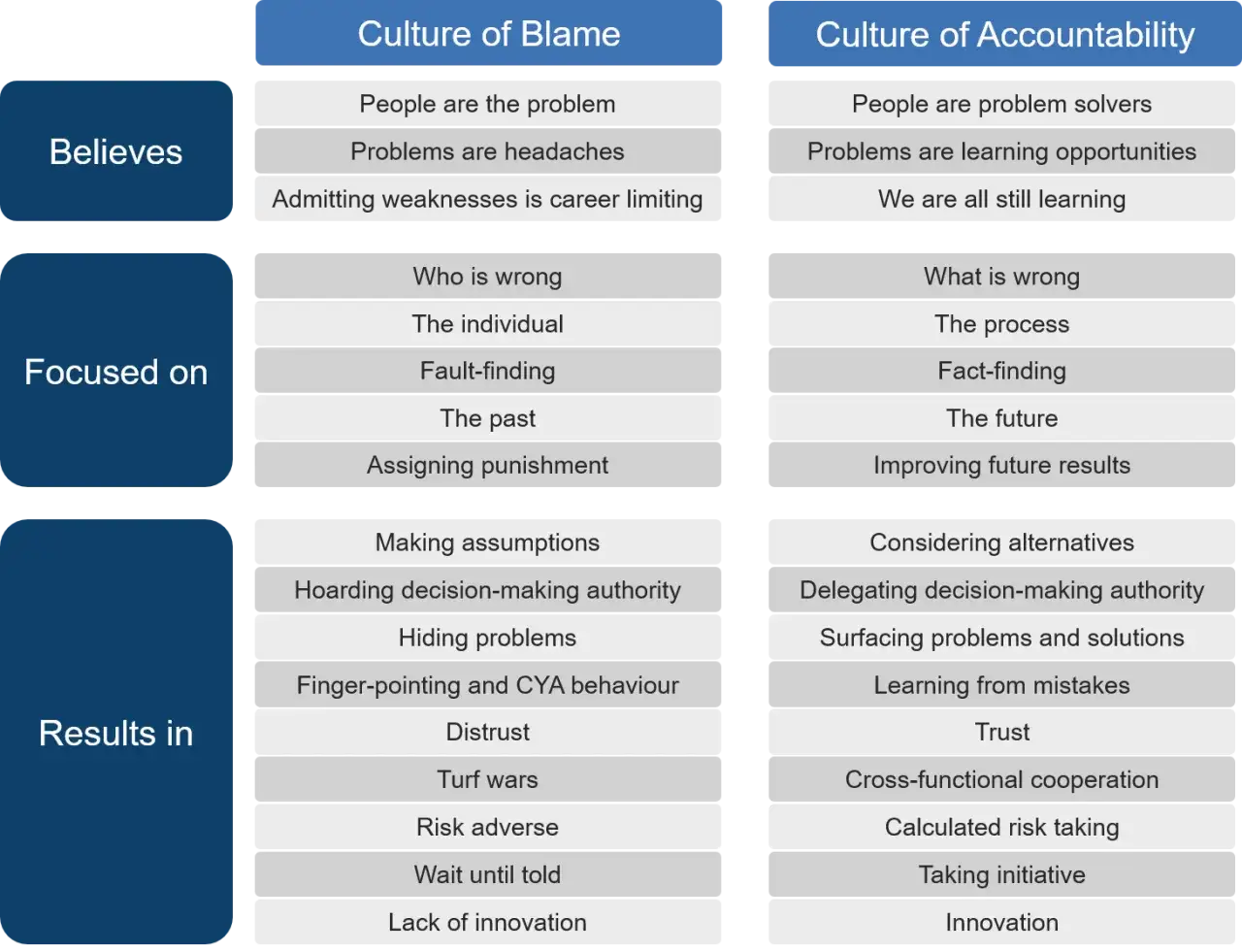
Accountability and blame are often confused, but they produce very different workplace cultures. Healthy accountability is direct, calm, and future-focused. Blame is noisy, selective, and usually backwards-looking. The CIPD’s evidence review on trust and psychological safety also recommends avoiding punishment for questions and mistakes, and treating them as learning opportunities where possible.| Situation | Healthy accountability | Blame culture |
|---|---|---|
| A deadline is missed | The owner explains what changed, resets the plan, and agrees the next checkpoint. | People look for someone to criticise, and the real issue stays unresolved. |
| A mistake is discovered early | The team raises it quickly so the fix is cheap and contained. | The mistake is hidden until it is impossible to ignore. |
| Someone is unsure about a task | They ask a direct question and get a clear answer. | They stay silent because asking feels risky. |
| Standards slip repeatedly | The manager addresses the pattern, not just the latest incident. | The issue is brushed off until morale drops or performance suffers. |
The practical rule is simple: accountability focuses on ownership and correction; blame focuses on fault and shame. If you want people to speak early, admit errors, and improve, you need the first and not the second. That balance is what leaders have to manage if they want accountability to stick.
How leaders build it without creating fear
Most accountability problems are leadership problems before they are employee problems. If expectations are vague, priorities keep changing, or one person can break rules without consequence, the culture will drift. I prefer a straightforward structure here:
- Define the outcome clearly. “Improve customer response time” is vague; “reply within one working day to all priority cases” is workable.
- Give one owner per outcome. Shared effort is fine, but one person should still be answerable for the result.
- Make work visible. A shared tracker, project board, or simple status note prevents hidden drift.
- Use short review cycles. A 15-minute weekly check-in is often enough to surface blockers early; a 30-minute monthly reset keeps bigger work aligned.
- Keep feedback specific and private. Public correction may feel efficient, but it usually creates defensiveness instead of improvement.
- Model the behaviour yourself. If you miss a commitment, say so directly and explain the fix.
Acas makes a useful point here: when issues become disciplinary or grievance matters, early resolution is usually less time-consuming and less likely to damage working relationships. That is why I see a clear line between everyday accountability and formal process. Good managers do not jump straight to punishment; they create clarity, check progress, and address patterns before they become structural problems.
Once leadership sets that tone, the remaining threat is usually more subtle: habits that quietly weaken accountability from the inside.
The mistakes that quietly weaken the culture
The biggest accountability failures are often small, repeated, and easy to excuse. They do not look dramatic, which is exactly why they are dangerous. I see the same patterns again and again:
- Confusing activity with progress. Busy calendars are not the same as finished work.
- Changing priorities without resetting ownership. The task moves, but nobody confirms who now owns it.
- Rewarding results while ignoring process. High performers get praised even when they create avoidable problems for others.
- Making every miss public. This teaches people to protect themselves, not improve.
- Letting standards vary by person. Inconsistency destroys trust faster than almost anything else.
- Ending meetings without actions. If nobody leaves with a clear next step, the meeting was mostly theatre.
The pattern underneath all of these is inconsistency. If one person is challenged for a miss and another is excused for the same behaviour, the message is not accountability; it is hierarchy without fairness. That is the point where a team starts to protect itself instead of improving itself, which is why the next section matters so much.
The signals I would watch in a team that is getting this right
When accountability is becoming part of the culture, you can usually see it before you can measure it. People escalate problems earlier. Meetings end with names, dates, and decisions instead of vague agreement. Managers spend less time chasing and more time coaching. And, just as importantly, the strongest people stop feeling as though they are carrying the whole team.
- Issues are raised early, before they become reputational or financial problems.
- Owners are easy to identify, even when several people contribute to the work.
- Follow-through is normal, not treated as a special achievement.
- Feedback sounds specific and calm, not personal or theatrical.
- Good performers are protected from overload, rather than rewarded with more of everyone else’s unfinished work.
If I had to keep only three habits, I would keep a single owner for every important outcome, a short weekly review, and a habit of talking about misses before they become surprises. Those three moves do more for workplace culture than most grand statements about values, because they make reliability visible and repeatable. That is the practical reason accountability matters: it helps good teams stay honest, efficient, and worth trusting.