
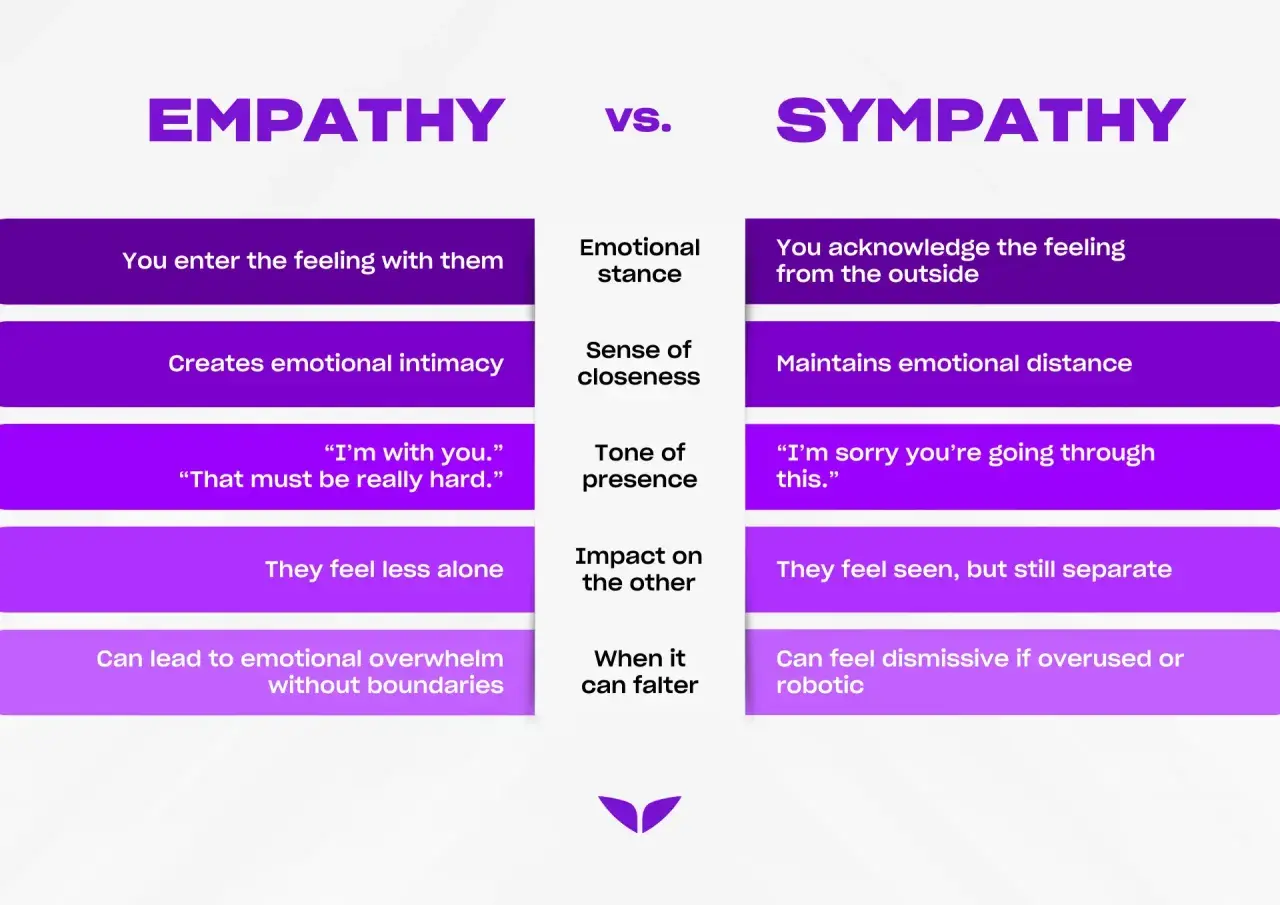
Understanding the difference helps you respond with clarity, not guesswork
- Cognitive empathy is perspective-taking: you work out what someone is experiencing and why.
- Sympathy is concern: you acknowledge difficulty and express care, but you stay outside the other person's perspective.
- In feedback, conflict, and negotiation, cognitive empathy usually helps more because it keeps the conversation specific.
- In bereavement, illness, or personal crisis, sympathy can be the right first response because warmth matters more than analysis.
- The best workplace communication blends both: understand first, then respond with appropriate care and action.
What cognitive empathy and sympathy mean in plain English
When I separate these terms in practice, I keep it simple. Cognitive empathy is the ability to read someone’s perspective accurately: what they might be thinking, what is driving their reaction, and what matters to them right now. Sympathy is a caring response to their situation, usually expressed as concern, sadness, or support. It does not require you to step fully into their point of view.
That difference sounds subtle, but it changes the tone of a conversation fast. Psychology references such as the APA Dictionary of Psychology treat empathy as more than feeling sorry for someone; it involves understanding their inner state. Sympathy, by contrast, is closer to compassion from the outside. Neither is inherently better. They do different jobs.
| Feature | Cognitive empathy | Sympathy |
|---|---|---|
| Core focus | Understanding another person’s perspective, reasoning, and constraints | Recognising difficulty and responding with concern |
| Typical tone | “I can see why this feels blocked.” | “I’m sorry you’re dealing with that.” |
| Best use at work | Feedback, conflict, negotiation, problem-solving | Bereavement, illness, crisis, sensitive personal situations |
| Main risk | Sounding clinical or manipulative if warmth is missing | Sounding vague or patronising if it stops at pity |
Why the distinction changes workplace communication
In a work setting, people are not only looking to be comforted. They want to know whether their manager, colleague, or client understands what is actually happening. Cognitive empathy helps because it reduces guesswork. You are less likely to interrupt, overreact, or offer advice that solves the wrong issue.
Harvard Business Review has repeatedly made the case that empathy improves trust at work, and I agree with the practical side of that argument. Trust grows when people feel accurately understood, not just politely sympathised with. That is why this distinction matters most in moments that carry risk: performance feedback, conflict, redundancy, workload pressure, and team breakdowns.
- In feedback, it helps you target the real obstacle instead of the loudest complaint.
- In conflict, it stops you from taking sides too early.
- In workload conversations, it helps you separate capacity issues from motivation issues.
- In client communication, it keeps you calm without sounding dismissive.
Once you see that, the next question is obvious: how do you actually use cognitive empathy without sounding clinical or cold?

How to use perspective-taking without sounding detached
This is the part many managers get wrong. They hear “be empathetic” and assume they need to mirror emotion or agree with everything. That is not necessary. The more useful skill is disciplined curiosity: notice the other person’s frame of reference, then reflect it back clearly.
- Listen for the situation, not just the emotion. Ask yourself what triggered the reaction, what constraint exists, and what outcome the person wants.
- Reflect the logic back. A line such as “It sounds as if the deadline is difficult because two priorities landed at once” shows you have understood the structure of the issue.
- Ask one focused question. “What would make this more manageable this week?” is better than five broad questions.
- Separate facts from assumptions. I often see people jump from “they are frustrated” to “they are disengaged”. Those are not the same thing.
- Offer action only after understanding. If you move too quickly into fixes, the other person may feel talked over rather than supported.
In other words, cognitive empathy is not about becoming emotionally absorbed. It is about making the other person feel accurately seen. That is usually what unlocks a useful next step.
When sympathy helps and when it gets in the way
Sympathy has its place, and I would not strip it out of workplace life. When someone is grieving, dealing with illness, or facing a personal crisis, a measured expression of concern is often the right first move. The conversation does not need a clever diagnosis. It needs humane acknowledgement.
Where sympathy becomes weak is when it replaces understanding. If you only say “That must be hard” and move on, you may sound kind but still fail to solve the actual issue. In work, that gap matters because people often need both care and clarity.
| Situation | Better first response | Why it works |
|---|---|---|
| Bereavement | Sympathy | The priority is warmth, privacy, and practical support, not analysis. |
| Performance feedback | Cognitive empathy | You need to understand the person’s perspective before you challenge behaviour. |
| Team conflict | Cognitive empathy first, sympathy second | Perspective-taking prevents premature blame; care keeps the tone constructive. |
| Heavy workload | Both, in sequence | Understand the pressure, then decide what can be changed. |
The sequence matters. Sympathy opens the door in human moments; cognitive empathy keeps the conversation useful once you step through it.
The mistakes that make empathy look fake at work
Most empathy failures are not caused by cruelty. They happen because people choose the wrong tool for the moment. I see four mistakes again and again in managers, team leads, and even experienced professionals.
- Rushing to reassurance. Saying “it will be fine” before you understand the problem can feel dismissive, especially if the other person is under real pressure.
- Using sympathy as a script. Repeated phrases such as “that’s tough” can sound polite but empty if they are not followed by something concrete.
- Turning cognitive empathy into analysis mode. Over-explaining someone’s behaviour can feel patronising if you speak as though you know more about their experience than they do.
- Confusing empathy with agreement. You can understand a colleague’s frustration without accepting an unrealistic request or poor behaviour.
The fix is rarely dramatic. Short, specific language usually works best: “I can see why that matters”, “Help me understand what is blocking you”, or “Let’s separate the urgent part from the frustrating part”. Those phrases do more than sound caring. They move the conversation forward.
What good looks like in real UK workplace conversations
In day-to-day UK workplace communication, the strongest responses are usually understated. You do not need grand statements. You need steady, precise language that fits the setting and the relationship.
In a one-to-one
If a team member says they are overwhelmed, a good response is, “Talk me through what has changed since last week.” That question shows interest in the cause, not just the emotion. If they are going through a personal issue, a simpler response may be better: “I’m sorry you’re dealing with this. Tell me what support would help most.”
In performance feedback
When someone misses a target, cognitive empathy helps you avoid turning the conversation into a character judgement. I would rather hear a manager say, “I can see the deadline slipped because you were covering two priorities, but we still need a tighter plan for the next cycle.” That is firm, fair, and human.
Read Also: Measure Internal Comms: Reach, Understand, Act – Not Just Opens
In team conflict
Conflict conversations improve when you stop asking who is right first and ask what each person is protecting. Often one person is protecting standards, another is protecting time, and a third is protecting status. Understanding that gives you a real route to resolution.
The point is not to sound polished. The point is to sound accurate. Accuracy is what makes empathy believable in work settings.
How I would apply this when the pressure is high
Under pressure, I use a simple sequence: understand, acknowledge, act. First I work out the other person’s perspective; then I show concern; then I decide what action is actually available. That order keeps me from being either cold or performative.
It is also the most useful way to think about cognitive empathy vs sympathy in 2026 workplaces, where hybrid routines, tighter deadlines, and heavier emotional load can blur conversation quickly. If you are a manager, the real skill is not choosing one over the other forever. It is choosing the right response for the moment, while keeping your language clear enough that people leave the conversation knowing they were understood.
That is the practical test I use: if the other person feels seen, the issue is named accurately, and the next step is clear, the communication worked.
