
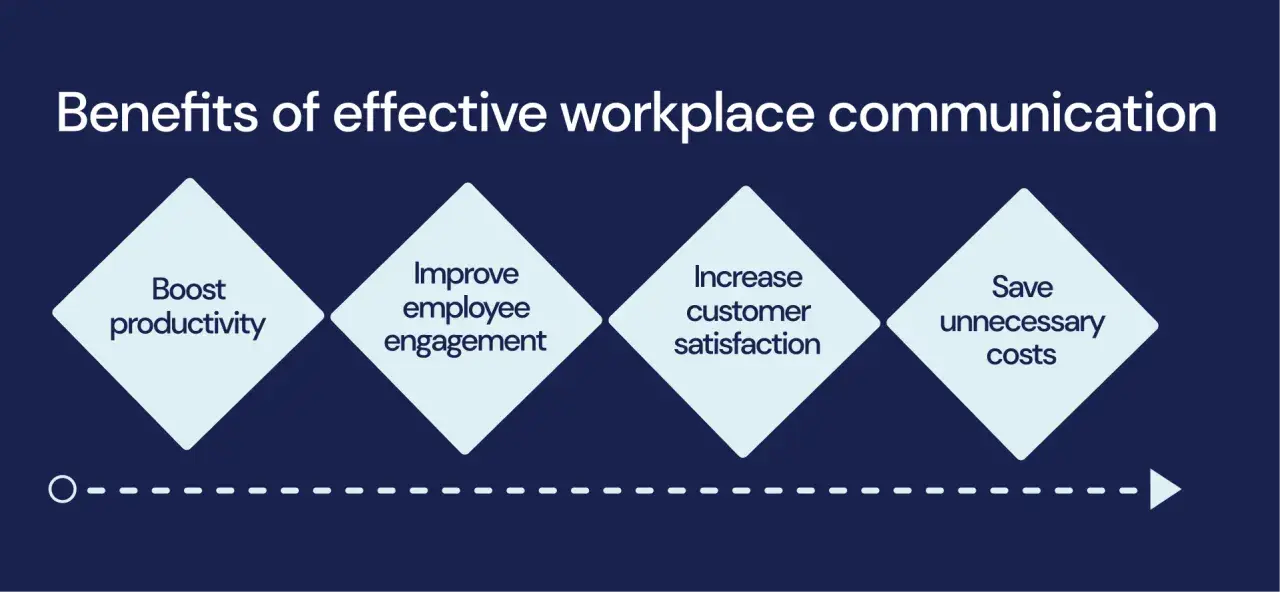
What strong workplace communication needs to do
- Make the message easy to understand on the first read or listen.
- Give enough context for people to act without guessing.
- Match the channel to the task, whether that is email, chat, a call, or a meeting.
- Include listening, follow-up, and confirmation, not just speaking.
- Reduce errors, delays, and unnecessary friction across the team.
What good workplace communication actually means
At work, communication is not just the act of sending a message. It is the full process of moving information, decisions, concerns, and next steps from one person to another in a way that survives real life: busy calendars, poor memory, conflicting priorities, and different levels of knowledge. If the other person cannot act on the message, the communication was incomplete.
That is why I treat strong communication as a practical outcome rather than a personality trait. A clear update, a useful question, or a concise handover all count only if they reduce confusion and move work forward. In other words, good communication is measured by what happens after the message is delivered.
If you want a quick test, ask whether the recipient can answer three things after hearing you: what matters, what they should do, and when it needs to happen. That simple filter usually exposes weak wording fast, and it leads naturally to the traits that separate useful communication from noise.
The traits that make communication effective
Effective workplace communication usually has the same core features, even when the tone, channel, or audience changes. The details vary, but the standards do not.
| Trait | What it looks like | Why it matters |
|---|---|---|
| Clarity | Simple language, one main point, no hidden meaning | People understand the message quickly and make fewer mistakes |
| Context | Enough background to explain why the message matters | Prevents guesswork and reduces back-and-forth |
| Timing | Shared early enough for action, not after the decision has passed | Protects deadlines and avoids unnecessary escalation |
| Listening | Questions, paraphrasing, and attention to what others are really saying | Stops assumptions from hardening into conflict |
| Consistency | What is said in meetings matches what is written afterwards | Builds trust and keeps everyone working from the same version |
| Tone | Respectful, calm, and appropriately direct | Helps people stay open rather than defensive |
| Follow-through | Deadlines, owners, and next steps are confirmed | Turns communication into action instead of loose agreement |
I would add one more trait that often gets ignored: adaptability. Good communication is adjusted to the person in front of you. A senior stakeholder may want the headline first. A new starter may need more context. A client may need fewer internal details and more certainty. That flexibility matters more than polished wording, which is why the next section focuses on how it plays out in everyday work.

How it looks in real workplace situations
Abstract definitions only go far enough to start the conversation. In practice, strong communication shows up in small moments that either save time or create work for everyone else.
| Situation | Weak version | Better version | What changes |
|---|---|---|---|
| Email request | "Can you look at this soon?" | "Please review the attached draft by 3 pm on Thursday and flag any factual issues." | The action, deadline, and scope are obvious |
| Team meeting | A long discussion without a clear decision | Summarise the decision, owner, and next step before people leave | People leave aligned, not merely informed |
| Feedback | "This needs work." | "The structure is clear, but the opening section needs one concrete example and a shorter summary." | Feedback becomes usable rather than vague |
| Hybrid handover | Assuming everyone saw the chat thread | Send a short written recap with the decision and the open points | Remote and in-office colleagues stay in sync |
| Disagreement | Interrupting or defending too early | Repeat the other person's point, then state your concern calmly | The conversation stays productive instead of turning personal |
The pattern is consistent: good comms reduces ambiguity. It is not about sounding impressive; it is about making work easier for the next person in the chain. Once that is clear, the main threats are easier to spot.
Common mistakes that quietly damage communication
Most communication problems at work do not come from bad intentions. They come from speed, assumptions, and messages that are just vague enough to create confusion later.
- Assuming shared context - If people were not in the meeting, they may not know the backstory or the decision.
- Using soft but empty language - Phrases like "when you get a chance" or "ASAP" can be useful, but only if the real priority is already understood.
- Overloading one message - Trying to solve three problems in one email usually makes all three harder to follow.
- Choosing the wrong channel - Sensitive feedback rarely works well in a busy group chat, and complex updates can be lost in a call with no notes.
- Confusing politeness with clarity - Being tactful is useful; being too indirect often leaves people guessing.
- Leaving decisions undocumented - If no one writes down the outcome, the team may remember the conversation differently a day later.
These mistakes are costly because they compound. One unclear instruction creates rework; rework creates frustration; frustration reduces trust. That is why improvement needs to be deliberate rather than accidental.
How to improve it without sounding scripted
I usually recommend a simple structure for anything important: context, point, action, deadline. It keeps communication grounded and stops people from burying the lead.
- Start with the outcome. State what you want the other person to know or do before you add detail.
- Trim the filler. Remove repeated phrases, side notes, and jargon that does not help the reader act.
- Match the channel to the job. Use chat for quick coordination, email for records and detail, and a call or meeting when tone, nuance, or negotiation matters.
- Check understanding. Ask for a brief recap, not just a vague "Does that make sense?"
- Close the loop. Confirm who owns the next step, by when, and what success looks like.
- Write things down when it matters. Even a short recap prevents memory drift and reduces future arguments.
The best part of this approach is that it works in both simple and complex settings. A one-line update and a difficult performance conversation both improve when they are clear, specific, and followed by confirmation. For managers, that bar is even higher.
Why managers have to set the standard
In most teams, managers are not just another sender of messages. They translate priorities, absorb uncertainty, and decide whether information flows in one direction or two. If they communicate poorly, the entire team pays the price in confusion, silence, and misalignment.
Good managers do three things consistently. They explain decisions in plain language, they invite questions before people are stuck, and they make it safe to raise problems early. That last point matters more than many leaders admit: people rarely share bad news quickly if they expect to be dismissed, blamed, or corrected in public.
They also model a useful standard for UK workplaces: direct, respectful, and specific. That style is usually stronger than over-explaining or hiding behind corporate phrasing. When leaders communicate this way, the team tends to mirror it, and that creates a cleaner working rhythm across the whole organisation.
The communication habit that keeps careers moving forward
Good workplace communication is not a decorative skill. It is one of the clearest signs that someone can be trusted with responsibility, because it shows judgement, structure, and respect for other people's time. In career terms, that matters just as much as technical ability.
If I had to reduce the whole topic to one line, I would say this: the strongest communicators make work less confusing for everyone else. That is useful in an interview, useful in a team, and essential if you want to lead people well. Keep that standard in mind, and most everyday comms problems become much easier to solve.
