
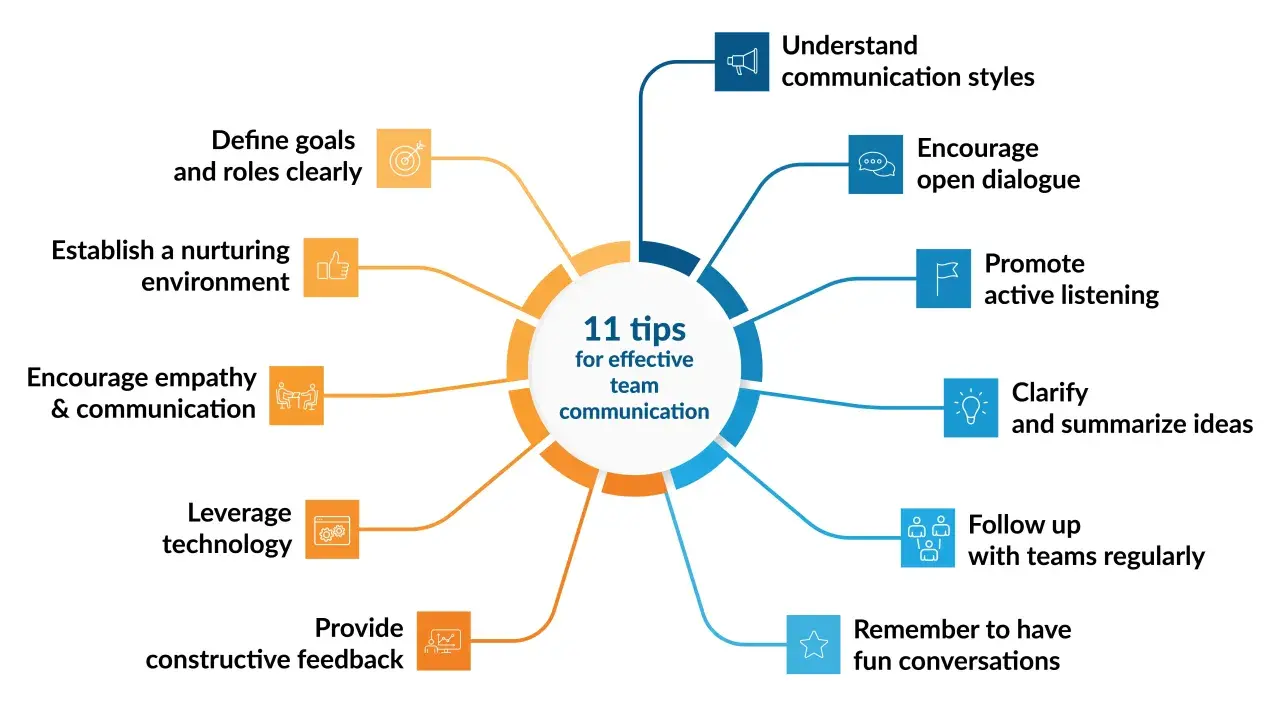
The main shifts are about clarity, not just more tools
- Hybrid working has made written context more important than hallway updates.
- Asynchronous updates now carry work that used to be handled in meetings.
- AI is useful for drafting and summarising, but it should not replace judgment or ownership.
- The right channel depends on urgency, sensitivity, and whether the message needs a record.
- Most communication failures come from ambiguity, not from a lack of messages.
What the latest communications trends mean for UK teams
The biggest shift is not where people work. It is that communication now has to survive without shared physical context. According to CIPD's 2025 UK research, 91% of employers offer some form of flexible working, 50% of employees use working from home during normal hours, and 38% use flexi-time. The same research shows that hybrid rules are far from uniform: 32% of employers with hybrid working do not require a set number of office days, while 52% require a minimum number of days each week and 13% set the minimum by month.
That range matters. If part of the team is on-site, part is at home, and people are following different attendance rules, then communication cannot rely on chance conversations or overheard updates. The teams that cope best are the ones that treat written context, documentation, and repeatable process as part of the job, not as admin left over after the real work.
In practice, that also changes expectations. A message is no longer judged only by how quickly it is sent. It is judged by whether it leaves a usable record, whether it is clear without extra explanation, and whether someone outside the original conversation could still act on it later. That is the real adjustment behind the current shift in workplace communication, and it leads directly to the question of rules.

Why hybrid working has made communication rules non-negotiable
I see the same pattern again and again: when communication feels messy, the problem is usually not the channel itself. It is the lack of rules around when to use it. Teams need simple agreements on response times, escalation paths, and where decisions live. Without those basics, every manager improvises, and people end up guessing whether a message is urgent, optional, or already resolved.
Set the minimum rules first
For routine requests, a same-day acknowledgement is usually enough. For non-urgent decisions, a 24-hour response window prevents chat from becoming a second inbox. For sensitive issues, write less in public channels and move to a direct conversation quickly. The key is consistency: if one manager expects an instant reply and another is fine with next-day responses, the whole system feels random.
Make documentation part of the flow
Any decision that affects budget, scope, timing, or responsibility should leave a written trace. That might be a short summary in a project channel, a note in a shared document, or a recap sent after a call. If a person joins the project two weeks later, they should be able to understand what was decided and why without replaying every meeting.
Hybrid communication works when people know where the truth lives. Once that is clear, the next step is deciding which conversations should happen live and which should not.
Why asynchronous communication is now the default for routine updates
Asynchronous communication means people can contribute on their own schedule rather than having to respond in real time. That sounds simple, but it solves several real problems at once: it reduces meeting overload, protects focus time, supports different working patterns, and creates a searchable record of what was said. It is especially useful when people are spread across locations or simply need time to think before they respond.
Microsoft's Work Trend Index has repeatedly highlighted the cost of the infinite workday, where digital interruptions stretch work across more hours than anyone wants. That is the underlying reason async-first habits are gaining ground: teams are trying to reduce the friction created by constant switching. The point is not to communicate less. It is to communicate with more intention.
Use async for updates, not for ambiguity
- Put the context in the first line so people know why the message matters.
- Separate information from decision so no one has to infer what is expected.
- End with one owner and one deadline so the next step is obvious.
There is a simple rule I use: if the answer is needed in the next hour, it probably belongs in a live conversation. If it is a status update, a draft, or a handoff, it usually does not. That distinction keeps teams from turning every minor task into a meeting.
How AI is changing everyday communication
AI is now handling the unglamorous parts of communication: first-draft emails, meeting summaries, action-item extraction, tone smoothing, and message variants for different audiences. Used well, that saves time and reduces the odds of a messy or inconsistent message. Used badly, it creates polished-looking text that is vague, overconfident, or simply wrong.
My view is straightforward: AI should speed up communication, not dilute accountability. It can help communicators draft faster, summarise longer threads, and turn technical language into plain English. It can also support managers who need to communicate the same message to different audiences without rewriting everything from scratch.
Where AI helps most
- Drafting status updates and project summaries.
- Condensing long meeting notes into action points.
- Reworking one message for staff, managers, and external stakeholders.
- Translating specialist language into simpler wording for wider teams.
Read Also: Interpersonal Savvy Meaning - Master Workplace Communication
Where I would keep humans in the loop
- Performance feedback.
- Restructuring announcements.
- HR, legal, or privacy-sensitive messages.
- Any communication that could affect trust if the tone is even slightly off.
The risk is not only tone. It is also accuracy, confidentiality, and the temptation to send something before the thinking is finished. If a message needs empathy, timing, or political awareness, AI can assist, but it should not be the final author.
How to pick the right channel instead of adding another one
One of the most useful things a team can do is stop treating every channel as interchangeable. Chat, email, documents, and meetings each solve different problems. When they are used for the wrong job, communication becomes noisy and people waste time duplicating the same information in three places.
| Message type | Best channel | Why it works | Common mistake |
|---|---|---|---|
| Quick status update | Chat or project channel | Fast, searchable, and low friction | Burying the action item in a long thread |
| Decision with context | Shared document plus short message | Preserves the rationale and the record | Turning everything into a meeting |
| Sensitive feedback | 1:1 call or face-to-face discussion | Nuance is easier to manage live | Putting it in a group channel |
| Broad announcement | Email plus central hub post | Reaches most people with one reference point | Sending slightly different versions in multiple places |
| Urgent incident | Live call or escalation channel | Speed matters more than polish | Waiting for a perfect written update |
My rule of thumb is simple: if it must be remembered, write it down; if it must be discussed, schedule it; if it must be acted on now, make the owner obvious. That one discipline removes a surprising amount of confusion.
The mistakes that quietly damage trust
Most teams do not lose trust because they send too few messages. They lose trust because the messages are inconsistent, duplicated, or hard to act on. The damage is gradual, which is why leaders often underestimate it until people start missing deadlines or asking the same questions again and again.
- Too many places for the same information make people unsure where the latest version lives.
- Too little ownership leaves everyone assuming somebody else will act.
- Mixed signals from leaders make rules feel optional instead of shared.
- Over-explaining low-stakes items and under-explaining change makes priorities feel skewed.
- Confusing visibility with alignment creates the false sense that copying more people solves the problem.
Communication fails most often when people assume presence equals clarity. A meeting invite is not the same as understanding, and a long thread is not the same as alignment. Once a team accepts that distinction, it can start fixing the system instead of blaming the people inside it.
The first communication fixes I would make in a UK team
If I were tightening a team’s communication this month, I would start with three things: one channel map, one written rule for response times, and one place where decisions are stored. That usually does more than buying another tool. It also makes hybrid work feel less fragmented, because people know where to look and how to respond.
- Remove duplicate channels that serve the same purpose.
- Write down what belongs in chat, what belongs in email, and what needs a meeting.
- Replace one recurring status meeting with a short written update and test whether the work actually suffers.
- Ask managers to model the same rules, because communication standards fail fast when leaders ignore them.
For UK employers balancing flexible schedules, changing expectations, and more AI support, the winning teams are not the loudest. They are the ones that make information easy to find, easy to act on, and hard to misread. If I had to choose one priority, I would reduce ambiguity first, because that is where most communication problems begin.
